

Larva Control: natural broad-spectrum larvicide
Larva Control is a natural, broad-spectrum larvicide that kills mosquito and insect larvae on contact. Its active, Sophora flavescens extract, penetrates the larval cuticle and disrupts the nervous and respiratory systems, targeting eggs and early instars before they mature - with low residue and minimal impact on beneficial insects.
Natural broad-spectrum larvicide · Zero-hour REI, Minimum toxicity.
- Zero REINo re-entry wait
- Zero PHIHarvest the same day
Natural broad-spectrum larvicide from Vegalab Crop Science, powered by Oxymatrine (Sophora flavescens extract). Larva Control targets Diamondback moth, armyworm, cutworm, leaffolder, stemborer · 300+ larval species.
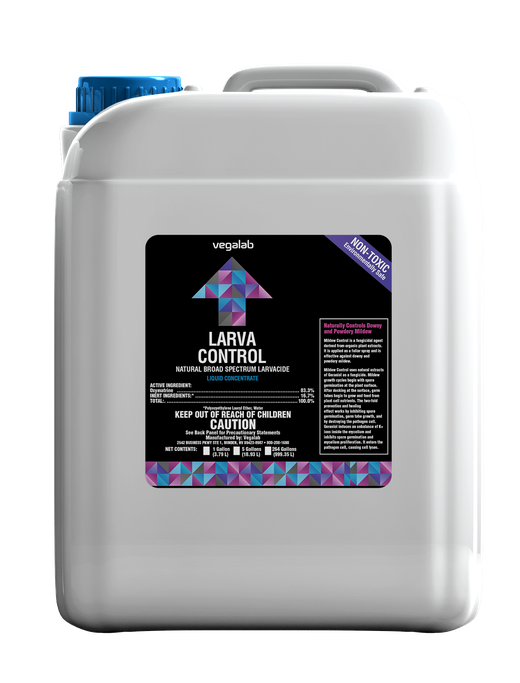
Sophora flavescens extract penetrates the cuticle of larvae and disrupts the insect's nervous and respiratory systems on contact. Eggs and early-instar larvae fail to reach the adult stage, breaking the reproductive cycle. Activity is fastest on Lepidoptera larvae and acts within three days of application.
| Active | Oxymatrine (Sophora flavescens extract) |
|---|---|
| Targets | Diamondback moth, armyworm, cutworm, leaffolder, stemborer - 300+ larval species |
| Dilution rate | 1:1,000 · 1 mL/L (3.8 mL/gal) · 0.5–1.0 L/ha (6.9–13.7 fl oz/acre) |
| Application | Foliar spray at start of larval occurrence |
| Line · Category | Control · Natural broad-spectrum larvicide |
- Diamondback moth, Cabbage moth, Armyworm
- Cutworm, Leaffolder, Stemborer
- European corn borer, Codling moth
- Over 300 lepidopteran larval species
What pests does Larva Control target?
Larva Control is a natural, broad-spectrum larvicide for the larval stage of insect pests. Its strongest activity is on Lepidoptera (moth and butterfly) larvae - diamondback moth, cabbage moth, armyworm, cutworm, leaffolder, stemborer, European corn borer and codling moth - with reported activity across more than 300 larval species. Because it targets larvae before they mature, it breaks the reproductive cycle rather than only treating visible adults.
How does Larva Control work?
The active is oxymatrine, derived from Sophora flavescens. On contact it penetrates the larval cuticle and disrupts the insect’s nervous and respiratory systems, so eggs and early-instar larvae fail to reach the adult stage. Activity is fastest on Lepidoptera larvae and typically acts within three days of application. It carries a zero-hour re-entry interval (REI) and is minimum toxicity and biodegradable when used as directed.
How and when should it be applied?
- Apply when
- At the start of larval occurrence
- Target stage
- Eggs and early instars
- Method
- Foliar spray
- Rate
- 1:1,000 · 1 mL/L · 0.5–1.0 L/ha1:1,000 · 3.8 mL/gal · 6.9–13.7 fl oz/acre · Work out your rate
- Pre-harvest interval
- Zero - harvest the same day
- Re-entry interval
- Zero - no re-entry wait
Always read and follow the applicable product label.
Apply as a foliar spray at the start of larval occurrence - timing on eggs and early instars is what makes a natural larvicide effective. The typical rate is 1:1,000 - 1 mL/L (3.8 mL/gal), or 0.5–1.0 L/ha (6.9–13.7 fl oz/acre). It has been tested on brassicas, cotton, corn, rice, vegetables and vines.
Is it safe around people, pets and beneficial insects?
Larva Control is minimum toxicity and biodegradable, with a zero-hour re-entry interval, and is designed to target larvae with minimal impact on beneficial insects when used as directed. Its low-residue profile makes it well suited to programs where worker safety and beneficial-insect protection matter. Follow the label for your crop and region.
Need a recommendation for your crop or pest?
Contact usCrop-specific solutions using this product
Frequently asked questions
What does Larva Control target?
Diamondback moth, armyworm, cutworm, leaffolder, stemborer - 300+ larval species
What is the application rate for Larva Control?
1:1,000 · 1 mL/L (3.8 mL/gal) · 0.5–1.0 L/ha (6.9–13.7 fl oz/acre) Application: Foliar spray at start of larval occurrence.
Is Larva Control suitable for natural or organic programs?
Larva Control is a naturally derived input (Oxymatrine (Sophora flavescens extract)) designed to fit low-residue and IPM programs.
Does Larva Control kill mosquito and caterpillar larvae?
It is a broad-spectrum larvicide that kills mosquito and insect larvae on contact, with the strongest and fastest activity on caterpillar (Lepidoptera) larvae such as armyworm, cutworm and diamondback moth. It targets eggs and early instars before they mature.
How fast does it work?
Activity is fastest on Lepidoptera larvae and typically acts within three days of application when sprayed at the start of larval occurrence.
Is it safe for beneficial insects?
It is minimum toxicity and biodegradable with a zero-hour re-entry interval, and is designed to minimise impact on beneficial insects when applied at label rates targeting early-instar larvae.
How long does a treatment last, and how often should I re-apply?
Re-apply based on pest pressure and new larval emergence; the most effective timing is at the start of each larval occurrence. An agronomist can help set a spray schedule for your crop.
The evidence behind these actives
Reference pages on the actives this product declares - mode of action, limits and the published sources, written independently of the product listing.
Problems addressed
Pest & disease library
See all plant pests & diseases →
Reference links to identification and management guides. Claims and product availability vary by jurisdiction - always read and follow the product label.
Last updated: