


Biosecurity Product Finder
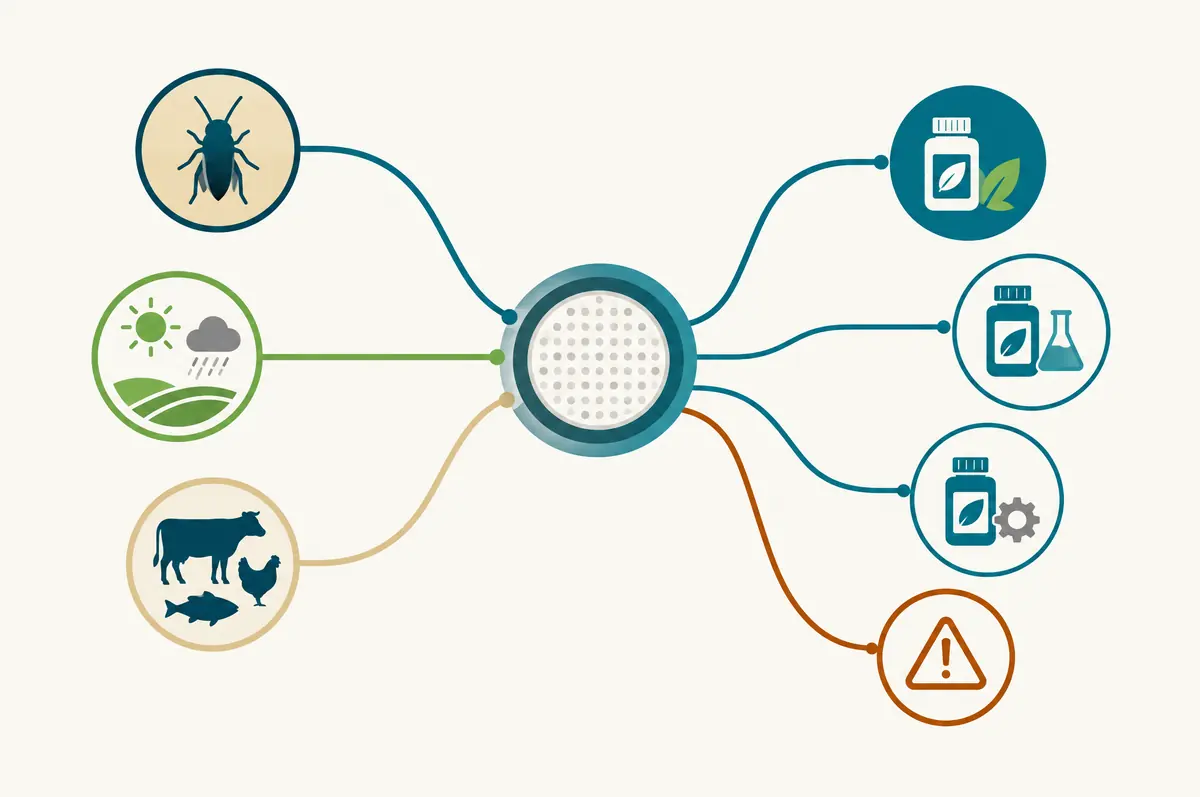
The Product Finder matches a pest or pathogen, an environment and the animals present to Vegalab products whose current label covers that use. It separates labeled products from those in development and flags species cautions before a recommendation appears.
Inputs
Step 1, target: pick a pest or pathogen group from the Pest and Pathogen Library (housing mites, lice, ticks, flies and larvae, ants and cockroaches, slugs, mosquitoes, jumping worms, biofilm and surface pathogens). Step 2, environment: broiler house, layer house, backyard coop, hatchery, dairy, swine, equine stable, kennel or shelter, apiary, residential yard, feed storage, drinking-water system. Step 3, animals present: poultry, cattle, horses, dogs, cats, bees, fish or ponds nearby. Step 4, jurisdiction: country and, for the US, state. Optional: occupied or empty housing.
Logic
Each product record holds its labeled sites, pests, jurisdictions and state acceptance list. The finder returns a product only where target, site and jurisdiction all match a current label. Products that match the target but not the site or state are shown separately as 'in development for this use' with no rate. Species rules run last: if cats are present, any essential-oil product is flagged with the cat caution; if bees or fish are present, saponin and essential-oil products show exposure precautions. No combination ever produces an on-animal recommendation.
Outputs
A ranked result card per product showing name, active, label status for the chosen site and state, link to the label and SDS, the relevant protocol, and a button into the Dose Calculator preloaded with the label rate. A second panel lists in-development options with a link to the trial program. If nothing matches, the finder routes to the protocol page and a contact form rather than suggesting an off-label product. Data source: a maintained product and label table, versioned with an effective date shown on the page.
Key facts
- Pesticide use must follow the label's listed sites, pests and directions (FIFRA section 12(a)(2)(G))
- Minimum-risk products remain subject to state pesticide requirements, which vary by state (US EPA, State Regulation of Minimum Risk Pesticides)
- Cats have limited hepatic glucuronidation of phenolic compounds because UGT1A6 is a pseudogene in cats (Court and Greenblatt 2000, Pharmacogenetics 10:355)
How our delivery technology applies
The finder encodes what each product's delivery form is suited for: stabilized chlorine dioxide for surfaces and water, nano-emulsified essential oils for crevices and residual on housing surfaces, live nematodes for moist substrates. Matching form to site is where most field failures start, so the tool asks about the site before the pest.
Start with your pest, your site and the animals present.
Related reading
Last updated: