Terminal Cleandown Between Flocks
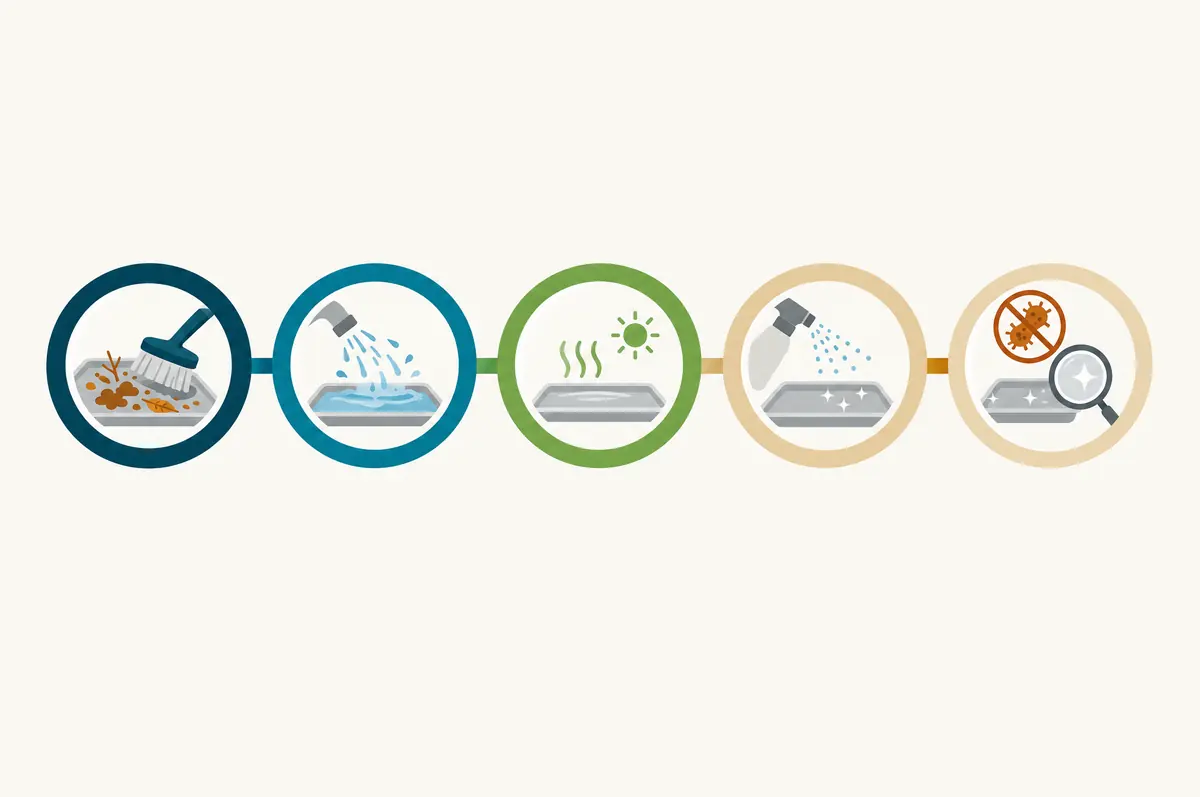
A terminal cleandown succeeds or fails on sequence and drying, not on the disinfectant.



Products fail most often because a step before them was skipped. These protocols set out the sequence, checks and records for the jobs that decide outcomes on animal premises and in yards. Each one names where a product fits, and where habitat, cleaning or timing does more.
Four protocols cover the pathways pathogens use to move onto and around a site. Terminal cleandown sets the order of dry clean, wash, dry and disinfect between flocks or batches. Water line sanitation covers biofilm removal with animals absent and residual maintenance during production. Footbaths and entry points covers the line of separation, boot hygiene and bath maintenance. Vehicle and equipment disinfection covers trucks, trailers and shared tools, where organic load and drying time are the usual failures.
Three protocols cover arthropod pests on premises and in yards. Integrated mite management in layer houses combines monitoring, cleandown timing and premise treatment for poultry red mite. Tick yard zoning covers habitat changes and edge treatment in residential landscapes. The perimeter barrier protocol covers exclusion, sanitation and band treatment for ants and cockroaches. Where these reference Vegalab products for uses not yet on the label, they are marked as in development.
Rotation and resistance management applies across both groups: mode-of-action rotation for acaricides and insecticides, and the limits of rotating disinfectants. Every protocol ends with verification, such as swabs, mite traps or tick drags, and a record that lets you see whether the program is working. Use the dose calculator for dilution arithmetic and always follow the product label. Protocols are written for site managers and service technicians and can be adapted to a site plan, with the order of steps kept intact.
Protocols define when a product is applied; encapsulation defines how long it stays active once there. A stabilized chlorine dioxide powder removes the generator step from water and surface protocols. For arthropod programs, multi-layer shells extend botanical residual from days toward weeks, which changes the reapplication interval a protocol has to plan for.
Need a protocol adapted to your site? Contact our biosecurity team.
A terminal cleandown succeeds or fails on sequence and drying, not on the disinfectant.
Biofilm is removed with animals absent, using a high-concentration clean held in the lines and then flushed out.
A footbath on its own is a weak barrier, because manure on boots consumes the disinfectant and most people step through in seconds.
Livestock trucks, feed trucks and shared equipment are among the most important routes for moving viruses between farms.
Poultry red mite lives in the structure, not on the bird, and feeds at night.
Ticks concentrate where humidity is high and hosts pass: leaf litter, stone walls and the band where lawn meets woods.
A perimeter program works when it combines exclusion, sanitation and targeted treatment.
Arthropods develop resistance when the same mode of action is used repeatedly against the same population.
Last updated: