


Formulation Finder
The Formulation Finder matches an active's physicochemical profile and target route to the delivery barriers it is most likely to hit and the encapsulation strategies that address them. It is a screening tool for partners, and it outputs a structured brief that feeds a feasibility request. This page specifies the inputs, logic and outputs for the build.
Inputs
Required fields: compound name or class; molecular weight in Da; logP or logD at pH 7.4 (numeric or 'unknown'); aqueous solubility band (above 1 mg/mL, 0.1 to 1, below 0.1); known degradation routes as multi-select (hydrolysis, oxidation, light, acid, proteases, heat); target route (oral solid, oral liquid, sublingual or buccal, intranasal, topical or transdermal, veterinary); target market (US, Canada, EU, UK, other); intended category (supplement or NHP, cosmetic, drug, veterinary). Optional: half-life, known P-gp substrate status, taste or odor issue.
Logic
Rules assign barrier flags. Solubility below 0.1 mg/mL or logP above 3 flags poor solubility. Molecular weight above 500 Da with more than 5 hydrogen bond donors, or logP below 0, flags poor permeability. Peptide class or MW above 1 kDa on oral routes flags protease degradation and permeability together. Acid-labile plus oral flags gastric degradation. Oxidation or light flags storage instability. Half-life under 2 hours flags clearance. Topical route with MW above 500 Da flags skin penetration. Each flag maps to layer functions from a lookup table maintained by the formulation team.
Outputs
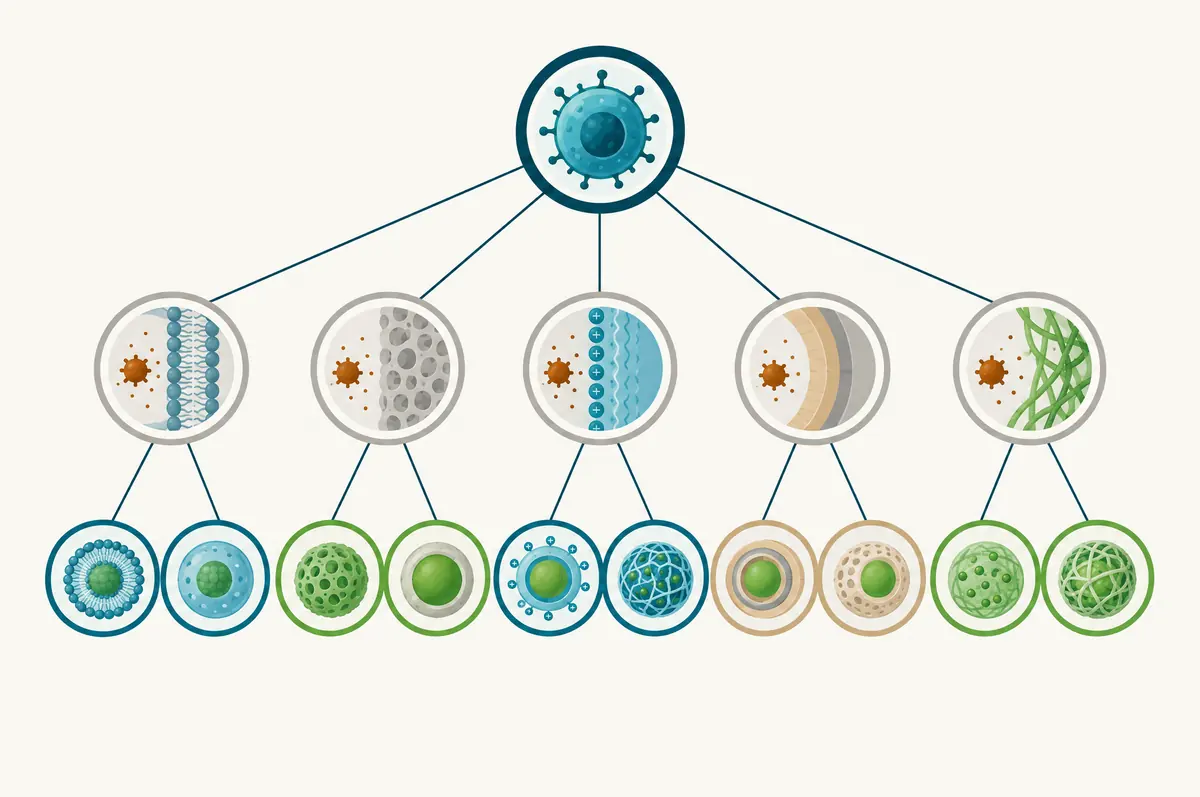
The result screen shows ranked barrier flags with a one-line explanation and a link to the matching challenge page; suggested layer functions (moisture barrier, antioxidant core, enteric shell, protease shield, mucoadhesive, permeation support, sustained release); a feasibility rating of straightforward, moderate or research-grade; and regulatory flags. WADA-prohibited peptides and unapproved compounds requested for consumer categories route to a regulatory pathway screen, with a link to Program Standards. A 'Send to feasibility' button emails the structured brief to the partnerships team.
Build notes
No personal health data are collected, and the tool never returns dosing, reconstitution or sourcing information. Results are rule-based and version-stamped so partners can cite the ruleset version in correspondence. Every result page notes that output is a screening aid and that laboratory testing confirms formulation performance. Usage logs of compound classes and routes, stored without contact details, inform which challenge pages and layer designs to prioritize.
Key facts
- Poor absorption is more likely when a molecule has more than 5 H-bond donors, 10 H-bond acceptors, MW above 500 or logP above 5 (Lipinski et al. 1997, Adv Drug Deliv Rev)
- The Biopharmaceutics Classification System sorts drugs by solubility and permeability into four classes (Amidon et al. 1995, Pharm Res)
- Molecules above about 500 Da penetrate intact skin poorly (Bos and Meinardi 2000, Exp Dermatol)
- FDA uses BCS classification to support biowaivers for immediate-release oral products (FDA guidance, M9 Biopharmaceutics Classification System-Based Biowaivers, 2021)
How our delivery technology applies
The finder encodes how we actually design particles: each barrier maps to a layer function, and the order of barriers along the route sets the order of layers from outside in. An oral peptide gets an acid-resistant shell, then a protease shield, then a mucoadhesive, while an oxidation-prone topical active gets an antioxidant core and a slow-release outer layer. The tool makes that reasoning visible before any lab time is spent.
Run your active through the Formulation Finder, then send the brief to our team.
Related reading
Last updated: