Ticks: Biology, Habitat and Premise Control
Hard ticks spend more than 90% of their lives off the host, in leaf litter, vegetation and building cracks, so control is largely a premise problem.


This library describes the pests and pathogens that drive premise biosecurity programs: their biology, where they live on a farm or property, why control fails, and which delivery approach addresses that failure. Each entry links to the environments, protocols and products that apply.
Ticks cover the blacklegged, lone star, brown dog and cattle ticks, with life-stage biology and habitat. Housing ectoparasites cover poultry red mite, northern fowl mite and poultry lice, which differ sharply in where they live and so in how they are treated. Insects cover flies, darkling beetles, stored-product pests, ants, fire ants, cockroaches, bed bugs, fleas and mosquito larvae, plus the two apiary threats, varroa mite and Asian hornet. Each entry notes life stage and season.
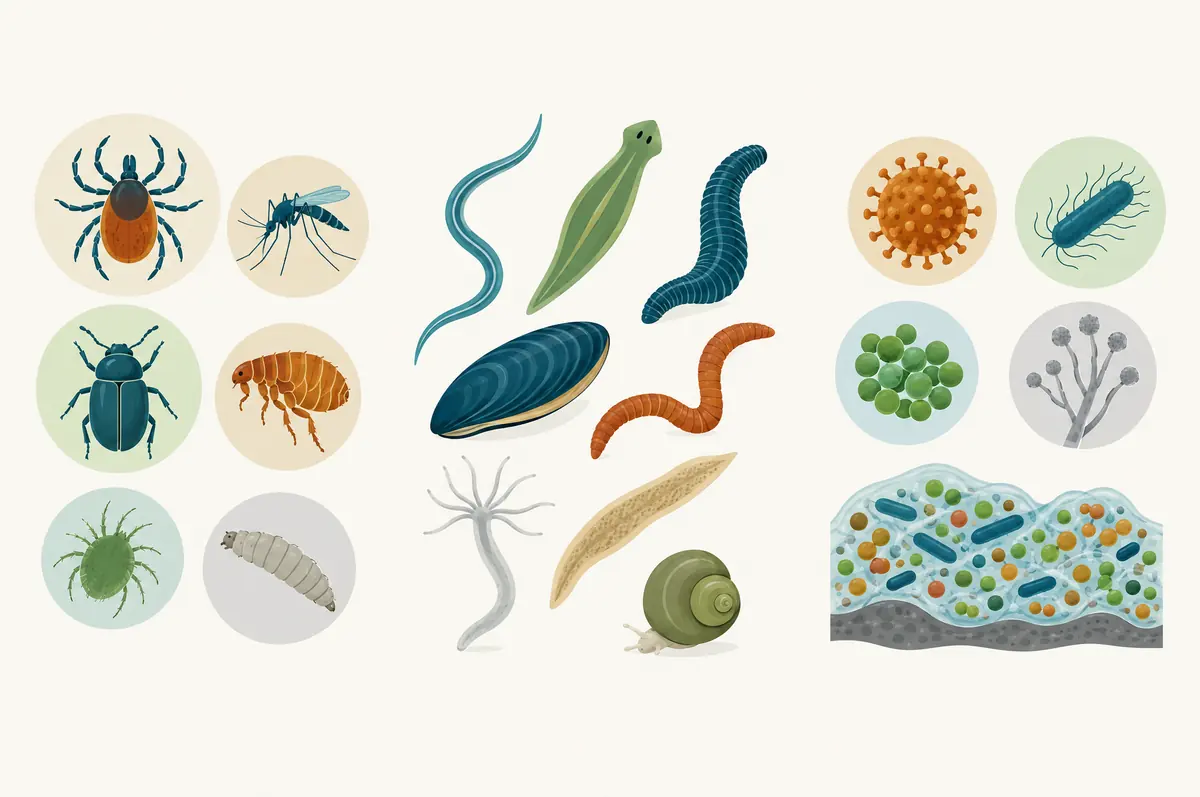
Slugs and snails and invasive jumping worms are covered as biosecurity problems of movement: soil, mulch, plants and equipment carry them between sites. Entries explain life cycle, how they spread, and which containment steps sit alongside treatment. Where a species is regulated by a state or national invasive species list, the entry names the rule and what it restricts, so nurseries, landscapers and farms know their obligations before they treat or move material.
Pathogen entries cover avian influenza, Salmonella, water-line biofilm, canine parvovirus in kennels, dermatophytes, Aspergillus and mold, and coccidia. They explain the organism, how it persists in the environment, and how disinfectant chemistry, especially chlorine dioxide, interacts with it in published studies. Product claims against any pathogen are governed by the registered label in each jurisdiction, and these pages keep disease biology separate from product claims. Entries also cover persistence on surfaces.
Each library entry ends with the delivery problem that defines control of that organism: refuges a spray cannot reach, residual that lasts days instead of weeks, a disinfectant spent by organic load. Those are the problems encapsulation is designed to change, and the entry states whether a Vegalab product addresses it now or is in development.
Choose a pest or pathogen to see biology, environments and control options.
Hard ticks spend more than 90% of their lives off the host, in leaf litter, vegetation and building cracks, so control is largely a premise problem.
The blacklegged tick is a three-host tick of eastern and upper midwestern North America that lives in leaf litter at woodland edges.
The lone star tick is an aggressive, fast-moving three-host tick whose range has expanded from the southeastern United States into the Midwest and Northeast.
The brown dog tick is the one common tick that completes its entire life cycle indoors.
Rhipicephalus microplus and R.
The poultry red mite is a nocturnal blood feeder that lives in the structure of the henhouse, not on the bird.
The northern fowl mite completes its whole life cycle on the bird, mostly in the vent feathers, which makes it a different problem from the poultry red mite.
Poultry lice are chewing lice that feed on feather and skin debris and spend their entire life on the bird.
Varroa destructor is the most damaging parasite of the western honey bee.
The Asian hornet is an invasive social wasp that hunts honey bees at the hive entrance and can collapse foraging in weak colonies.
Ant infestations are colony problems, so killing foragers rarely ends them.
Red imported fire ants are a regulated invasive pest across the southern United States and a target of eradication in Australia.
German cockroaches breed indoors year round and resist many insecticide classes, so spray-only programs fail.
Bed bugs are hard to control because they hide in cracks, resist pyrethroids and survive months without feeding.
Most of a flea infestation is not on the animal.
Fly control on farms is won or lost in the manure and wasted feed where larvae develop.
The lesser mealworm, Alphitobius diaperinus, breeds in broiler and turkey litter and survives cleanout by burrowing into soil floors and insulation.
Stored-product pests reduce feed quality, heat grain and contaminate it with frass and allergens.
Mosquitoes are cheapest to control as larvae, in the standing water where they develop.
Slugs and snails move onto hard standing, runs and kennel yards from surrounding vegetation, especially in wet weather.
Jumping worms are invasive Asian earthworms that turn forest floors and garden soils into dry, granular castings and strip leaf litter.
Avian influenza virus is enveloped, so it is among the easier viruses to inactivate on a clean surface.
Salmonella survives cleanout in dust, cracks, drains, rodents and insects, then recolonizes the next flock or herd.
Warm, slow-moving water, vitamins and water-soluble medications feed biofilm inside drinker lines.
Canine parvovirus is a non-enveloped virus that survives for months on surfaces and resists many common disinfectants, including most quaternary ammonium products.
Ringworm in horses, cattle and small animals spreads through infective arthrospores shed with hair and scale onto stalls, tack, brushes and fences.
Aspergillus fumigatus spores are everywhere, but hatcheries, damp litter, moldy feed and bedding concentrate them to levels that challenge young birds and stock.
Coccidian oocysts are among the hardest biological targets on a farm.
Last updated: