


Peptide Delivery Program
Peptides are potent and selective, but most must be injected because the gut destroys them and the intestinal wall barely lets them through. Our Peptide Delivery Program studies whether multi-layer encapsulation can shield peptides from proteases and improve mucosal delivery. It is a research program run with pharmaceutical, biotech and cosmetic peptide partners.
The size of the problem
Peptides above about 1 kDa face three barriers in sequence: acid and pepsin in the stomach, pancreatic proteases and brush-border peptidases in the intestine, and an epithelium that restricts molecules of this size and polarity. Oral bioavailability of unformulated peptides is typically well under 1%. The two approved oral peptide products that use permeation enhancers, oral semaglutide and oral octreotide, still reach only low single-digit bioavailability or less and compensate with high doses.
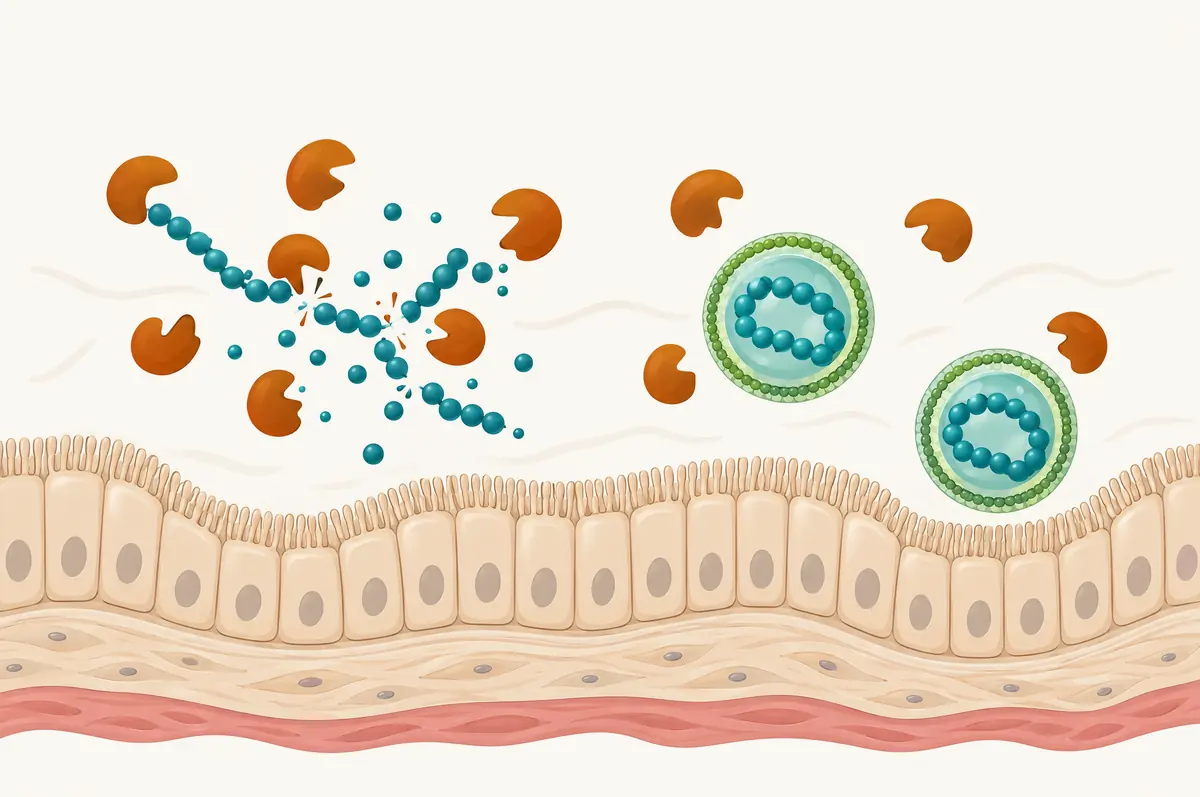
Bead-chain peptide cut by amber enzymes; then the same chain inside a multi-layer sphere, enzymes bounce off.
What the program tests
We test layered particles that combine an acid-resistant outer shell, protease-shielding middle layers and mucoadhesive or permeation-supporting inner layers. Model peptides are chosen for regulatory clarity and published pharmacokinetics. Readouts are intact peptide recovery after simulated gastric and intestinal digestion, transport across Caco-2 and similar monolayers, and, where a partner's program allows, animal pharmacokinetics compared with a subcutaneous reference. Every study includes an unencapsulated control, so any improvement is measured rather than assumed.
Other routes in scope
Oral delivery is the hardest route. The program also evaluates sublingual and buccal films, intranasal formulations and topical delivery for cosmetic peptides, where barriers are lower and regulatory routes may be shorter. For long-acting injectables developed by pharmaceutical partners, the same layering chemistry is evaluated for controlled release. Buccal and sublingual tissue avoids gastric acid and first-pass metabolism, and the nasal mucosa offers a large, well-perfused surface, although both limit dose volume and require careful irritation testing.
Who we work with
Partners are pharmaceutical and biotech companies with peptides in development, cosmetic peptide suppliers, and API manufacturers operating under GMP. Each partner program begins with a written regulatory assessment for the target market, so every program has a lawful pathway before formulation work starts.
Key facts
- Oral semaglutide has an absolute bioavailability of about 0.4 to 1% despite 300 mg of SNAC (FDA label, Rybelsus 2019)
- SNAC acts locally in the stomach by buffering pH and transiently increasing transcellular absorption (Buckley et al. 2018, Sci Transl Med)
- Oral octreotide capsules using transient permeation enhancer technology were FDA approved in 2020 for acromegaly (FDA label, Mycapssa 2020)
- Intestinal permeation enhancers remain the main clinical strategy for oral peptides, with modest and variable bioavailability (Maher et al. 2016, Adv Drug Deliv Rev)
How our delivery technology applies
Encapsulation can address degradation more directly than permeability. A shell that survives pH 1 to 3 and excludes pepsin and trypsin can raise the fraction of intact peptide reaching the epithelium, and mucoadhesive layers can hold it there with a co-released enhancer. The program measures intact recovery and epithelial transport separately and reports both, so each layer's contribution is visible.
Questions
Does Vegalab supply peptides?
Vegalab formulates peptides that partners supply with documented provenance and a regulatory pathway, and delivers the encapsulated format, stability data and GMP manufacture.
Pharma and biotech partners: propose a peptide for a feasibility screen.
Related reading
Last updated: