Why Essential Oils Fail After Three Days
Essential-oil sprays fail outdoors because the active leaves the surface before the pest arrives.



Last updated:
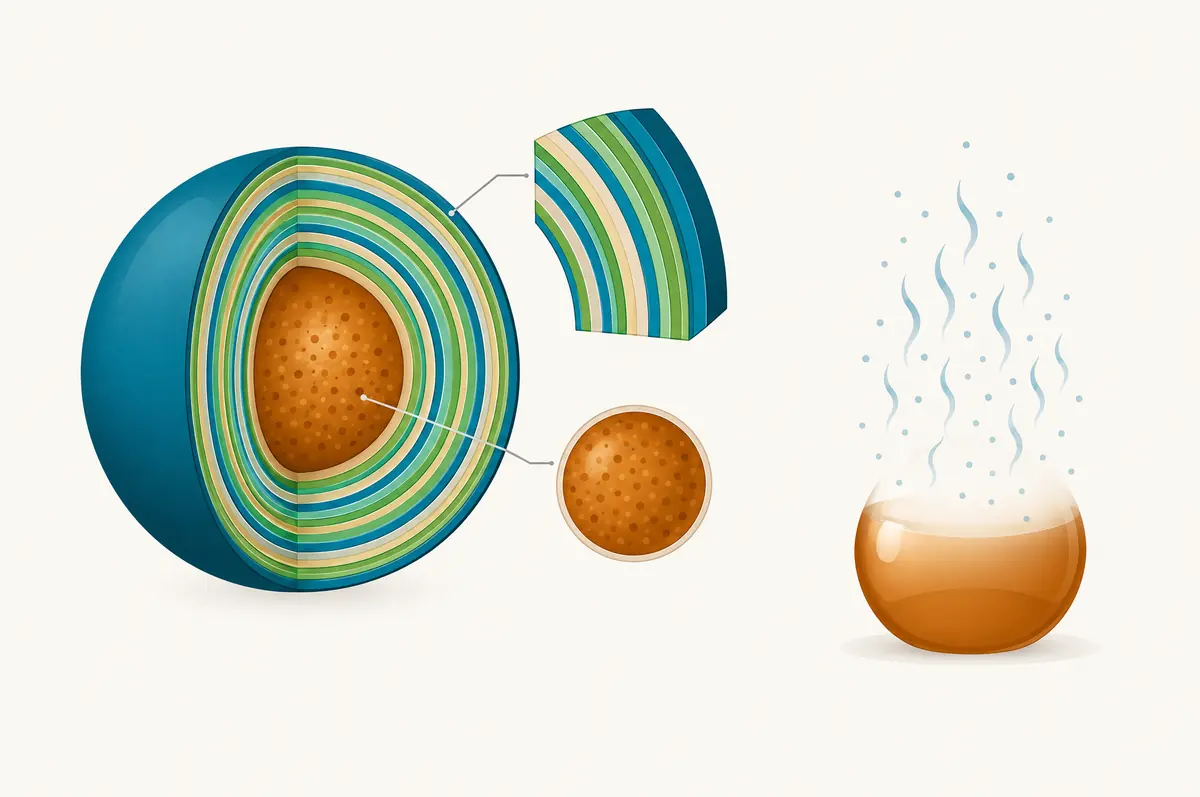
Most botanical and oxidizing biosecurity actives work in the lab and fail in the barn because they evaporate, degrade or react before reaching the target. Vegalab's platform builds up to 20 programmable biopolymer layers around an active to control when and where it is released. This section explains the specific delivery problems it addresses.
Essential oils such as geraniol and peppermint oil are potent on contact but evaporate from treated surfaces in days. Two pages cover this. Residual activity explains why unencapsulated botanicals hold a few days against ticks and what published encapsulation work shows. Volatility control explains how layer count, shell composition and core oil phase set a release rate, and what that means for reapplication intervals in housing and yards. Together they explain why a botanical that is active in a bioassay often disappoints in a barn or yard.
Split screen on concrete: a neat oil droplet evaporates; encapsulated capsules keep releasing a film for the whole clip.
A spider mite and an engorged tick present very different barriers. Cuticle penetration compares mite and tick cuticle and how oil carriers and shell chemistry affect uptake. The dose gap page sets out the arithmetic: Spider Mite Control at 1:500 delivers about 0.57 mg/mL geraniol, while published tick endpoints sit roughly 10 to 20 times higher. It explains why our tick program is a separate product, not a higher dose of an existing one.
Chlorine dioxide is an effective oxidizing disinfectant that is difficult to ship and store as a gas or solution. Chlorine dioxide stabilization explains how Vetpure Disinfectant holds precursors in a nano-encapsulated powder that dissolves to at least 98% ClO2 purity and remains stable in solution for up to one month, without forming trihalomethanes or haloacetic acids. The page also covers how encapsulated precursor chemistry supports tablet and sachet formats for water and surfaces, and why dose accuracy at use matters more than label concentration on the drum.
The common thread is release control. For volatile botanicals, shells slow evaporation and extend residual. For contact actives, oil-compatible cores improve transfer across waxy cuticle. For chlorine dioxide, encapsulation separates reactive precursors until dissolution, so the oxidizer forms on demand at high purity. Each page states what is demonstrated and what is still in trial.
Partners and distributors: request the Biosecurity technology briefing.
Essential-oil sprays fail outdoors because the active leaves the surface before the pest arrives.
Release rate from an encapsulated volatile is set by three variables: the number of shell layers, the permeability of each layer, and the oil phase the active is dissolved in.
A contact active has to cross the arthropod cuticle before it can act.
Chlorine dioxide is a strong, selective oxidizing disinfectant that is hard to handle because it is an unstable gas.
Spider Mite Control at its 1:500 dilution delivers about 0.57 mg/mL geraniol, enough for spider mites.