Multi-Layer Nano-Encapsulation
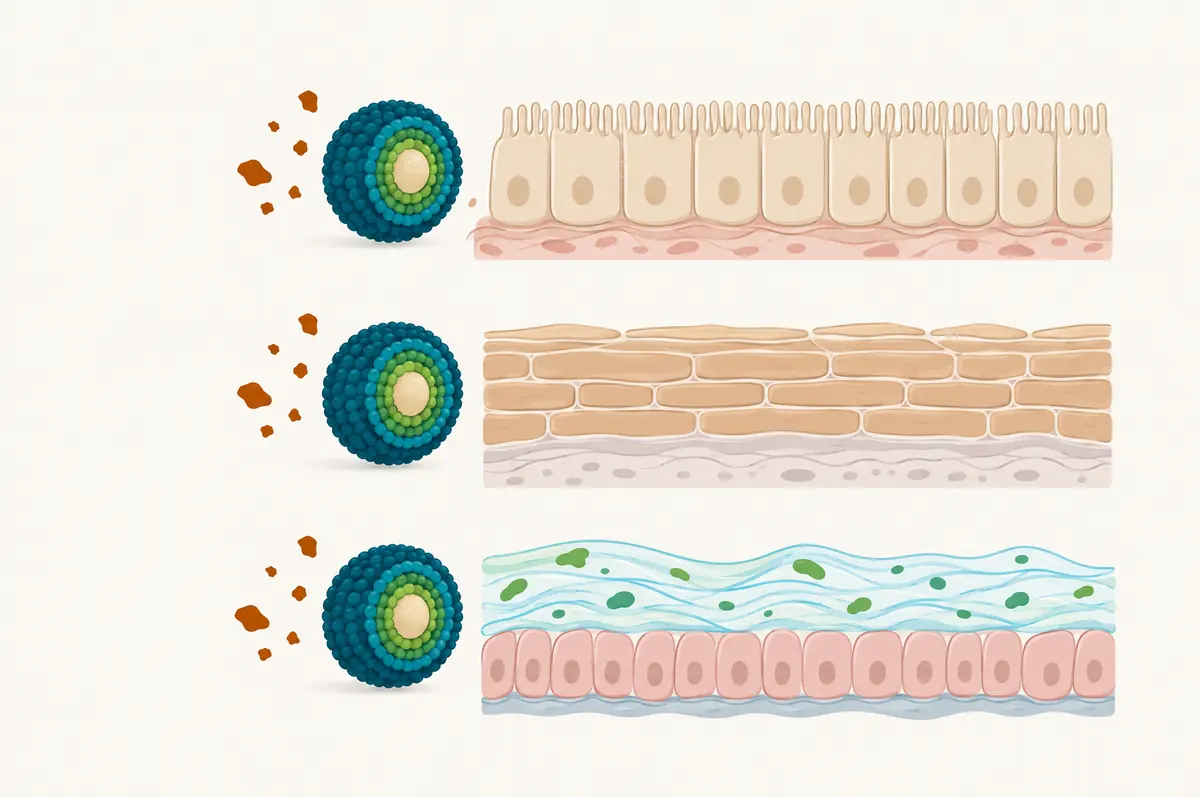
Vegalab's platform builds a particle in sequence rather than in one step: a payload core, then discrete biopolymer layers, up to 20, each selected for one job.



Last updated:
A molecule with good pharmacology and bad delivery is a failed product. This section sets out the physical chemistry Vegalab works with, what multi-layer encapsulation changes in a delivery profile, and how to read a bioavailability number correctly.
The multi-layer encapsulation page describes the core method: a core payload surrounded by up to 20 programmable biopolymer layers, each chosen for a specific job such as protease resistance, pH-triggered release, mucoadhesion, or oxidation control. Layer count, layer chemistry and particle size distribution are the design variables. Layer count, chemistry and particle size are set per payload, and the page maps each design variable to the barrier it addresses.
Oral peptide delivery is treated separately because it is the most demanding route in the field. That page collects the approved-product benchmarks, including oral semaglutide with the permeation enhancer SNAC at roughly 0.4 to 1% bioavailability, and explains where an encapsulated system adds value. Read it before assuming any peptide can be moved from injection to capsule. It also covers the sublingual, intranasal and transdermal routes, where each route has its own molecular weight window and the carrier is designed around it.
Liposomes, lipid nanoparticles and polymer shells are not interchangeable, and the carriers compared page sets out stability, payload type, manufacturing burden and shelf life for each. The bioavailability page covers what an AUC ratio means, why a plasma curve for a compound with intracellular targets can mislead, and which studies a formulation partner should insist on before making any claim. Read both pages before signing off any absorption figure in marketing copy, since most published multiples in this trade are relative comparisons against a weak comparator rather than absolute bioavailability.
Vegalab sells formulation capability, not molecules. The value of the multi-layer approach is that each barrier in a given route can be assigned to its own layer: an acid-resistant outer shell for gastric transit, a mucoadhesive layer for residence time, an inner matrix that protects against oxidation or proteolysis until release. Sequencing those layers is the engineering problem, and it is compound and route specific.
Bring us a molecule and a route, and we will tell you which barrier decides the outcome.
Vegalab's platform builds a particle in sequence rather than in one step: a payload core, then discrete biopolymer layers, up to 20, each selected for one job.
Two peptides have been approved for oral use with permeation enhancers, and both land at roughly 1% bioavailability or less.
Carrier choice follows the payload and the route, not fashion.
Most bioavailability claims in the supplement and cosmetic trade are relative comparisons dressed as absolute numbers.
Exosomes are frequently called nature's delivery vehicle.