


How do predatory mites control spider mites?
Last updated:
Predatory mites hunt spider mites and suck them dry2. Phytoseiulus persimilis, a specialist predator, eats every spider mite life stage, up to 20 a day, and completes its life cycle faster than its prey, so it can push twospotted spider mite numbers below damaging levels1,3. Released early, at about one predator per 10 spider mites, it should shrink colonies within 2 to 3 weeks5,2.
What are predatory mites and how do they find spider mites?
The predatory mites used against spider mites, such as Phytoseiulus persimilis and Neoseiulus californicus, belong to the mite family Phytoseiidae3. Researchers group them into lifestyles, from specialized predators of Tetranychus spider mites, through selective predators of the wider spider mite family, to generalist predators and pollen-feeding generalists7. The best known, Phytoseiulus persimilis, is a specialist that feeds almost exclusively on Tetranychus mites such as the twospotted spider mite (Tetranychus urticae)3. It is one of the mainstays of greenhouse integrated pest management for spider mites on vegetables and ornamentals in Europe and North America4.
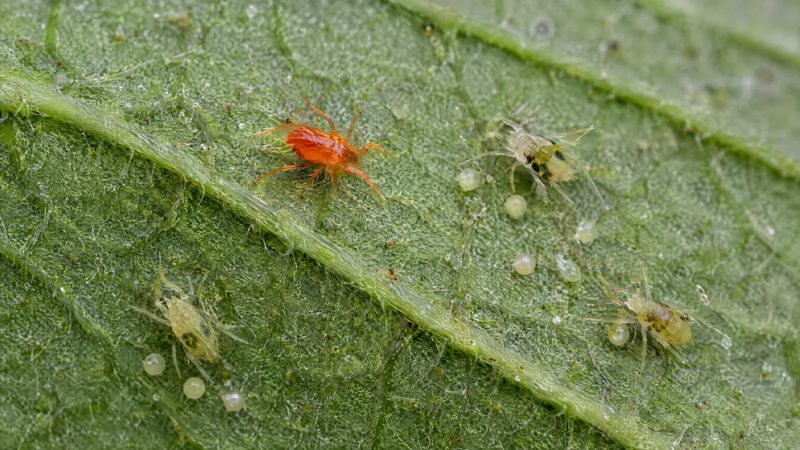
Predatory mites are about the same size as plant-feeding mites but have longer legs, are more active and are more teardrop-shaped5. P. persimilis adults are red to orange, pear shaped and nearly twice the size of a twospotted spider mite, and their speed helps them find prey1. They locate colonies by scent: leaves fed on by spider mites release a volatile odor that attracts the predator1, and contact with spider mite webbing makes it search harder4. The predator is blind, so it follows these chemical cues and the webbing to disperse through a crop3.
In North America, searches for predatory mites peak in April, ahead of the warm months when spider mites build up outdoors, which is the right time to plan early releases while mite numbers are low. In the Southern Hemisphere, the same planning window falls around October.
How does Phytoseiulus persimilis kill spider mites so quickly?
The first reason is speed of reproduction. Under optimal conditions, between 68°F and 86°F with relative humidity above 60%, P. persimilis can complete its life cycle within 5 days, compared with spider mite development times of up to 20 days3. At 68°F to 77°F its life cycle takes 4 to 7 days, which is why its populations can quickly drive twospotted spider mites below plant-damaging levels1. A mated female can lay up to five eggs a day and up to 60 over her 50-day life when temperatures sit between 62°F and 80°F1.
The second reason is appetite. The six-legged larvae do not feed, but nymphs and adults attack eggs, larvae, nymphs and adults of the twospotted spider mite1. At 68°F one adult can eat 10 adult spider mites, or 20 larvae or eggs, per day1. P. persimilis has the highest consumption rate of all phytoseiid mites4, and its adults have been shown to eat up to 3 times more twospotted spider mites than adults of Neoseiulus californicus3. Fed-on spider mites look dead, shriveled and deflated, which is how you confirm the predators are working2.
Which predatory mite should you use?
Each commercially available species is adapted to different temperature and humidity levels, so match the predator to the conditions2. P. persimilis is the fast-acting specialist for humid, moderate conditions2. Neoseiulus californicus acts more slowly but survives longer without spider mites by feeding on other plant-feeding mites, thrips, mold, nectar and pollen, so it can be released preventively and suits sites with wide swings in temperature or humidity2. Its lower feeding rate gives a slower drop in spider mite numbers, but suppression can last longer than with P. persimilis3. The western predatory mite, Galendromus occidentalis, is more effective under hot, dry conditions5. The two species can also be released together2.
| Predatory mite | Prey range | Conditions reported by extension sources |
|---|---|---|
| Phytoseiulus persimilis | Specialist on Tetranychus spider mites3 | Optimum above 68°F and above 75% relative humidity; eggs shrivel below 60% humidity; falls behind spider mites above 86°F2 |
| Neoseiulus californicus | Spider mites, plus broad and cyclamen mites, thrips, mold, nectar and pollen2 | Active from 46°F to 95°F at 40 to 80% relative humidity2 |
| Galendromus occidentalis (western predatory mite) | Twospotted spider mite; pollen when prey is scarce2 | Best at 50°F to 115°F and 30 to 60% relative humidity; more effective in hot, dry conditions2,5 |
| Amblyseius andersoni | Spider mites, broad mites and cyclamen mites; thrips and fungal spores without mites2 | Active from 42°F to 104°F; tolerates cooler temperatures than other species2 |
| Neoseiulus fallacis | Spider mites and cyclamen mites; small arthropods and pollen without prey2 | 48°F to 85°F; does best in a dense canopy above 50% relative humidity2 |
When and how do you release predatory mites?
Release early, when spider mites are first noticed and numbers are still low2. Successful suppression has been reported when P. persimilis goes into the crop early in an infestation, before spider mites reach severely damaging levels3. A good guideline is one predator for every 10 spider mites, and more than one release may be needed to bring numbers down quickly5. In a heavily infested garden or orchard with few natural predators, first lower the pest mites with a soap spray or a selective miticide, then release predators5. Follow the product label for any spray you use.
Concentrate releases on the hot spots where spider mites are densest5,2. Predatory mites are sold in sealed containers, sachets or slow-release bags with a bran carrier; rotate containers gently so the mites spread evenly, and lightly mist leaves before release so the predators do not fall off1. Ask your supplier for release rates, because they vary with crop susceptibility, crop length and infestation level2. Spider mite colonies should shrink within 2 to 3 weeks2.
- Check the carrier on a sheet of white paper first to confirm the predators are alive and moving2.
- Plants whose leaves touch let P. persimilis spread through the crop; when plants have little contact, its dispersal drops by about 70%1,4.
- Watch for dead, shriveled spider mites and for the predators' larger, football-shaped eggs among the round spider mite eggs2.
Why do predatory mite releases fail?
Dry air is the first limit. At a relative humidity below 60%, P. persimilis eggs shrivel and do not hatch2. In one study at 27°C (about 81°F), only 7.5% of eggs hatched at 40% relative humidity compared with 99.7% at 80% humidity4. Temperatures above 86°F and relative humidity below 40% both reduce its activity and feeding, and when the two occur together it moves down into the cooler, more humid lower canopy, leaving spider mites in the upper canopy to keep feeding1.
Running out of prey is the second limit. P. persimilis must have spider mites or it disperses or starves4, and without them its populations turn cannibal and decline, so repeat releases may be needed if spider mites rebound1. Leaf hairs also get in the way: trichomes hinder its search1, and the glandular hairs on greenhouse tomato leaves reduce its dispersal2.
Broad-spectrum insecticides are the third. Some organophosphates and pyrethroids are not very effective against mites, often kill mite predators and can trigger spikes in spider mite numbers5. Once established on perennials, predatory mites may keep reproducing and give control indefinitely unless nonselective insecticides kill them5.
Do predatory mites work outdoors and alongside sprays?
Yes, with planning. P. persimilis has been used very successfully in field-grown strawberries in California and Florida, but open-field use is far less common than greenhouse use6. In North Carolina staked field tomatoes, research plots and commercial fields showed season-long twospotted spider mite control when P. persimilis was applied correctly, despite the tomato's glandular hairs6. The species has also become established in parts of the southeastern United States, where resident populations help suppress late-season spider mites6.
Spray choice decides whether released predators survive, because nonselective insecticides kill them5. In a review of side-effect data for Florida strawberry pesticides, N. californicus was generally less susceptible to insecticides than P. persimilis3. Among OMRI-listed organic products, only one, a potassium salts of fatty acids insecticide, was rated highly toxic to both species, while five Bacillus thuringiensis formulations fell in the lowest toxicity class, under 25% mortality, for both3. Plan spray timing around releases, and follow the product label for any pesticide.
Key takeaways
- Predatory mites such as Phytoseiulus persimilis eat every spider mite life stage and reproduce faster than their prey.
- Match the species to the site: P. persimilis for humid, moderate conditions, Neoseiulus californicus for swings in heat and humidity or preventive use.
- Release early, at hot spots, at about one predator per 10 spider mites; colonies should shrink within 2 to 3 weeks.
- Low humidity, heat above 86°F, hairy leaves and broad-spectrum insecticides are the main reasons releases fail.
- Follow the product label for any spray used alongside predators, and avoid products rated highly toxic to them.
References
- Phytoseiulus persimilis: Biological Control Agent of the Twospotted Spider Mite (MF3665)
- Biological Control of Two-Spotted Spider Mites
- Susceptibility of Phytoseiulus persimilis and Neoseiulus californicus (Acari: Phytoseiidae) to Commonly Used Insecticides Approved for Managing Arthropod Pests in Florida Strawberries (ENY-996/IN1216)
- Phytoseiulus persimilis (Acarina: Phytoseiidae), in Biological Control: A Guide to Natural Enemies in North America
- Pest Notes: Spider Mites (UC ANR Publication 7405)
- Biological Control of Spider Mites in Tomatoes
- Revision of the lifestyles of phytoseiid mites (Acari: Phytoseiidae) and implications for biological control strategies
Frequently asked questions
How do you tell predatory mites from spider mites?
Do predatory mites control broad mites?
Can predatory mites damage plants?
What happens to predatory mites when the spider mites are gone?
P. persimilis populations tend to die out once spider mites are exhausted3. N. californicus can survive on other mites, small insects and pollen, and can establish lasting populations3. N. californicus is useful for keeping low spider mite populations in check, and it can be released together with P. persimilis2.