


Dose Gap: From Spider Mite Rate to Tick Rate
Last updated:
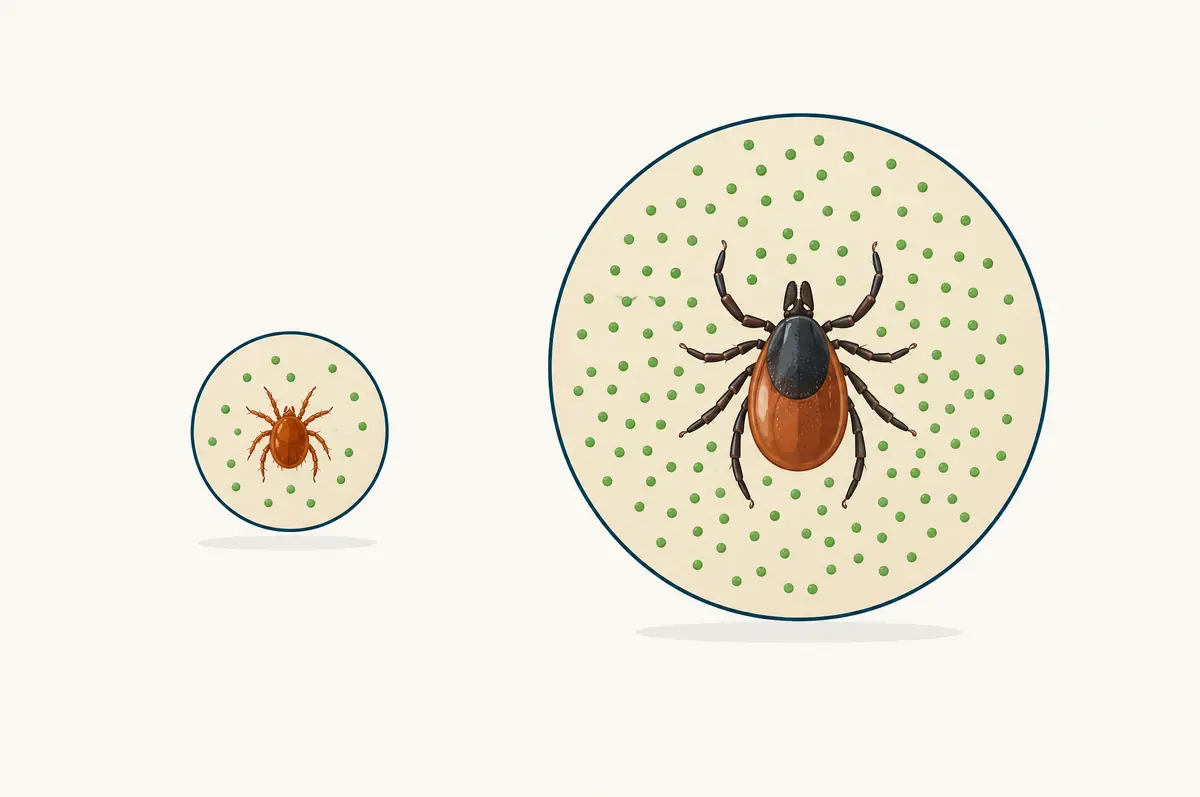
Spider Mite Control at its 1:500 dilution delivers about 0.57 mg/mL geraniol, enough for spider mites. Published geraniol endpoints for ticks sit at roughly 6.6 to 11 mg/mL, so ticks need 10 to 20 times more active. That gap is why tick control is a separate development program, not a stronger mix of an existing product.
The arithmetic
Spider Mite Control contains 30% geraniol. At 1:500, the working solution carries about 0.57 mg/mL. Published tick data give larval LC50 of about 6.6 mg/mL for pure geraniol (R. microplus), higher estimated values for unfed adult R. sanguineus, higher again for engorged female R. annulatus (estimated from geranium-oil studies), and larval LC95 about 11.1 mg/mL for R. microplus. Reaching median kill implies roughly a 1:50 dilution; reliable kill implies roughly 1:25. Those are research figures, not use rates.
Why you cannot just mix it stronger
Using a registered pesticide at a rate or on a site not on its label is a FIFRA violation. The current Spider Mite Control label covers crops and plants at the labeled rate, not ticks. Higher geraniol concentrations also raise phytotoxicity, surface residue and exposure to non-target animals, including cats, which are highly sensitive to essential oils. A tick product needs its own label, its own safety data and its own directions.
How the program closes the gap
Two levers work together. First, formulate for ticks: higher geraniol load in a shell designed for questing-zone residues. Second, extend residual so the effective concentration persists at the surface long enough to contact ticks. The planned USDA-ARS larval packet test runs SMC as formulated, adds an Ixodes scapularis nymph arm, and compares encapsulated with neat geraniol residues at day 1, 7, 14 and 28. Repellency data (1% geraniol reduced tick counts on cattle by over 90% for three weeks) support a repellent positioning alongside mortality.
Key facts
- Geraniol larval LC95 against Rhipicephalus microplus is about 11.1 mg/mL (Singh et al. 2018, Ticks Tick Borne Dis 9:201).
- 1% geraniol on cattle reduced Hyalomma tick counts by 98.4%, 97.3% and 91.3% at day 7, 14 and 21 (Khallaayoune et al. 2009, Parasite 16:223).
- Geranium and savory thyme essential oils were antagonistic against Ixodes scapularis at all concentrations tested, so blending oils does not automatically raise potency (Anholeto et al. 2024, Ticks Tick Borne Dis 15:102309).
- Use of a pesticide in a manner inconsistent with its labeling is unlawful (FIFRA sec. 12(a)(2)(G), 7 U.S.C. 136j).
How our delivery technology applies
Encapsulation does not change geraniol's intrinsic potency; it changes how much reaches the tick and for how long. A multi-layer shell holds a higher active load without an initial evaporative burst, and releases at the surface where ticks quest. Closing the dose gap therefore combines a tick-specific concentration with extended residual, measured against neat geraniol.
PMPs and researchers: register interest in Tick Control trial results.