


Getting Through the Cuticle: Mites vs Ticks
Last updated:
A contact active has to cross the arthropod cuticle before it can act. Small mites have a thin, lightly sclerotized cuticle and a high surface-to-volume ratio, so low doses work. Hard ticks have thick sclerotized plates and, once engorged, a large body mass behind a stretched cuticle, so doses must rise sharply.
Mite cuticle
Spider mites and poultry red mites are under 1 mm long. Their cuticle is thin, with a waxy epicuticle over a soft procuticle. A small droplet covers a large fraction of the body surface, and diffusion distances to nerve tissue are short. This is why Spider Mite Control works at a 1:500 dilution, delivering about 0.57 mg/mL geraniol. Mites also lose water quickly, so anything that disrupts the wax layer adds a desiccation effect on top of the active's neurotoxicity.
Tick cuticle
Hard ticks carry a sclerotized scutum and a thick, folded alloscutum that expands enormously during feeding. Unfed larvae and nymphs are small and relatively permeable, which is why larval endpoints are the lowest. Unfed adults have more armor, and engorged females combine thick cuticle with a large internal volume. Published geraniol endpoints follow that order: larval LC50 of about 6.6 mg/mL for pure geraniol (R. microplus), higher for unfed adults, highest for engorged females.
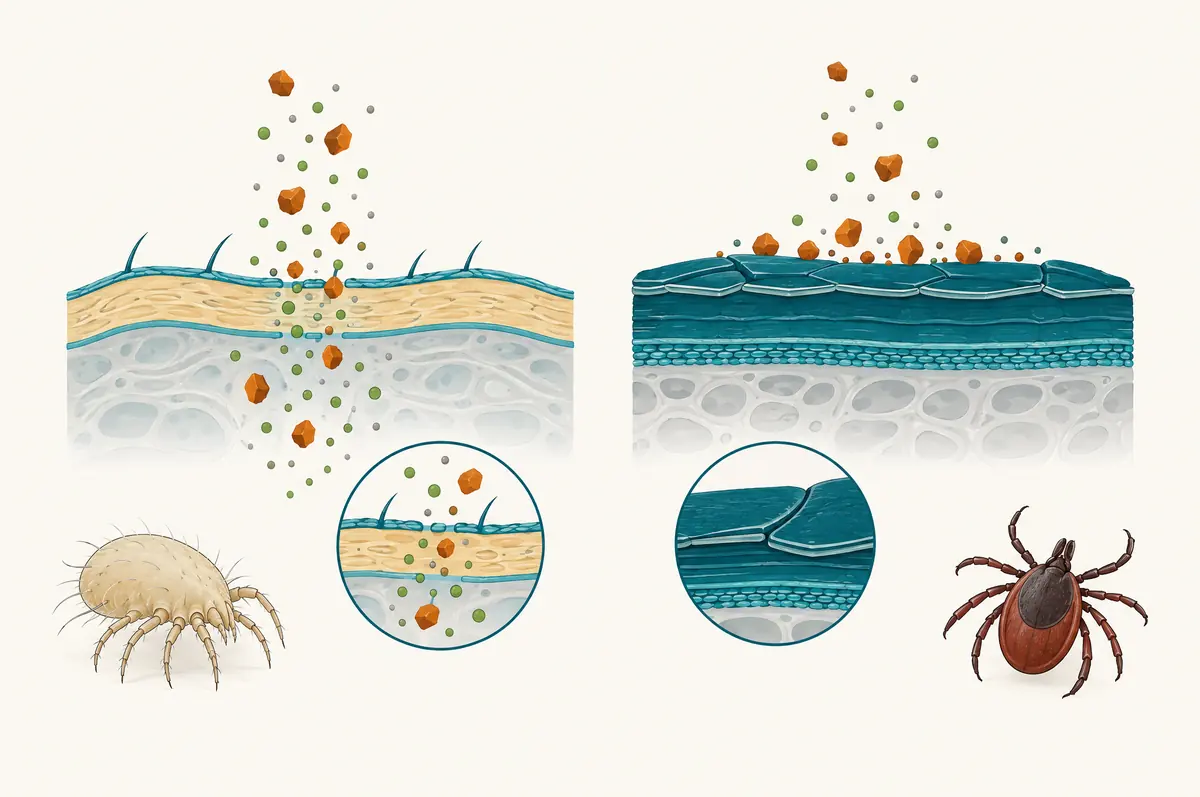
What helps an active get through
Oil carriers dissolve epicuticular lipids and hold a lipophilic active against the surface. Surfactant components improve wetting of hydrophobic cuticle. Contact time matters: a residue that stays on the substrate for weeks has more chances to transfer during questing. Particle size and surface chemistry of a capsule affect whether it adheres to cuticle and setae or simply falls off. These are delivery levers, and none of them replaces adequate dose at the surface. The dose gap page sets out how much further the tick program must go.
Key facts
- Pure geraniol gave a larval LC50 of about 6.6 mg/mL and LC95 of about 11.1 mg/mL against susceptible Rhipicephalus microplus (Singh et al. 2018, Ticks Tick Borne Dis 9:201).
- Geranium oil formulations have been bioassayed against engorged females and larvae of acaricide-resistant Rhipicephalus annulatus, with fixed-oil blends improving activity (Ibrahium et al. 2022, Sci Rep 12:11693).
- Spider Mite Control at 1:500 delivers about 0.57 mg/mL geraniol (Vegalab formulation calculation, Spider Mite Control label).
- Published geraniol mortality bioassays against ticks center on larvae, with a pure-geraniol LC50 reported for Rhipicephalus microplus larvae (Singh et al. 2018, Ticks Tick Borne Dis 9:201).
How our delivery technology applies
Nanoscale capsules with a lipophilic outer layer adhere to the epicuticle and release geraniol into the oil phase directly at the cuticle surface. That raises local concentration at the point of entry without raising the whole-surface application rate. Combined with a formulation built for the tick dose range, it raises how much of each applied milligram reaches the target.
Researchers: request the tick cuticle and nymph assay design.