

How does sulfur fungicide work?
Last updated:
Sulfur fungicide kills fungi on contact. The exact mechanism is not fully understood, but the main theory is that sulfur enters fungal cells and disrupts their respiration1. Against powdery mildew it works only as a preventive, applied before symptoms appear, and it can injure some squash and melon varieties, especially near or above 90°F or within 2 weeks of an oil spray3.
What is sulfur fungicide?
Elemental sulfur (S) is a natural element found in soil, plants, foods and water, and it is an essential plant nutrient1. As a pesticide it can kill fungi, insects and mites, and it has been registered for pesticide use in the United States since the 1920s1,2. More than 200 active products contain it, and some are approved for organic gardening1.
Sulfur products come as dusts, wettable powders and liquids1. They are registered for field crops, tree fruits, nuts, berries, vegetables, ornamentals and turf1. In commercial grape guidelines, elemental sulfur is listed as a multi-site contact fungicide (FRAC group M2)7. Sulfur, along with some soaps and oils, is acceptable on organically certified grapes, although growers should check with their certifier7.
| Form | How it is used | What to know |
|---|---|---|
| Wettable sulfur with surfactants | Sprayed on foliage as a preventive | The preferred garden form for powdery mildew, because surfactants help it spread on the leaf3,4 |
| Sulfur dust | Dusted on plants | Harder to use, irritating to skin and eyes, and drifts easily4,8 |
| Lime sulfur | Sprayed as a liquid | Listed among the eradicant materials for powdery mildew in commercial nursery guidelines6 |
In North America, interest in sulfur fungicide peaks in June, when preventive powdery mildew sprays begin and before midsummer heat pushes temperatures toward the 90°F limit for sulfur. In the Southern Hemisphere, the same window falls around December.
How does sulfur kill fungi?
Sulfur kills fungi on contact1. Researchers have not fully worked out how. Some believe sulfur reacts with plants or fungi to form a toxic agent, but the main theory is that it enters fungal cells and interferes with cell respiration1. Insects and mites are affected when they touch or eat it, because it disrupts their ability to produce energy1.
Because sulfur acts only where it lands, coverage matters. Protectant fungicides such as sulfur must cover all susceptible plant parts, and as plants grow new tissue, repeat applications may be needed at 7- to 10-day intervals while conditions favor disease5. Deposits removed by rain or irrigation also need renewing6. Follow the product label for the interval on your crop.
Temperature changes how sulfur behaves. Its effectiveness rises as temperature rises, but so does the likelihood of plant injury6.
Does sulfur work on powdery mildew?
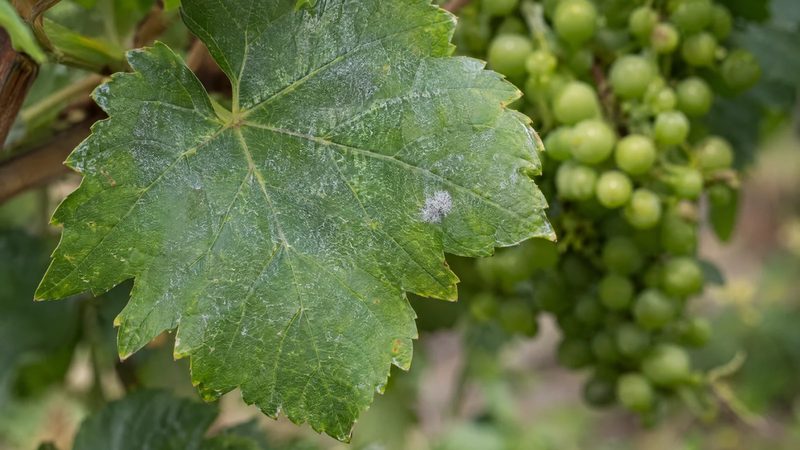
Yes, as a preventive. Sulfur has been used against powdery mildew for centuries, but it is effective only when applied before the disease appears3,4. Once mildew growth is mild to moderate, protective fungicides generally come too late, except to protect new growth5.
Oils work differently. University of California guidance lists horticultural oils and neem oil as the eradicants for mild to moderate infections, while sulfur and most other low-toxicity fungicides are mainly preventive3. On highly susceptible fruit plants, sulfur can go on early in the season while temperatures are below 90°F, with a switch to other materials as the season progresses5.
Sulfur also reduces mite populations: on strawberries, sulfur treatments for powdery mildew also cut mite numbers5. Sulfur sprays can be used against spider mites on some vegetables, fruit trees and ornamentals8.
Which plants can sulfur damage?
Sulfur can damage some squash and melon varieties, and some ornamental cultivars3,4. It can burn cucurbits and other plants in some cases, so University of California guidance advises using it only where it has been shown to be suitable for that plant locally8. It should never be applied to apricot trees at any temperature5.
Heat is the other trigger. Do not apply sulfur when the air temperature is near or over 90°F3. For caneberries and strawberries the cutoff is lower, at 80°F, because sulfur then damages foliage and fruit5. Sulfur drifting onto areas near a treated field can injure sulfur-sensitive plants1.
| Plants | Precaution |
|---|---|
| Squash, melons and other cucurbits | Some varieties are damaged; sulfur can burn cucurbits3,8 |
| Apricot | Never apply sulfur, at any temperature5 |
| Caneberries and strawberry | Do not apply above 80°F5 |
| Most other garden plants | Do not apply near or above 90°F3,5 |
| Some ornamental cultivars | Sulfur sprays can damage them; check the label4 |
Can you use sulfur and oil sprays together?
No. Do not apply sulfur within 2 weeks of an oil spray, and never apply an oil within 2 weeks of a sulfur spray, or plants may be injured3,4. Some plants are more sensitive, and the interval between sulfur and oil may need to be even longer4. University of California spider mite guidance gives a longer gap still, advising against sulfur within 30 days of an oil spray8.
The same caution applies to neem oil, which is an oil spray3. In commercial vineyards, oil is never mixed with sulfur or applied within 2 weeks of it7. Always check the fungicide label for special precautions4.
Is sulfur fungicide harmful to people, pets, bees or fish?
Sulfur is low in toxicity to people1. EPA placed it in the least toxic category for acute oral toxicity and skin irritation, but it can cause some eye irritation and inhalation hazards2. Breathing sulfur dust can irritate the airways or cause coughing, and it can irritate skin and eyes1. Based on skin and eye irritation among California field workers, EPA requires a 24-hour reentry interval and protective clothing on outdoor sulfur product labels2.
Animals that eat too much sulfur can be poisoned, and it can be fatal; signs include stomach and intestinal problems, lung effects and neurologic disorders1. Store products where pets and livestock cannot reach them, and follow the label.
Sulfur is practically non-toxic to honey bees, bobwhite quail, bluegill sunfish, rainbow trout, water fleas and mysid shrimp1,2. It does not dissolve well in water, so drift or runoff is not expected to affect aquatic life1. Applied to soil, elemental sulfur joins the natural sulfur cycle2.
Key takeaways
- Sulfur kills fungi on contact; the main theory is that it disrupts fungal cell respiration.
- For powdery mildew it is a preventive only: apply before symptoms appear and renew as new leaves grow.
- Skip sulfur near or above 90°F, on apricots, and on sulfur-sensitive squash and melon varieties.
- Keep sulfur and oil sprays, including neem, at least 2 weeks apart, and follow the label where it asks for longer.
- Sulfur is low in toxicity to people and practically non-toxic to bees and fish, but dust irritates eyes, skin and airways.
References
- Sulfur General Fact Sheet
- R.E.D. Facts: Sulfur (EPA-738-F-91-110)
- Pest Notes: Powdery Mildew on Vegetables (UC ANR Publication 7406)
- Pest Notes: Powdery Mildew on Ornamentals (UC ANR Publication 7493)
- Pest Notes: Powdery Mildew on Fruits and Berries (UC ANR Publication 7494)
- Agriculture: Floriculture and Ornamental Nurseries Pest Management Guidelines, Powdery Mildew
- Agriculture: Grape Pest Management Guidelines, Powdery Mildew
- Pest Notes: Spider Mites (UC ANR Publication 7405)
Frequently asked questions
What is the best sulfur fungicide spray for powdery mildew in a garden?
Does sulfur fungicide cure powdery mildew that is already on the leaves?
Generally not. Sulfur is effective only when applied before symptoms appear, so it protects healthy tissue rather than clearing existing growth3. For mild to moderate infections, University of California guidance points to horticultural or plant-based oils, kept at least 2 weeks away from any sulfur spray3.