


How do you stop powdery mildew on squash and zucchini?
Last updated:
Powdery mildew on squash and zucchini, caused mainly by the fungus Podosphaera xanthii, is managed with resistant varieties plus protectant sprays started as soon as the first white spots appear on older leaves, then repeated weekly.1,2 Sulfur is the most effective organic option; potassium bicarbonate, oils and biofungicides are alternatives. Cover leaf undersides and follow the product label.1,2
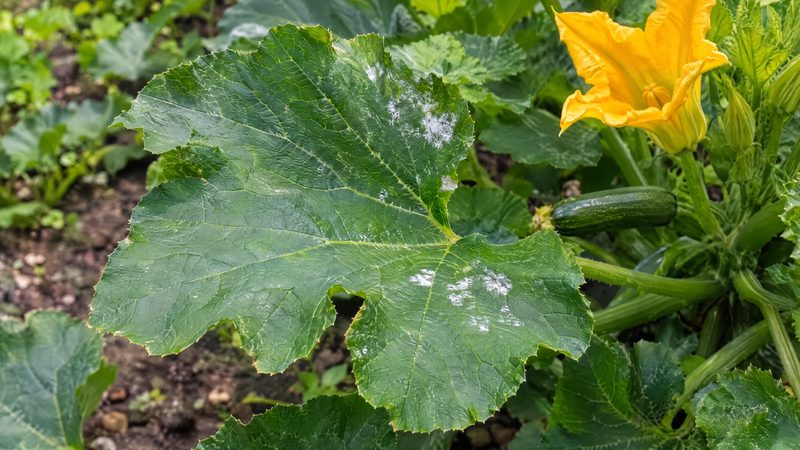
What does powdery mildew look like on squash, zucchini and pumpkin leaves?
Cucurbit powdery mildew is caused by two fungi, Podosphaera xanthii (previously called Sphaerotheca fuliginea) and Erysiphe cichoracearum, and P. xanthii is now the more common and more aggressive of the two.1 Infection often starts as pale yellow spots on stems, petioles and leaves that spread into white, powdery growth, which is mostly asexual spores.1,3
The growth usually appears first on crown leaves, shaded lower leaves and leaf undersides, and older plants are affected first.1 Yellow spots can form on the upper leaf surface opposite colonies underneath, and infected leaves usually wither and die early.1 Leaves become dull and yellowed, may wilt in afternoon heat, and finally turn brown and papery.3
| Stage | What you see | Where to look |
|---|---|---|
| Early | Pale yellow spots, then small white powdery patches | Undersides of older, shaded leaves near the crown |
| Spreading | White growth on both leaf surfaces, petioles and stems; yellow spots on the upper surface | Throughout the lower canopy |
| Advanced | Dull, yellow leaves that wilt in afternoon heat, then brown and papery | Whole plant, oldest leaves first |
| Late season | Tiny dark brown chasmothecia, barely visible without a hand lens | On infected leaves |
In North America, cucurbit powdery mildew usually appears around the start of fruit production in midsummer, with airborne spores believed to spread from southern states where cucurbits are planted earlier1. In the Southern Hemisphere, the same risk period falls from about January to March.
Why does powdery mildew show up on squash in midsummer?
Plants become susceptible around fruit set, which is a physiological stress.2 Cornell Cooperative Extension notes that field plants often are not affected until after fruit initiation, and that leaves are most susceptible 16 to 23 days after unfolding.1 The main source of infection is believed to be airborne spores carried long distances from other cucurbit crops, beginning in southern states where cucurbits are grown earlier in the year.1
Unlike most leaf diseases, powdery mildew favors dry conditions. Infection can occur at relative humidity as low as 50%, dryness favors spore production and spread, and rain and free water on leaves are unfavorable.1 Mean temperatures of 68 to 80°F are favorable, development stops when daytime temperatures reach about 100°F, and the time from infection to symptoms is usually only 3 to 7 days.1 Dense plant growth and low light also favor the disease.1
How do you prevent powdery mildew on squash and zucchini?
Resistant varieties are the foundation. Resistance has been bred into most cucurbit crops, but in squash and pumpkin it is moderate, so resistant varieties of these crops still need fungicide support to protect yield.1 Where possible, choose varieties with resistance from both parents, sometimes labeled high resistance rather than intermediate resistance or tolerance.1
- Plant in full sun, space plants for air circulation, and avoid excess nitrogen, which produces lush, shaded foliage.4
- Separate successive plantings, or plant new ones upwind of older plantings, because older plants supply spores.1
- Scout weekly from the start of fruit formation, checking both surfaces of older leaves.1,2
- Pull up and remove plant debris at the end of the season.5
What organic sprays work on powdery mildew on squash and pumpkins?
Timing matters more than product choice. Cornell Cooperative Extension sets the action threshold at one leaf with symptoms out of 50 older leaves examined, and advises weekly applications from that point; starting later compromises control.1 Organic fungicides act by contact, so getting spray onto leaf undersides, where the fungus develops best, is essential.1,2
Sulfur is the most effective organic fungicide for cucurbit powdery mildew and one of the least expensive.1,2 It works as a preventive and can injure some squash and melon varieties, especially near or above 90°F or within 2 weeks of an oil spray.4 Potassium bicarbonate kills the fungus only by direct contact.3 In greenhouse trials, a potassium bicarbonate product reduced powdery mildew about as well as sulfur on most crops tested, including cucumber, but was less effective on melon where the disease was already established before the first spray.7 Horticultural oils and plant-based oils such as neem oil work best on mild to moderate infections that are already present.4 Biological products, such as Bacillus subtilis, are available but have not proven as effective as oils or sulfur.4
Copper is also available for powdery mildew but is not very effective against it.4 Using at least two products with different modes of action is the recommended organic strategy, and whichever you choose, follow the product label for crops, rates and intervals.2
| Option | How it works | Main caution |
|---|---|---|
| Sulfur | Preventive; most effective organic choice | Can injure some squash and melon varieties in heat; keep 2 weeks from oil sprays |
| Potassium bicarbonate | Kills the fungus on direct contact | Needs thorough coverage; weaker on established infections |
| Horticultural and neem oils | Best on mild to moderate existing infections | Not above 90°F, on drought-stressed plants, or within 2 weeks of sulfur |
| Bacillus subtilis and other biologicals | Microbes that suppress infection | Less effective than oils or sulfur in UC IPM's assessment |
| Copper | Contact protectant | Not very effective against powdery mildew |
Does milk spray work on zucchini powdery mildew?
There is peer-reviewed evidence that it can. In five greenhouse experiments on zucchini squash (Cucurbita pepo), a study in Crop Protection sprayed fresh cow's milk at 5 to 50% concentrations once or twice a week and compared it with conventional fungicides and water.6 Infected leaf area fell as milk concentration rose, and high concentrations were more effective than the conventional fungicides tested.6
The trial was run in a greenhouse, and the authors framed milk as an alternative for powdery mildew in organic agriculture.6 Milk is not a registered fungicide, so treat it as a supplement to resistant varieties and good timing rather than a replacement for them.
Is powdery mildew on cucumber plants different from squash?
The disease is the same, but cucumber has much stronger genetic resistance. Resistance is standard in modern cucumber varieties and so strong that it is easy to forget cucumber is susceptible until an heirloom type is grown.1 Organic growers see suppression from resistant varieties ranging from limited in pumpkin and squash to very high in cucumber.2
Watermelon also shows powdery mildew less often than other cucurbits, and fruit infection is rare on watermelon and cucumber.1,3 Melons need extra care with sulfur: cantaloupe can be injured, especially above 80°F, although sulfur-tolerant varieties exist.2 On pumpkin, powdery mildew that kills leaves early can leave fruit with poor rind color and shriveled, discolored handles, and on winter squash it reduces storability.1
Key takeaways
- Cucurbit powdery mildew is caused mainly by Podosphaera xanthii and appears first on the undersides of older, shaded leaves around fruit set.
- It thrives in dry weather at 68 to 80°F, so rain does not stop it; dryness favors spread.
- Resistant varieties plus weekly protectant sprays from the first symptomatic leaf give the most reliable control.
- Sulfur is the most effective organic spray; potassium bicarbonate, oils and milk are alternatives, and sulfur and oil sprays must stay 2 weeks apart.
- Cucumber resistance is strong, while squash and pumpkin resistance is moderate and still needs spray support.
References
- Cucurbit Powdery Mildew
- Managing Cucurbit Powdery Mildew Organically: Key Points for Success
- UC IPM Pest Management Guidelines: Cucurbits, Powdery Mildew (UC ANR Publication 3445)
- Pest Notes: Powdery Mildew on Vegetables (UC ANR Publication 7406)
- Powdery Mildew on Vegetables
- Effectiveness of cow's milk against zucchini squash powdery mildew (Sphaerotheca fuliginea) in greenhouse conditions
- Potassium Bicarbonate as a Potential Sulphur Substitute in Protected Organic Cropping
Frequently asked questions
Can you eat squash and zucchini from plants with powdery mildew?
Should you cut off leaves with powdery mildew?
Pruning out small infestations helps limit spread, and infected material can go in the compost, green waste or trash; a properly maintained compost pile should kill the spores.4 At the end of the season, pull up and remove all plant debris.5 Pruning alone is not a management program: Cornell Cooperative Extension bases control on resistant varieties and fungicides.1
Does spraying plants with water wash off powdery mildew?
Overhead sprinkling can wash spores off leaves, and some powdery mildew spores are killed by long periods of water on plant surfaces.4 UC IPM does not usually recommend it for vegetables because sprinkler use may contribute to other pest problems, and if you try it, water in midmorning so leaves dry quickly.4
Why does powdery mildew keep coming back every year?
The spores are dispersed by wind over long distances, and the fungus can form a sexual spore in fall that lets it survive the winter.1 It also adapts: Cornell Cooperative Extension reports a decline in the suppression achieved with resistant varieties and resistance to several fungicide groups, which is why rotating products with different modes of action matters.1,3