


Does garlic spray repel garden pests?
Last updated:
Only weakly, and the evidence is thin. Garlic-based products act mainly as repellents that may reduce feeding damage, and university IPM programs report limited information on how well they work3,2. In a laboratory test, garlic extracts deterred aphids from settling only by 24 hours, while horticultural soap alone deterred them from the first hour6. Commercial insecticidal soaps and oils are the better-tested choice8.
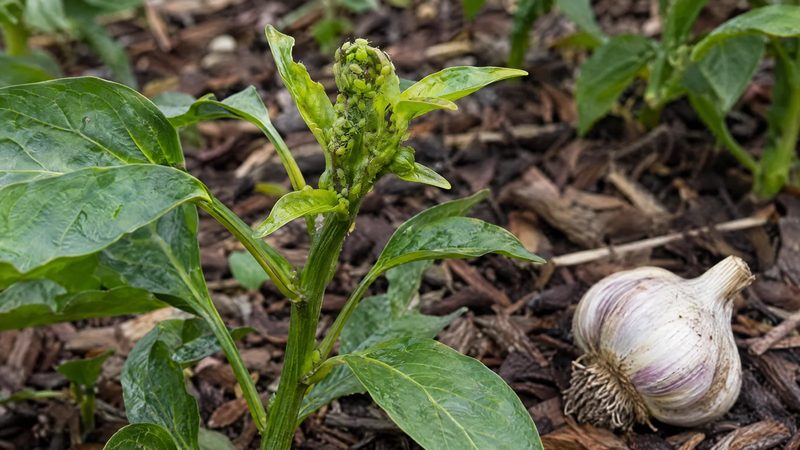
What do people believe about garlic spray?
The belief is that a spray made from garlic (Allium sativum) keeps aphids and other insects off garden plants, by repelling them with its smell or by killing them on contact. Garlic is one of the household ingredients most often used in homemade pest sprays, alongside dish soap, vinegar and cooking oils1. Recipes shared online and on social media vary from one to another1. Commercial garlic products are also labeled to repel a wide variety of pests on ornamental plants4.
Kitchen ingredients do not change the legal status of the mixture. A mixture made with household ingredients with the intent to kill, control, reduce or repel a pest is considered a pesticide1. Garlic and garlic oil are on the federal list of active ingredients permitted in minimum risk pesticide products, a category exempt from registration when every listed condition is met5.
In North America, searches for garlic spray peak in April and are lowest in February, and many aphid species do the most damage in late spring when temperatures are warm but not hot, so the advice on early checks and water sprays matters most then. In the Southern Hemisphere the same spring peak falls around October.
What does the evidence show?
The evidence supports garlic as a mild repellent, not as a dependable control. Clemson Cooperative Extension describes garlic-based insecticides as acting primarily as repellents that may reduce feeding damage from certain insect pests and animals3. The University of California Statewide IPM Program (UC IPM) lists garlic, hot pepper, peppermint oil and clove oil among products sold as insect repellents for plants, and states that limited information is available about their effectiveness2. University of Florida extension guidance, citing Clemson, adds that there is little research showing the effectiveness of garlic insecticides4.
Homemade versions have even less behind them. UC IPM states that homemade pesticides generally have not been studied in replicated research trials and therefore have not been scientifically proven to control pests1. Their ingredients vary widely, and their effects on natural enemies, pollinators, water quality and soil quality have not been studied1.
Does garlic spray work on aphids?
Controlled tests give a modest answer. In a 2008 laboratory choice test, Chinese cabbage leaves were dipped in commercially prepared garlic water extracts, and green peach aphids (Myzus persicae) were offered a treated leaf and an untreated leaf6. Garlic extracts at 2% and 5% did not significantly reduce settling in the first hour, but fewer aphids had settled on the treated leaves after 24 hours6. A second 2% garlic extract had no deterrent effect at any point, while potassium horticultural soap alone at 1% and 4% strongly deterred settling from the first hour to the end of the test6. The authors suggested such extracts are better used as one part of a wider strategy alongside other means of reducing aphid numbers6.
Field results are similar. In field trials in Ghana over the 2010 and 2011 seasons, homemade garlic and hot pepper extracts were tested on cabbage, where the key pests were the cabbage aphid (Brevicoryne brassicae) and the diamondback moth7. The extracts were generally comparable to an emamectin benzoate reference insecticide, but a pepper extract and that reference insecticide controlled diamondback moth better than the other treatments7. Cabbage head yields were comparable between insecticide-treated and botanical plots, and untreated control plots did well in some instances7.
| Source | Setting | Pests | Finding |
|---|---|---|---|
| Laboratory study, 20086 | Choice test on cut cabbage leaves | Green peach aphid | 2% and 5% garlic extracts deterred settling only by 24 hours; one 2% extract had no effect6 |
| Same study, soap alone6 | Choice test on cut cabbage leaves | Green peach aphid | Potassium horticultural soap at 1% and 4% deterred settling from the first hour6 |
| Field trials, Ghana, 2010 and 20117 | Cabbage plots over two seasons | Cabbage aphid, diamondback moth | Garlic generally comparable to a reference insecticide; pepper better on diamondback moth; yields comparable7 |
| Extension reviews2,3,4 | Product and literature summaries | Insect pests generally | Mainly a repellent; limited information and little research on effectiveness2,3,4 |
Can garlic spray harm bees or beneficial insects?
It can. Garlic and capsaicin products have been shown to repel and harm beneficial insects such as bees, as well as deterring pests4. In the Ghana trials, the plant extracts had a milder effect on natural enemies, which included lady beetles, hover flies and spiders, than the two synthetic reference insecticides7.
A homemade spray also comes without a label, so it carries no tested instructions on the amount to use, how often to apply, how soon to harvest, or whether the mixture can be used on edible crops1. Most dish soaps added to these recipes are not naturally occurring substances and are not biodegradable, and they can contain detergents and degreasers that harm groundwater and aquatic and soil organisms1. UC IPM also notes that homemade pesticides are not registered by the EPA and are not in compliance with federal pesticide law1.
If you choose a commercial garlic repellent, follow the product label. A minimum risk product must show the name and percentage of each active ingredient and list every inert ingredient on its label5.
What works instead?
Start by deciding whether aphids need treatment at all. Most established plants tolerate aphid feeding and outgrow the damage, and lady beetles, lacewings, syrphid fly larvae and parasitic wasps often reduce colonies without any spray8. These steps are better supported than garlic:
- Check plants at least twice a week while they grow fast, including leaf undersides, so colonies are caught early8.
- Knock aphids off sturdy plants with a strong spray of water; most dislodged aphids cannot return to the plant8.
- Keep ants off infested plants, because ants protect aphids from their natural enemies8.
- Avoid excess nitrogen fertilizer, which favors aphid reproduction8.
- Use silver reflective mulch under susceptible vegetables to repel invading aphids from seedlings and small plants8.
- If a spray is needed, commercial insecticidal soaps and oils, including neem oil, are the best choices for most situations; follow the product label and cover both leaf surfaces8.
- Expect to repeat soap and oil sprays, because they kill only the aphids present on the day they are applied8.
- Do not apply soaps or oils to water-stressed plants or above 90°F, and test on a small part of the plant several days before a full treatment8.
Key takeaways
- Garlic-based products act mainly as repellents that may reduce feeding damage.
- University IPM programs report limited information and little research on garlic's effectiveness.
- In a laboratory test, garlic extracts deterred aphids only by 24 hours, while horticultural soap alone worked from the first hour.
- Homemade garlic sprays have no label and untested side effects, and garlic products can harm beneficial insects such as bees.
- Commercial insecticidal soaps and oils, used according to the label, are the better-tested aphid sprays.
References
- UC IPM Statement on Homemade Pesticides
- Less Toxic Insecticides (Quick Tips)
- Less Toxic Insecticides for Garden and Landscape Pest Control in South Carolina (HGIC 2770)
- Q: I was watching a show about the Queen's garden and they use garlic to kill aphids. It appears to work. What do you think?
- 40 CFR 152.25 Exemptions for pesticides of a character not requiring FIFRA regulation (paragraph (f), minimum risk pesticides)
- Effect of extracts of garlic (Allium sativum L.), wormwood (Artemisia absinthium L.) and tansy (Tanaceum vulgare L.) on the behaviour of the peach potato aphid Myzus persicae (Sulz.) during the settling on plants
- Sustainable management of two key pests of cabbage, Brassica oleracea var. capitata L. (Brassicaceae), using homemade extracts from garlic and hot pepper
- Pest Notes: Aphids (UC ANR Publication 7404)
Frequently asked questions
Does garlic spray kill aphids or only repel them?
Can I use homemade garlic spray on vegetables I plan to eat?
A homemade mixture has no label, so there is no tested guidance on how much to use, how often to apply, or how long to wait before harvest1. For that reason UC IPM advises that homemade pesticides should not be recommended to the public by its Master Gardeners1. If you want a garlic repellent on edible crops, choose a commercial product whose label lists those crops, and follow the label.
Does garlic repel deer and rabbits?
Does adding dish soap make garlic spray work better?
In the laboratory aphid test, potassium horticultural soap on its own deterred settling more strongly than garlic extract on its own6. Household dish soap is a different material: most are not biodegradable and can contain degreasers that harm soil and aquatic organisms1. When UC IPM recommends soaps, it means commercial insecticidal soaps formulated as pesticides1.