

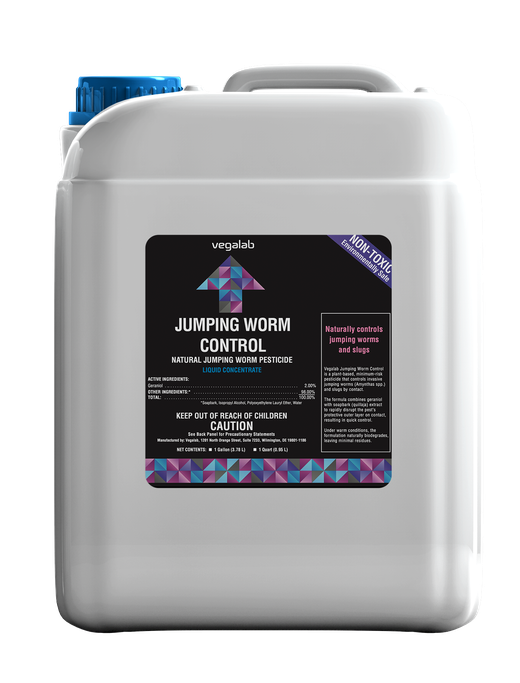
Jumping Worm Control: bioinsecticide for jumping worms
Jumping Worm Control is an all-natural bioinsecticide that targets invasive jumping worms (Amynthas spp.) which strip soil of nutrients and degrade its structure. Geraniol with plant-derived saponins and bio-surfactants drives the worms to the surface and disrupts them, and it also helps against slugs, mole crickets and ants - without synthetic chemistry.
All-natural bioinsecticide for invasive jumping worms - Plant-based, Minimum-risk pesticide.
- Zero REINo re-entry wait
- Zero PHIHarvest the same day
All-natural bioinsecticide for invasive jumping worms from Vegalab Crop Science, powered by Geraniol · plant-derived saponins · bio-surfactants. Jumping Worm Control targets Jumping worms (Amynthas spp.), slugs, mole crickets, ants.
Shipping $20 + $5 per gallon, calculated at checkout. Online orders up to 50 gallons; contact us for larger loads. Not available for delivery to Canada.
Secure checkout on Shopify. Each store keeps its own bag.
Geraniol with plant-derived saponins rapidly disrupts the jumping worm's protective outer mucus layer on contact, dehydrating the pest within minutes. A plant-based minimum-risk pesticide that biodegrades under warm conditions, leaving negligible soil residue.
| Active | Geraniol · plant-derived saponins · bio-surfactants |
|---|---|
| Targets | Jumping worms (Amynthas spp.), slugs, mole crickets, ants |
| Dilution rate | 1:800–1:600 · 1.25–1.67 mL/L (4.7–6.3 mL/gal) · 1.2–3.5 L/ha (16–48 fl oz/acre) |
| Application | Soil drench or foliar spray at start of infestation; avoid application before heavy rain |
| Line · Category | Control · All-natural bioinsecticide for invasive jumping worms |
- Asian jumping worm (Amynthas spp.)
- Crazy worm (Amynthas agrestis)
- Slugs by contact
- Snails by contact
What are jumping worms and why are they a problem?
Jumping worms (Amynthas spp.) are invasive earthworms that feed voraciously near the soil surface, rapidly stripping organic matter and nutrients and leaving a dry, granular casting layer that resembles coffee grounds. They degrade soil structure, harm plant roots and outcompete native soil life - a growing problem in turf, ornamentals, vegetable plots and hardwood understory. Because they reproduce quickly and spread easily, early action matters.
How does Jumping Worm Control work?
The active blend is geraniol with plant-derived saponins and bio-surfactants. The saponins and surfactants disrupt the protective surface of the worms and irritate them, driving jumping worms up out of the soil where they can be removed, while geraniol adds broad irritant activity. The whole blend is nature-derived, so it works without the synthetic residues that conventional soil insecticides leave behind.
How and when should it be applied?
- Apply when
- Jumping worms are active near the surface
- Conditions
- Warm and moist
- Orchard tank-mix
- As a coverage aid with Spider Mite Control at 1:800, which is 32 fl oz/acre at 200 gallons of water per acre
- Method
- Soil and turf
- Rate
- 1:800–1:600 · 1.25–1.67 mL/L · 1.2–3.5 L/ha1:800–1:600 · 4.7–6.3 mL/gal · 16–48 fl oz/acre · Work out your rate
- Pack sizes
- 237 mL, 946 mL, 3.8 L8 fl oz, 32 fl oz, 1 gal
- Area treated
- 3.8 L treats 1.1-3.2 ha1 gal treats 2.7-7.8 acres
- Pre-harvest interval
- Zero - harvest the same day
- Re-entry interval
- Zero - no re-entry wait
Treating early in an infestation limits casting damage.
Always read and follow the applicable product label.
Apply to affected soil and turf following the label rate, ideally when jumping worms are active near the surface - warm, moist conditions. Treating early in an infestation limits the nutrient stripping and casting damage before populations build. Watering the area can help bring worms toward the surface where the product is most effective.
Which settings is it for?
Jumping Worm Control has been used on turf, ornamentals, vegetable plots and hardwood understory - the settings where invasive jumping worms cause the most visible soil degradation. It suits home and professional turf, ornamental beds and managed natural areas where preserving soil structure matters.
What else does it help control?
Beyond jumping worms, the geraniol-and-saponin blend also helps against slugs, mole crickets and ants - other soil-surface pests that share the same damp habitats. That makes it a useful multi-purpose, low-residue option for growers managing several surface pests at once rather than reaching for separate synthetic products.
Need a recommendation for your crop or pest?
Contact usCrop-specific solutions using this product
Frequently asked questions
What does Jumping Worm Control target?
Jumping worms (Amynthas spp.), slugs, mole crickets, ants
What is the application rate for Jumping Worm Control?
1:800–1:600 · 1.25–1.67 mL/L (4.7–6.3 mL/gal) · 1.2–3.5 L/ha (16–48 fl oz/acre) Application: Soil drench or foliar spray at start of infestation; avoid application before heavy rain.
Is Jumping Worm Control suitable for natural or organic programs?
Jumping Worm Control is a naturally derived input (Geraniol · plant-derived saponins · bio-surfactants) designed to fit low-residue and IPM programs.
What are jumping worms and why are they harmful?
Invasive earthworms (Amynthas spp.) that rapidly strip soil of nutrients and degrade its structure, harming plants and turf.
Is it chemical-free?
It uses geraniol with plant-derived saponins and bio-surfactants - no synthetic pesticides.
What else does it help with?
Slugs, mole crickets and ants.
Where can I use it?
Turf, ornamentals, vegetable plots and hardwood understory.
When is the best time to apply?
When jumping worms are active near the surface, in warm, moist conditions; watering first can help.
The evidence behind these actives
Reference pages on the actives this product declares - mode of action, limits and the published sources, written independently of the product listing.
Problems addressed
Pest & disease library
See all plant pests & diseases →
Reference links to identification and management guides. Claims and product availability vary by jurisdiction - always read and follow the product label.
Last updated: