


Melatonin
Last updated:
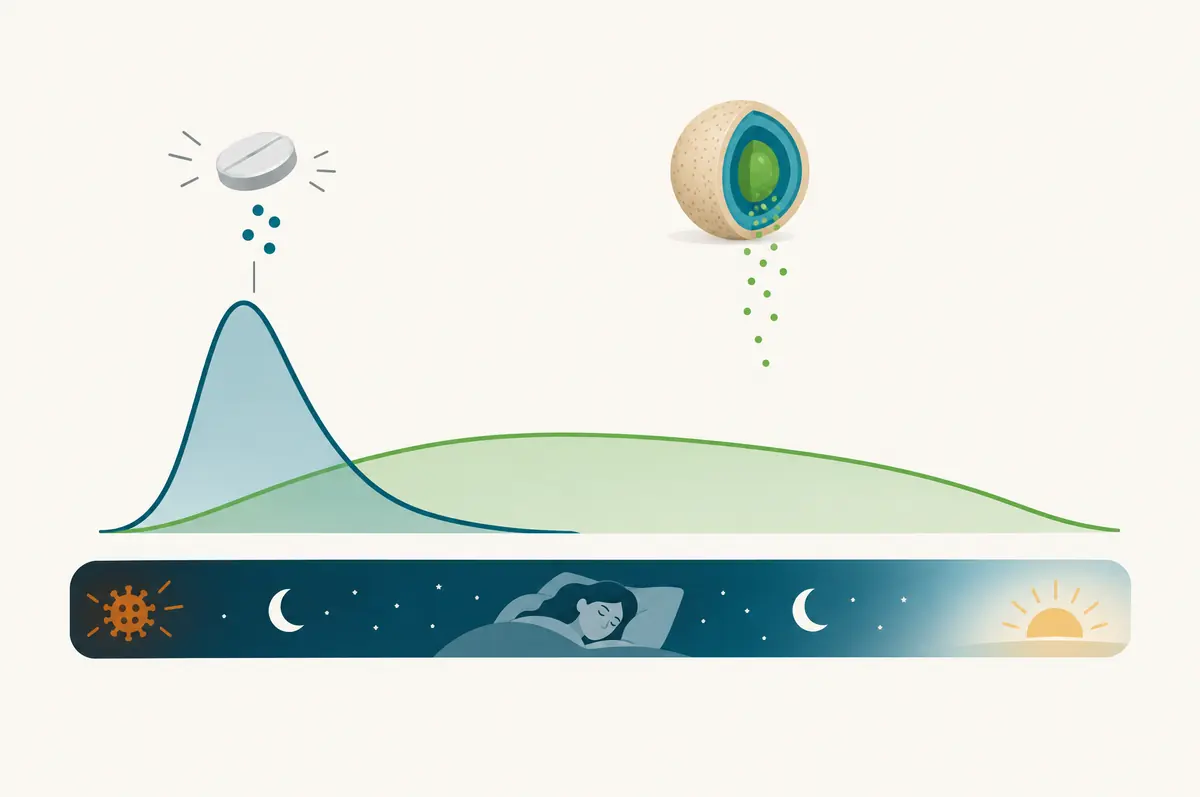
Melatonin's delivery problem is timing: oral bioavailability averages about 15% and its half-life is under an hour, so an immediate-release dose peaks and clears well before the night is over. It is a dietary supplement in the US and a prescription medicine in the EU.
What melatonin does
Melatonin (232 Da, N-acetyl-5-methoxytryptamine) is secreted by the pineal gland at night under control of the suprachiasmatic nucleus and signals darkness through MT1 and MT2 receptors. Exogenous melatonin shifts circadian phase depending on timing and has modest effects on sleep onset latency in trials. It is cleared mainly by hepatic CYP1A2 to 6-hydroxymelatonin, which is why fluvoxamine and other CYP1A2 inhibitors raise levels sharply. Its effects depend strongly on dose and timing relative to the internal clock.
Regulatory status
In the US melatonin is sold as a dietary supplement. In the EU, prolonged-release melatonin 2 mg (Circadin) is an EMA-authorized prescription medicine for short-term treatment of primary insomnia in patients aged 55 and over, and Slenyto is authorized for pediatric use in defined conditions. In Canada it is a natural health product. It is not on the WADA Prohibited List. Surveys have found supplement melatonin content ranging widely from label claims.
The delivery problem
Oral bioavailability is around 15% because of first-pass metabolism, with large between-person variation. Elimination half-life is roughly 40 to 60 minutes. Immediate-release doses produce high early peaks, often far above physiological night-time levels, and then fall away in the second half of the night. Melatonin is also light-sensitive and degrades in solution, which affects liquids and gummies. Excessively high doses can also cause residual next-morning levels in slow metabolizers. Variation between products compounds the problem.
Formulation routes in use
Prolonged-release matrix tablets, sublingual tablets and sprays, transdermal patches in research, and gummies. The approved EU product uses a prolonged-release matrix to mimic the endogenous profile. Each format sets different requirements. Sublingual forms aim for faster onset with partial avoidance of first pass. Liquids and gummies need protection from light, oxygen and heat, and content uniformity testing is essential because the dose is small. Prolonged-release products should show dissolution profiles over several hours. In markets where modified-release melatonin is regulated as a medicine, the formulation route decides the regulatory pathway.
Key facts
- Mean oral bioavailability of melatonin is about 15%, with wide individual variation (Harpsøe et al. 2015, Eur J Clin Pharmacol 71:901)
- Circadin 2 mg prolonged-release melatonin is authorized in the EU for primary insomnia in patients aged 55 and over (EMA, Circadin EPAR 2007)
- Melatonin content of 31 supplements ranged from minus 83% to plus 478% of the labeled amount (Erland and Saxena 2017, J Clin Sleep Med 13:275)
How our delivery technology applies
Melatonin is a release-profile problem, and layered encapsulation is built to program release. A fast outer layer can provide an initial fraction while inner layers release over several hours, flattening the peak and extending levels into the second half of the night. Shells also protect melatonin from light in liquid formats. Any such product must follow the regulatory classification of the target market, which for prolonged-release melatonin in the EU is a medicine.
Develop a programmed-release melatonin format for your market with Vegalab.