


Sublingual vs oral absorption
Last updated:
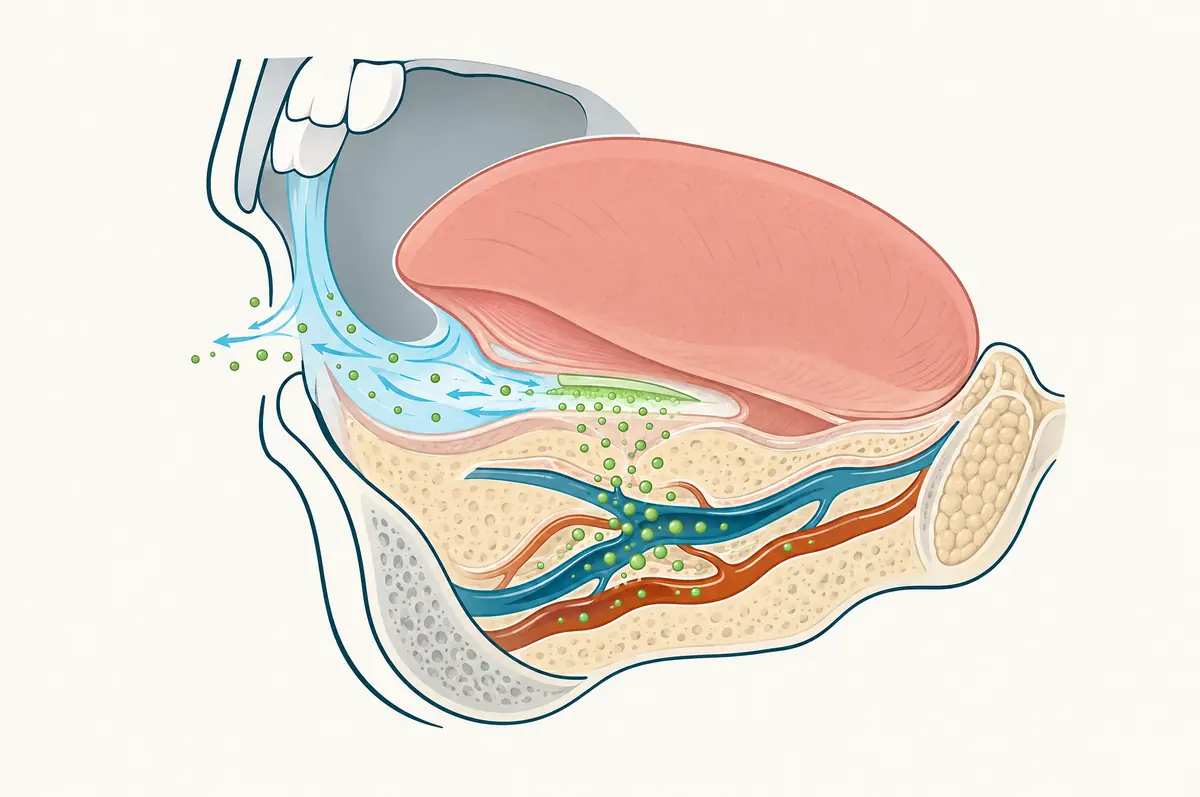
Sublingual absorption takes a drug through the thin, highly vascular tissue under the tongue straight into systemic circulation, bypassing the gut and the liver on first pass. A swallowed oral dose is exposed to that first-pass metabolism. The sublingual route suits small, potent, moderately lipophilic molecules, but saliva washout carries much of a dose to the stomach within minutes.
Sublingual and buccal routes send drug straight into systemic circulation, bypassing the gut and the liver on first pass. They work for small, potent, reasonably lipophilic molecules and struggle with anything large, polar or high dose. Saliva washout is the main enemy.
What limits sublingual and buccal absorption?
The sublingual mucosa is thin and highly vascular, which makes it fast but leaky: swallowing and saliva flow carry much of a dose to the stomach within minutes. Buccal mucosa is thicker and slower but tolerates a patch or film held in place for longer. Total surface area is small, so practical doses are milligrams, not grams. Molecules below about 500 Da with moderate lipophilicity absorb best; peptides absorb poorly without enhancers.
Which products show the sublingual route works?
Sublingual nitroglycerin, buprenorphine films, asenapine and fentanyl tablets show the route works for potent small molecules at low doses. Buccal insulin was studied for years without reaching approval in the US or EU, which marks the ceiling for peptides. In supplements, sublingual formats are common for melatonin and vitamin B12, although for many of these ingredients the absorbed fraction via the mucosa versus swallowing is rarely measured. The route is proven for drugs; for most supplement ingredients it is assumed.
Which design variables control sublingual performance?
Residence time, dissolution speed and taste govern performance. Orally dissolving films, lozenges and mucoadhesive tablets differ mainly in how long they hold the active against the mucosa. Formulators also control local pH, which changes the ionized fraction of weak acids and bases and therefore permeation. Taste masking is essential because the product dissolves in the mouth. Film and tablet disintegration times are measured in simulated saliva, and residence is assessed before any claim about sublingual absorption is made.
Key takeaways
- Sublingual and buccal routes bypass first-pass metabolism in the gut and liver.
- Sublingual mucosa is thin and fast; buccal mucosa is thicker and slower but holds a patch or film longer.
- Molecules below about 500 Da with moderate lipophilicity absorb best; peptides absorb poorly without enhancers.
- Saliva washout is the main limit on residence time.
- For most supplement ingredients, sublingual absorption is assumed rather than measured.
Key facts
- Sublingual mucosa is thinner and more permeable than buccal mucosa, but continuous saliva flow limits residence time (Shojaei 1998, J Pharm Pharm Sci 1:15)
- Buprenorphine and naloxone sublingual film is FDA approved, demonstrating systemic delivery by the sublingual route (FDA label, Suboxone film 2010)
- Oral melatonin undergoes extensive first-pass metabolism, with mean bioavailability about 15% (Harpsøe et al. 2015, Eur J Clin Pharmacol 71:901)
How our delivery technology applies
The limiting factor here is residence, not protection. A mucoadhesive outer biopolymer layer, such as chitosan or a cellulose derivative, holds encapsulated particles against the mucosa against saliva flow. Inner layers mask taste and control release so the active is presented at the surface over minutes rather than swallowed at once. For peptides the route remains a research question.
Questions
Is sublingual absorption faster than oral?
The sublingual mucosa is thin and highly vascular, which makes the route fast, and it delivers into systemic circulation without passing the gut and liver first. It is also leaky: swallowing and saliva flow carry much of a dose to the stomach within minutes.
What is the difference between sublingual and buccal delivery?
Sublingual delivery uses the thin, more permeable mucosa under the tongue, while buccal delivery uses the thicker mucosa of the cheek. Buccal absorption is slower but tolerates a patch or film held in place for longer. Continuous saliva flow limits residence time for both.
Do sublingual supplements absorb better than swallowed ones?
Sublingual formats are common for melatonin and vitamin B12, but for many of these ingredients the fraction absorbed through the mucosa versus swallowed is rarely measured. The route is proven for drugs such as sublingual nitroglycerin and buprenorphine films; for most supplement ingredients it is assumed.
Which molecules suit sublingual delivery?
Small, potent, reasonably lipophilic molecules, generally below about 500 Da. Large, polar or high-dose actives struggle, and peptides absorb poorly without enhancers; buccal insulin was studied for years without reaching approval in the US or EU.
Develop a sublingual or buccal format with Vegalab's team.