


Thymosin Alpha-1 and Thymalin
Last updated:
Thymosin alpha-1 is the only immunomodulatory thymic peptide with national drug approvals: as thymalfasin (Zadaxin) it is approved in a number of countries, mainly in Asia and Latin America, but not in the US or EU. Thymalin is a separate bovine thymus peptide extract used in Russia. Vegalab does not make, sell or source either.
What they are
Thymosin alpha-1 (Tα1) is a 28-amino-acid, N-acetylated peptide (about 3.1 kDa) derived from prothymosin alpha. It acts on toll-like receptor signaling in dendritic cells and T cells. Thymalfasin is the synthetic form. Thymalin is a polypeptide complex extracted from calf thymus and registered in Russia; its composition is less defined than a single synthetic peptide, and most of its literature is Russian-language. Evidence for Tα1 comes from clinical trials in hepatitis B and C and critical care settings, with mixed results across indications.
Regulatory status
Thymalfasin is approved in a number of countries for chronic hepatitis B and as an immune adjunct in certain settings. It is not approved by FDA or EMA; it has orphan designations in the US for specific indications. Thymalin has no approval outside Russia and some neighboring states. Neither is named on the WADA Prohibited List; athletes should confirm status with their anti-doping organization, because S0 applies to substances without current approval in any jurisdiction.
The delivery problem
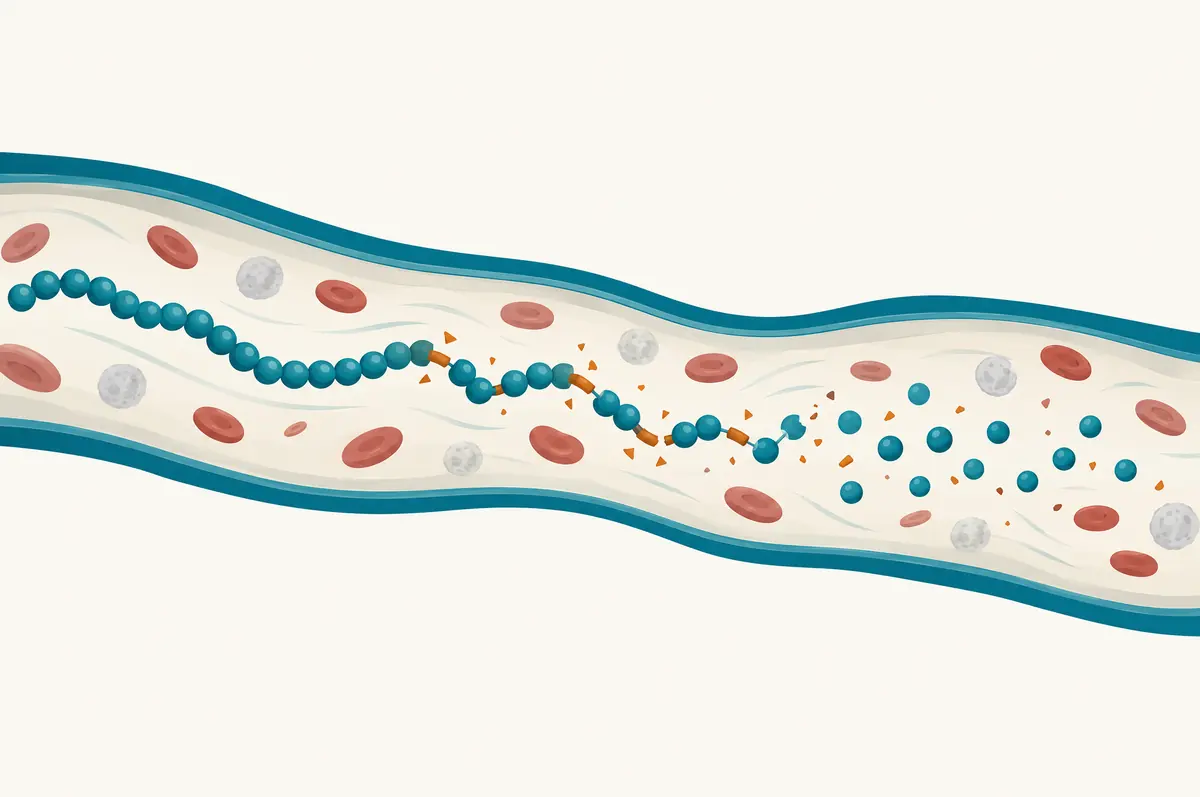
Tα1 is given by subcutaneous injection, typically twice weekly, because its plasma half-life is about two hours. It is highly acidic and unstructured in water, which makes it protease-sensitive, and oral bioavailability is negligible. Extended-release forms and PEGylated or fusion variants have been explored to reduce injection frequency. Injection frequency is the main patient burden. Stability of lyophilized product is good, but reconstituted solutions have limited shelf life. Adherence suffers with frequent injections.
Why this page exists
Tα1 is an example of an approved peptide whose delivery (frequent injections, short half-life) is the main limit on convenience. Thymalin is included because partners ask about it; it is a different product class. Russian thymic extracts and peptide bioregulators are marketed internationally, and partners frequently ask whether they are equivalent to thymalfasin. They are not: they differ in composition, manufacturing, evidence and regulatory status. Each would need separate assessment before any formulation work.
Key facts
- Thymosin alpha-1 has been studied as an immune modulator in viral infections, cancers and vaccine response, and is approved in over 30 countries (Dominari et al. 2020, World J Virol 9:67)
- Thymalfasin is not approved by FDA; its US status is limited to orphan drug designations (FDA Orphan Drug Designations database)
- Thymalfasin is given by subcutaneous injection and is rapidly cleared, with a plasma half-life of about 2 hours (Zadaxin prescribing information, SciClone Pharmaceuticals)
How our delivery technology applies
For an approved peptide with a two-hour half-life, the delivery opportunity is fewer injections. A multi-layer depot particle suspended in an injectable vehicle can release Tα1 over days while protecting it from tissue proteases at the injection site. That work suits a license holder in a market where thymalfasin is approved and a reformulation can be registered. It is a defined feasibility program.
License holders: scope a reduced-frequency peptide depot with Vegalab.