


LL-37
Last updated:
LL-37 is the only human cathelicidin antimicrobial peptide. It has been tested in early clinical trials as a topical agent for chronic wounds, but it is not approved for any use, and it is both protease-sensitive and cytotoxic at higher concentrations. Vegalab does not make, sell or source LL-37.
What LL-37 is
LL-37 is a 37-amino-acid, amphipathic, cationic peptide (about 4.5 kDa) cleaved from the precursor hCAP18 in neutrophils and epithelial cells. It disrupts bacterial membranes, neutralizes lipopolysaccharide and modulates immune signaling, chemotaxis and angiogenesis. Its effects are context-dependent: in psoriasis and rosacea, excess LL-37 and its fragments are implicated in inflammation. Its expression rises in skin and airways during infection and injury. The peptide forms helical structures on membranes, which underlies both its antimicrobial action and its toxicity to host cells at high levels. Serum proteins also bind LL-37 and reduce free activity.
Clinical and regulatory status
A randomized, placebo-controlled phase I/II trial of topical LL-37 in venous leg ulcers reported a faster healing rate at some doses, and later phase 2 development continued under the name ropocamptide. LL-37 is not approved by FDA or EMA. FDA placed it in 503A Category 2 in 2023 and in April 2026 announced its removal pending review, a compounding matter only. As a non-approved substance it falls under WADA S0.
The delivery problem
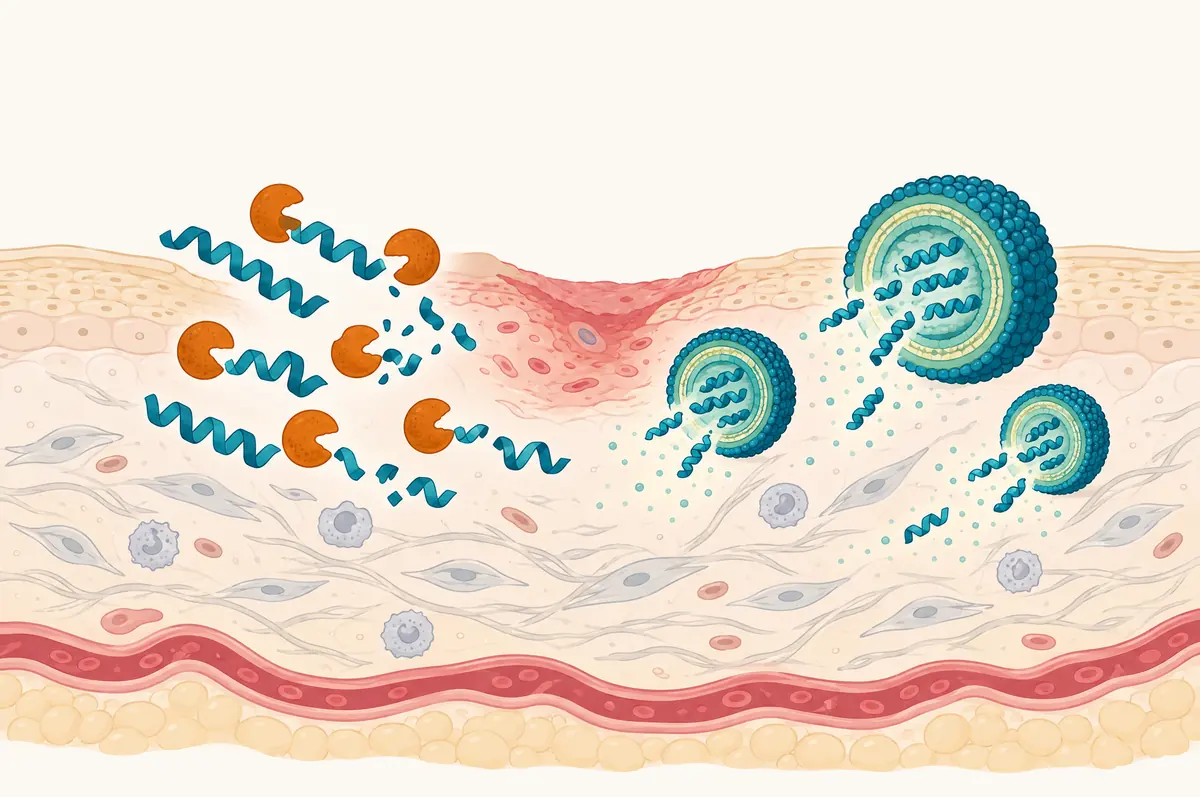
LL-37 is degraded by bacterial and host proteases in wound fluid, binds to wound matrix components that reduce its activity, and is toxic to human cells at concentrations not far above its antimicrobial range. Cost of synthesis for a 37-mer is high, so losses to degradation matter commercially. Systemic delivery is not a realistic route. Salt and serum proteins further reduce its antimicrobial activity in wound environments. Cost adds pressure to protect every molecule.
Formulation routes in research
Hydrogels, polymer nanoparticles (for example PLGA), lipid carriers and shorter engineered analogs have been tested to protect the peptide and reduce cytotoxicity. Truncated fragments and D-amino acid versions were designed to improve stability and reduce host toxicity. Most of this work is preclinical. Formulation choice also affects how much peptide binds to the carrier and is never released, which must be measured. Any product would be a drug requiring clinical approval.
Key facts
- Topical LL-37 was evaluated in a randomized, placebo-controlled phase I/II trial in venous leg ulcers (Grönberg et al. 2014, Wound Repair Regen 22:613)
- LL-37 is the sole human cathelicidin and has antimicrobial and immunomodulatory functions (Vandamme et al. 2012, Cell Immunol 280:22)
- Non-approved substances are prohibited at all times under S0 (WADA Prohibited List 2026)
How our delivery technology applies
LL-37 needs protection and dose control at the same time. A multi-layer particle shields the peptide from wound proteases and releases it gradually, keeping local concentration within the antimicrobial window and below the cytotoxic threshold rather than delivering a single high bolus. For partners running a clinical wound program, the testable endpoints are protease half-life, release kinetics and keratinocyte and fibroblast viability.
Partner with Vegalab on protease-protected topical peptide delivery.