


Oral Peptide Delivery: The State of the Art
Last updated:
Two peptides have been approved for oral use with permeation enhancers, and both land at roughly 1% bioavailability or less. Any program that assumes a carrier alone will move a peptide from injection to capsule is starting from the wrong premise.
The four barriers
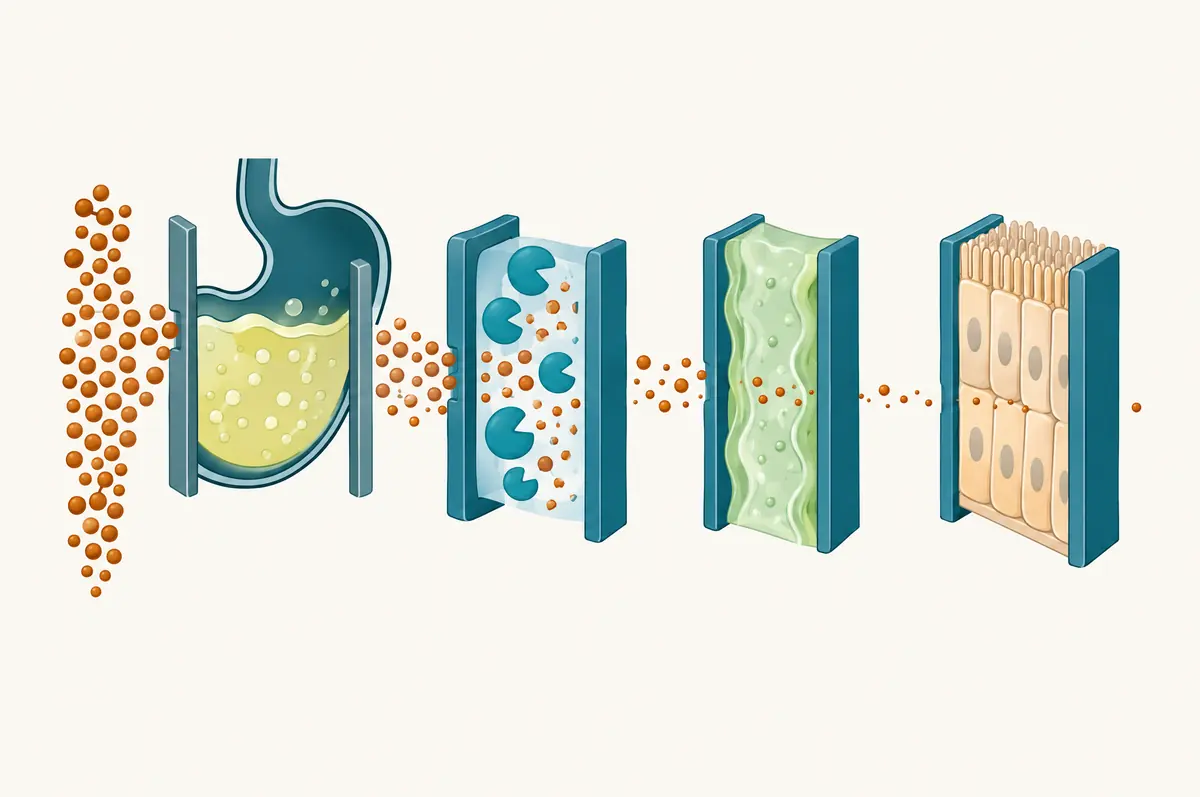
A peptide swallowed intact faces acid-catalyzed hydrolysis and pepsin in the stomach, then trypsin, chymotrypsin, elastase and carboxypeptidases in the small intestine, then brush-border and cytosolic peptidases at the epithelium. What survives must cross a mucus layer and then a tight epithelium that excludes hydrophilic molecules above a few hundred daltons through the paracellular route. Efflux transporters and hepatic first-pass metabolism remove part of the remainder. Each barrier multiplies, which is why fractions of a percent are the normal outcome rather than a formulation failure.
Bead-chain peptide cut by amber enzymes; then the same chain inside a multi-layer sphere, enzymes bounce off.
What approved products achieve
Oral semaglutide is co-formulated with sodium N-(8-[2-hydroxybenzoyl]amino) caprylate, known as SNAC, which raises local pH and transiently enhances gastric absorption. Absolute bioavailability is roughly 0.4 to 1%, and the label requires dosing on an empty stomach with no more than about half a glass of water and a wait before food or other medicines. Oral octreotide uses a transient permeation enhancer and also carries strict fasting conditions. Both prove the route is achievable and expensive, and both illustrate that variability, not average exposure, is the commercial problem.
Where encapsulation contributes
A multi-layer system can address the degradation and residence components directly: an acid-resistant outer layer to survive gastric transit, an inner matrix that excludes pancreatic proteases until release, and a mucoadhesive surface to hold the particle at the absorptive epithelium rather than in transit. Paired with a permeation strategy, it forms a complete oral design, and serious programs measure both exposure and variability.
How to judge a claim
Ask three questions of any oral peptide claim. Was there an intravenous reference arm, without which only relative bioavailability exists? Was intact peptide measured by mass spectrometry rather than an immunoassay that may detect fragments? And was a pharmacodynamic endpoint moved, not just a plasma curve produced? A claim that fails all three is a marketing statement. Fasting requirements and food effects belong in the assessment too, because a product that only works on an empty stomach carries a compliance burden that shows up in real-world results rather than in the trial.
Key facts
- Oral semaglutide with SNAC has absolute bioavailability of roughly 0.4 to 1% and requires fasted administration with limited water (FDA label, Rybelsus 2019)
- Oral octreotide capsules use a transient permeation enhancer technology and carry fasting administration requirements (FDA label, Mycapssa 2020)
- Paracellular transport across intestinal tight junctions is effectively limited to small hydrophilic molecules, excluding most peptides (Drucker 2020, Nat Rev Drug Discov 19:277)
- Absolute bioavailability cannot be stated without an intravenous comparison arm (FDA guidance, Bioavailability Studies Submitted in NDAs or INDs: General Considerations, 2022)
How our delivery technology applies
Vegalab's contribution to an oral peptide program is protease shielding and residence time. Layer assignment lets the gastric barrier, the pancreatic protease barrier and mucoadhesion be solved separately, so the surviving fraction reaching the epithelium rises. Epithelial transport is scoped as its own work package, so each gain is measured and attributable.
Discuss an oral feasibility study with our formulation team.