


Intranasal Delivery
Last updated:
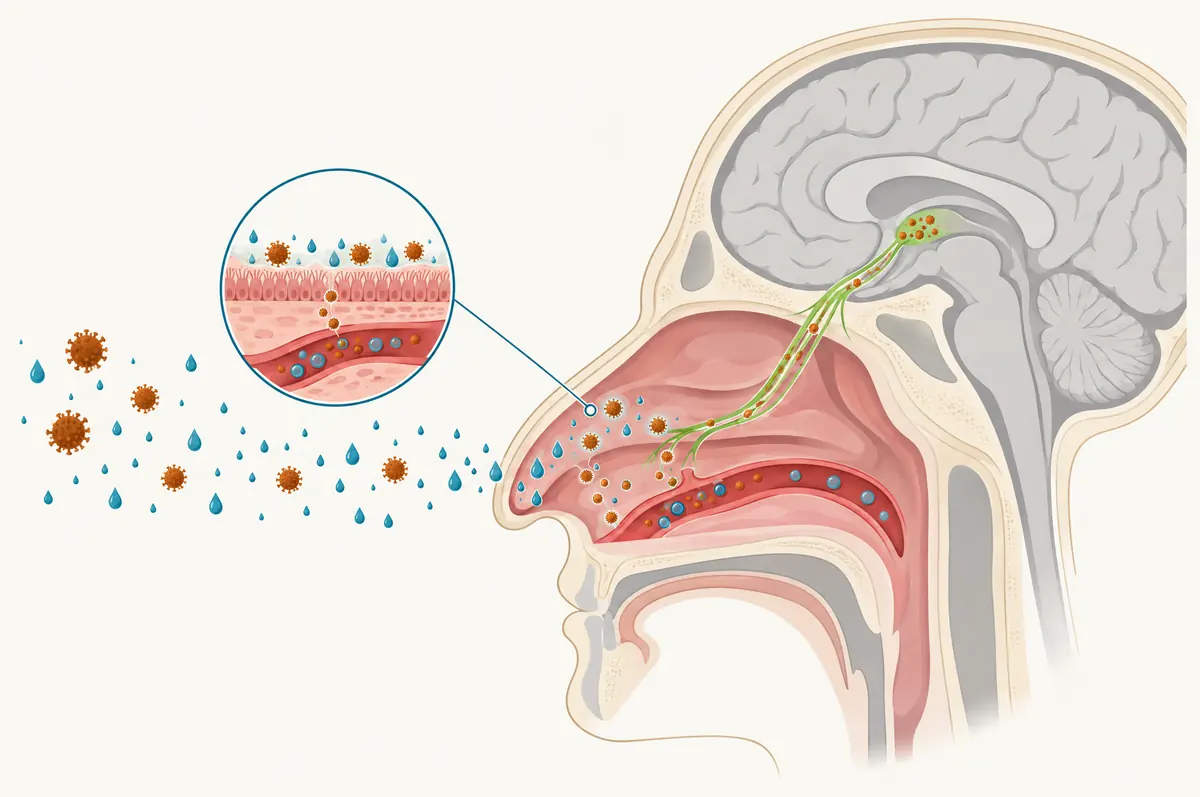
The nose absorbs fast and avoids first-pass metabolism, and a fraction of a nasal dose can reach the brain along olfactory and trigeminal nerves. The constraints are tight: about 100 to 150 microliters per nostril, clearance within minutes, and local peptidases. Several approved products prove the route; many research claims overstate it.
Physiology
The nasal cavity has roughly 150 square centimeters of highly vascular mucosa. Mucus is swept toward the throat by cilia, clearing deposited material from the respiratory region in about 15 to 20 minutes. The olfactory region at the roof of the cavity is small and hard to reach with a standard spray. Molecular size limits absorption: small lipophilic drugs absorb well, while peptides above about 1 kDa typically achieve low single-digit bioavailability without enhancers.
Approved nasal products
Desmopressin and calcitonin show peptides can be delivered nasally at low doses. Naloxone (Narcan) and esketamine (Spravato) demonstrate rapid systemic and central effects. Semax and Selank are registered as nasal medicines in Russia only. Oxytocin nasal is used in research; in several markets it is approved for obstetric use by injection, not nasal. Each approved nasal product required a full drug program including device and spray characterization. That history sets the evidence bar for any new nasal product.
Design and regulatory notes
Formulators control viscosity, pH near 5.5 to 6.5, osmolality and device plume to target deposition. Mucoadhesive polymers such as chitosan extend residence. Nasal sprays with pharmacological actives are medicines in virtually every market, and nasal products are held to device and droplet-size testing. There is no meaningful supplement pathway for nasal peptide sprays. Nasal formats sit in the drug category by default, so any Vegalab nasal work runs with a licensed sponsor under a drug development plan.
Key facts
- Nasal volume is about 15 to 20 mL with roughly 150 cm2 surface area, and mucociliary clearance limits residence to about 15 to 20 minutes (Illum 2003, J Control Release 87:187)
- Chitosan improves nasal absorption of polar drugs and peptides through mucoadhesion and transient tight junction opening (Illum 2003, J Control Release 87:187)
- Intranasal administration can deliver agents to the CNS via olfactory and trigeminal pathways (Lochhead and Thorne 2012, Adv Drug Deliv Rev 64:614)
- Naloxone nasal spray was FDA approved for emergency treatment of opioid overdose in 2015 (FDA label, Narcan 2015)
How our delivery technology applies
Nasal delivery fails mainly on residence and enzymatic loss. A mucoadhesive outer layer extends contact against mucociliary clearance, and inner layers shield a peptide from nasal peptidases while releasing it at the surface. Particle size must stay compatible with spray devices and deposition targets. Vegalab treats any nose-to-brain claim as requiring measured tissue data.
Licensed sponsors: explore an intranasal delivery program with Vegalab.