

Last updated:
The Asian citrus psyllid (Diaphorina citri) is an aphid-sized, mottled brown insect that feeds on new citrus leaves and spreads the bacterium associated with huanglongbing (HLB), or citrus greening, a fatal citrus disease with no known cure.1 Control combines regular inspection of new flush, reporting finds in new areas, ant control, natural enemies such as Tamarixia radiata, and insecticides used as the label directs.1,2
How do you identify the Asian citrus psyllid?
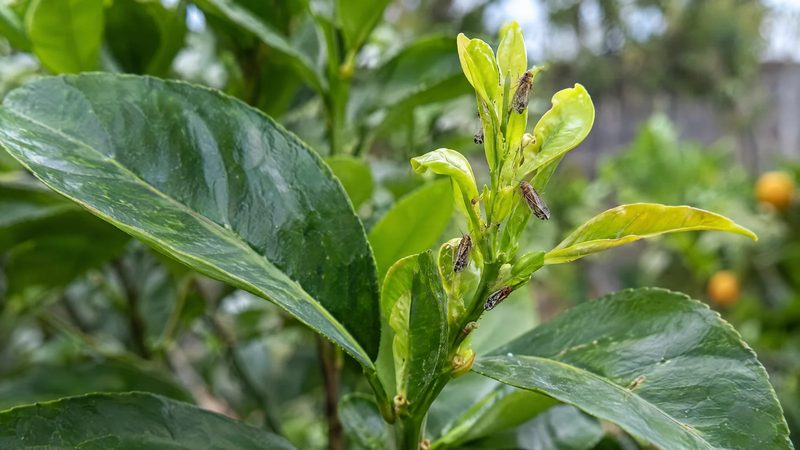
The Asian citrus psyllid (Diaphorina citri) is a small insect about the size of an aphid.1 Adults are 1/6 to 1/8 inch long with a pointed front end, red eyes and short antennae, and the wings are mottled brown around the outer edge except where a clear stripe breaks the pattern at the back.1 A living adult is covered with a whitish, waxy secretion that makes it look dusty.3 The adult feeds with its head down, almost touching the leaf, and its body raised at about 45 degrees, a posture no other citrus pest uses.1
Psyllids are most often confused with aphids on tender citrus leaves, but adult psyllids are active jumpers while aphids are sluggish, psyllid antennae usually have 10 segments, and psyllids lack the cornicles found on most aphids.3 Eucalyptus, tomato and Eugenia psyllids also turn up in gardens; the Asian citrus psyllid is told apart by its interrupted brown wing band, its body tilt and, in nymphs, the shape of its waxy tubules.1
| Stage | What it looks like | Where to find it |
|---|---|---|
| Egg | Tiny, yellow-orange, almond shaped, about 0.3 mm | Folds of unexpanded new leaves (feather flush) |
| Nymph (five instars) | Flattened, wingless, yellow-orange; red eyes in later instars; curly waxy tubules with a bulb at the end | Feather flush and young green stems only |
| Adult | 1/6 to 1/8 inch, mottled brown wings, tail raised at about 45 degrees | New flush, and mature leaves outside the flushing season |
In North America, mature citrus produces most new flush in spring and fall, when psyllids lay eggs and inspection matters most1, and California orchard programs treat from August through November and again in winter before spring flush2. In the Southern Hemisphere, the spring flush falls from about September to November and the fall flush from about March to May.
What is the life cycle of the Asian citrus psyllid?
Eggs hatch in 3 to 4 days at 75 to 85°F, slightly longer in cooler weather, and the five nymphal stages take 12 to 14 days.4 The full life cycle takes 15 to 47 days depending on the season, and the psyllid has 9 to 10 generations a year, with 16 observed in field cages.3 There is no diapause, although populations are low in winter.3 Adults live 30 to 50 days under ideal temperatures, longer when it is cool, and a female can lay 500 to 800 eggs.4
Nymphs can only grow on feather flush and young green stems, so populations rise with new growth.2 Mature citrus trees produce most new growth in spring and fall, while young trees and lemons flush periodically year round in warm weather.1 High heat slows the pest: nymphal development slows at 104°F, and 3 or more hours a day at 108°F kills nymphs.2
The psyllid feeds on all citrus varieties and on close relatives in the Rutaceae family, including calamondin, box orange, Indian curry leaf and orange jasmine.1 It reproduces faster on Murraya species, so UC IPM advises removing them in or near orchards.2 It was first found in the United States in 1998 in Palm Beach County, Florida, on orange jasmine, and in California in 2008.1
How does the psyllid spread citrus greening (huanglongbing)?
The psyllid is a vector of the bacterium Candidatus Liberibacter asiaticus, associated with huanglongbing (HLB), also called citrus greening.1 It takes up the bacterium while feeding on an infected plant and passes it on when it flies to a healthy one, and only a few psyllids are needed to spread the disease.1 Acquiring the bacterium takes an hour or more of feeding.4 Symptoms can take one to several years to appear, while nymphs that pick up the bacterium can spread it as adults only a few weeks after a tree is infected, so a healthy-looking tree is not proof of freedom from HLB.1
HLB can kill a citrus tree in as little as 5 years, all commonly grown varieties are susceptible, and there is no known cure.1 In Florida, HLB was first detected in 2005, and production has declined since; the 2016 to 2017 orange forecast of 67 million boxes was the smallest harvest in 53 years.7 In California, the first HLB tree was found in a Los Angeles County home garden in 2012.1
Direct feeding damage matters less: nymphs inject a salivary toxin that can twist, curl or kill new shoots and leaves a characteristic notch in leaves that mature, and honeydew supports sooty mold.1 Leaf twisting alone does not harm trees, but the death of new growth slows trees younger than 5 years.1
| Sign | Psyllid or HLB cause | Lookalike causes |
|---|---|---|
| Asymmetrical, blotchy yellow mottling on leaves, often on one limb or sector | HLB | Zinc and other nutrient deficiencies, which yellow symmetrically on both sides of the midvein |
| Twisted, curled or notched new leaves | Psyllid nymph feeding | Aphids, citrus leafminer and citrus thrips |
| Honeydew and black sooty mold | Psyllid nymphs | Aphids, whiteflies and soft scales |
How do you check citrus trees for psyllids?
UC IPM advises checking trees monthly from spring through fall, looking for eggs, nymphs and adults on newly forming leaves.1 Walk slowly around each tree and inspect the flush for twisted or notched leaves, waxy tubules, honeydew, sooty mold and adults, then use a hand lens for eggs and nymphs.1 Eggs and nymphs do not fly, so monitoring works best on these stages in citrus flush.1 Yellow sticky cards detect adults but generally do not estimate field populations.2
In orchards, UC IPM recommends combining visual flush inspection with tap sampling every 2 weeks, sampling 10 trees on each border and 10 in the center, because psyllids concentrate along edges.2 In California, finds in central or northern areas where the psyllid is not established should be reported to the county agricultural commissioner or the California Department of Food and Agriculture Exotic Pest Hotline.1 Quarantines restrict movement of citrus plants, so do not move citrus plants or clippings out of your area and buy trees from reputable local nurseries.1
How do you control the Asian citrus psyllid on backyard citrus?
Control ants first, because ants farm psyllid honeydew and protect nymphs from predators and parasites, and the Argentine ant can significantly reduce parasitoid attack rates.1 The parasitoid wasp Tamarixia radiata, which poses no threat to people, lays eggs under psyllid nymphs and leaves hollowed-out mummies.1 Since releases began in southern California in 2011, it has reached parasitism rates as high as 70% where established, and psyllid numbers there have fallen by at least 75%.2 It has not eradicated the pest or halted HLB, so other measures are still needed.1 Syrphid fly larvae, drawn to sweet alyssum plantings, are key predators of nymphs.2
Oils, insecticidal soap and neem oil can reduce psyllids with lower risk to beneficial insects, but they persist briefly, must contact the insect and need repeat applications every 7 to 14 days while psyllids are present.1 UC IPM also lists longer-lasting broad-spectrum foliar sprays and a systemic soil drench for home use; these are toxic to honey bees, so do not apply them while citrus is in bloom.1 Choose a product labeled for citrus, cover the undersides of leaves and new growth, and follow the product label.1 Where HLB is spreading in residential areas, UC IPM suggests considering removal of backyard citrus trees near infected trees.1
How do commercial citrus growers manage the psyllid?
No single insecticide fully controls the Asian citrus psyllid, because eggs and nymphs are tucked inside new foliage and adults fly well.2 In established areas of California, growers apply insecticides through coordinated areawide programs, with the most important timing in late summer through fall (August through November) and a second window in winter, before spring flush.2 Rotating insecticide modes of action delayed resistance in a Florida field study, while five consecutive applications of dimethoate raised the resistance ratio to more than 34 times the pre-treatment field population.7
Landscape matters: adult psyllids find host trees mainly by sight, can immigrate from several kilometers away, and management works best with large-area cooperation and border surveillance and treatment.5 In California, commercial groves that were larger, had more edge or more perforated shapes, or sat in more urbanized landscapes were invaded faster, and distance to urban or other grove detections was among the most important predictors.6 Physical barriers of 50-mesh netting at least 12 feet tall, living windbreaks, reflective mulches and kaolin particle films can each reduce psyllid pressure, though each has limits, such as secondary pest outbreaks under particle films, and pruning or nitrogen that pushes new flush is best timed for summer or winter, when psyllids are least active.2
Key takeaways
- The Asian citrus psyllid (Diaphorina citri) feeds with its tail raised at about 45 degrees, a posture no other citrus pest shares.
- Its main threat is spreading the bacterium associated with huanglongbing (citrus greening), which has no cure and can kill a tree in as little as 5 years.
- Inspect new flush monthly from spring through fall and report finds in areas where the psyllid is not established.
- Controlling ants lets Tamarixia radiata and syrphid fly larvae suppress nymphs; oils and soaps need repeat applications and full coverage.
- Orchard programs depend on areawide timing, rotating modes of action and border management.
References
- Pest Notes: Asian Citrus Psyllid and Huanglongbing Disease (UC ANR Publication 74155)
- UC IPM Pest Management Guidelines: Citrus, Asian Citrus Psyllid (UC ANR Publication 3441)
- Asian Citrus Psyllid, Diaphorina citri Kuwayama (Insecta: Hemiptera: Psyllidae) (EENY-033)
- Citrus Pest Quick Guide: Asian Citrus Psyllid (Diaphorina citri Kuwayama) (ENY-1004)
- Ecological Aspects of the Vector-Borne Bacterial Disease, Citrus Greening (Huanglongbing): Dispersal and Host Use by Asian Citrus Psyllid, Diaphorina citri Kuwayama
- Quantifying Spillover of an Urban Invasive Vector of Plant Disease: Asian Citrus Psyllid (Diaphorina citri) in California Citrus
- Resistance Management for Asian Citrus Psyllid, Diaphorina citri Kuwayama, in Florida