

Last updated:
Sooty mold is a black, soot-like coating of fungi that grow on honeydew excreted by sap-sucking insects such as aphids, whiteflies, soft scale and mealybugs. It does not infect the plant. Remove it by managing the honeydew-producing insect and the ants that protect it, wash the film off where appearance matters, and let rain and new growth clear the rest.
Crops affected
How do you identify sooty mold?
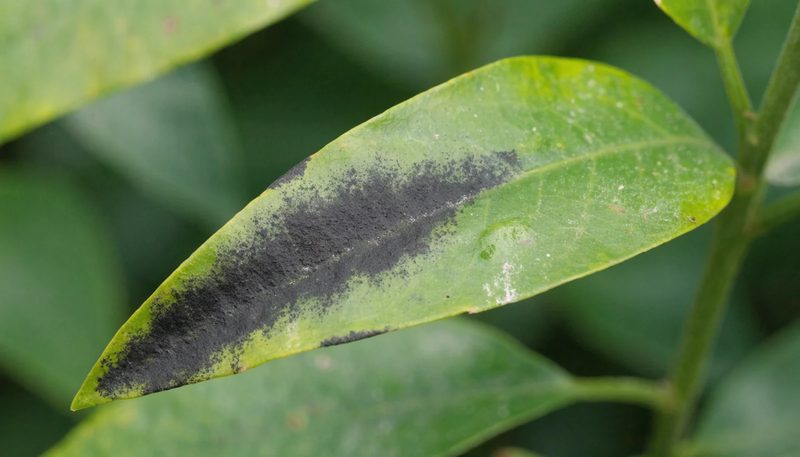
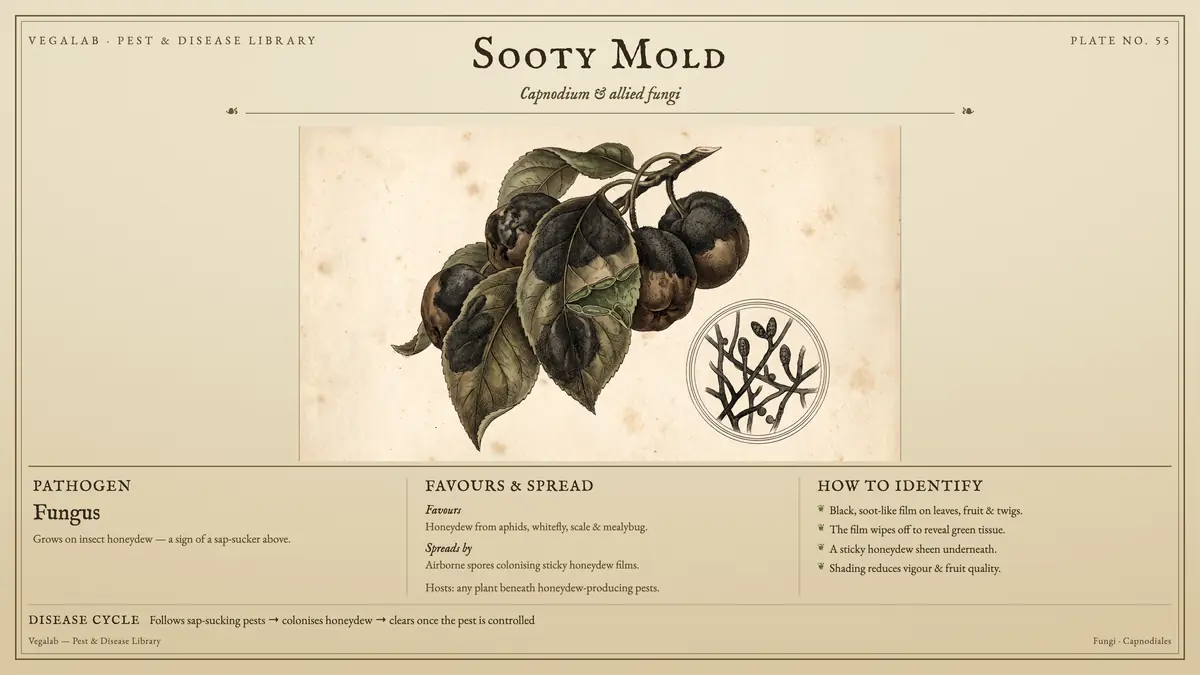
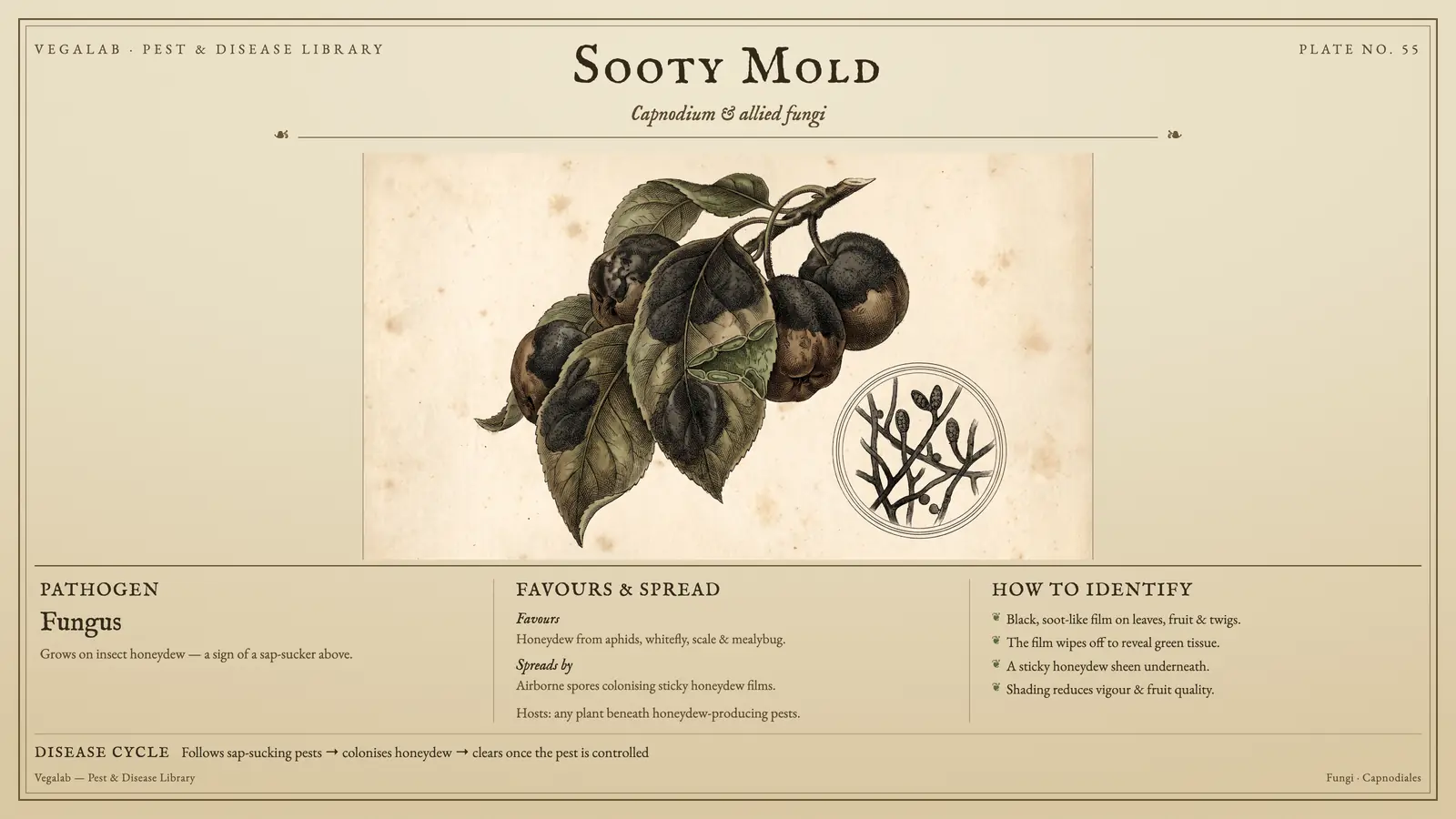
- The film wipes off to reveal green tissue.
Disease cycle. Follows sap-sucking pests → colonizes honeydew → clears once the pest is controlled
What is sooty mold?
Sooty mold fungi don't infect the plant - they grow on the sugary honeydew that sucking insects deposit on leaves and fruit. So sooty mold is a symptom of an insect problem; control the insect and the mold stops.
What does sooty mold look like?
- Black, dry, soot-like coating on leaf surfaces, stems and fruit that can be rubbed off.
- Sticky honeydew underneath, and colonies of aphids, whiteflies, scale or mealybugs nearby (often with ants).
- Reduced light reaching leaves; fruit blemished and downgraded.
- Decline in vigor where heavy coating blocks photosynthesis.
How does sooty mold spread?
The mold grows whenever honeydew is present and stops producing new growth once the honeydew source (the insects) is removed; old coating weathers and flakes off over time.
What conditions favor sooty mold?
Active populations of aphids, whiteflies, scale or mealybugs; ant activity that protects those insects; still, humid conditions.
How does sooty mold affect the crop?
Blocks light and reduces photosynthesis; blemishes and downgrades fruit and ornamentals; indicates an underlying sucking-pest infestation that is itself damaging the crop.
How do you trace sooty mold to its source?
Trace sooty mold back to the honeydew producer; scout for aphids, whiteflies, scale and mealybugs and for ant trails; target the insect, not the mold.
How do you control sooty mold?
- Control the honeydew-producing insects (the root cause);
- manage ants that protect them;
- once the insects are controlled, the mold stops growing and weathers off, and washing/rain speeds removal.
How do you get rid of sooty mold?
- Find and manage the insect producing the honeydew. This is the whole answer. Aphids, whitefly, soft scale, mealybugs and psyllids are the usual sources; identify which and manage it, and the mold stops being replenished.
- Do not apply fungicide. The fungus is not parasitising the plant and is growing on a sugar film; killing it does nothing about the honeydew that will simply be recolonised.
- Control ants, which farm honeydew-producing insects and defend them from predators - often the reason an infestation persists.
- Wash it off where appearance matters. A soap-and-water wash or a firm water spray removes the film from fruit and ornamental foliage; on fruit crops this is routinely done at packing.
- Let rain and new growth do the rest. Once the insect is managed, existing mold weathers away and new growth emerges clean.
- Reduce nitrogen where growth is soft and lush, since that is what supports the sap-feeder populations in the first place.
- Protect natural enemies · parasitoids and predators of the honeydew producers are what keep this problem rare in unsprayed systems.
Sooty mold is the only entry in this library where treating the visible problem is entirely the wrong response. It is a symptom of an insect infestation, not a disease, and fungicides are essentially irrelevant to it.
If sooty mold keeps returning after washing, the insect was never dealt with. The mold is a reliable indicator that a sap-feeder population is active above it.
The damage it does · and does not do
- It does not infect the plant. There is no penetration, no lesion, no vascular involvement. Tissue beneath a mold film is undamaged.
- It does block light. Heavy coverage reduces photosynthesis measurably, and on a severely affected crop that translates into reduced growth and yield - an indirect but real effect.
- It downgrades fruit. On citrus, mango, avocado, olives and ornamentals the cosmetic loss is the main commercial cost, and washing at packing adds handling expense.
- It signals a bigger problem. The insects producing the honeydew are doing their own damage - sap removal, growth distortion, and in many cases virus transmission - which is usually more costly than the mold.
- It can cause premature leaf drop in heavy long-standing cases, through the combined effect of shading and the insect feeding.
Sooty mold is often dismissed as purely cosmetic and often overstated as a disease. Both are wrong in specific ways worth understanding.
The economic case for acting is usually driven by the insect and by fruit finish, not by the fungus itself.
Which insect is producing the honeydew?
- Aphids: soft-bodied colonies on growing points and leaf undersides; often the fastest to appear and the fastest to resolve
- Whiteflies: tiny white adults flying up when disturbed; flat scale-like nymphs on leaf undersides
- Soft scale: immobile leathery domes on stems and leaves that come away with the insect; abundant honeydew - armoured scale produces none, so scale plus sooty mold means soft scale
- Mealybugs: white mealy waxy insects in leaf axils, under bark and in crowns
- Psyllids: small jumping insects, often with waxy filaments; vectors of serious diseases in citrus and potato
- Leafhoppers and planthoppers: wedge-shaped, fast-moving; some species produce honeydew
Deeper entries: Aphids, Whiteflies, Scale Insects, Mealybugs, Leafhoppers. The absence of honeydew rules out soft scale and points to armoured scale or a non-honeydew pest.
How is sooty mold different from sooty blotch and sooty spot?
- Sooty mold: honeydew present, insects above, wipes off, treat the insect
- Sooty blotch / flyspeck: apple and pear fruit, no honeydew, humid seasons, treat with canopy management and cover
- Sooty canker / spot / stripe: genuine tissue pathogens · diagnose individually
- Quick check: is the surface sticky, and is there a sap-feeder above it?
The word sooty attaches to several unrelated problems, and because the recommended response differs completely it is worth separating them.
Sooty mold - this entry - grows on insect honeydew, does not infect the plant, and is resolved by dealing with the insect. It wipes off, and the tissue beneath is sound.
Sooty blotch and flyspeck is a complex of fungi that colonize the waxy cuticle of apple and pear fruit in humid conditions. It does not need honeydew and is not insect-related at all: it is favored by long periods of high humidity, dense canopies and extended wet seasons, and it is managed by canopy opening, summer pruning and cover through humid periods. It is a cosmetic downgrade on fresh-market fruit and can usually be removed by brushing or washing at packing.
Sooty spot, sooty canker and sooty stripe are names attached to genuine pathogens on various hosts - real infections of tissue that need to be diagnosed and managed on their own terms.
The practical test for sooty mold specifically is whether there is honeydew and an insect above the affected surface. If there is, treat the insect. If there is not - particularly on apple or pear fruit in a humid season - the more likely diagnosis is sooty blotch and flyspeck, and the response is canopy and humidity management rather than insect control.
Getting this distinction wrong means either treating insects that are not there, or waiting for an insect problem to resolve a fungal one that has nothing to do with insects.
Recommended Vegalab solution: Spider Mite Control
Spider Mite Control · all-natural contact product (geraniol with peppermint, cottonseed and rosemary oils) to control the aphids, whiteflies, scale and mealybugs that produce the honeydew; once they're controlled, sooty mold stops growing.
| Role | Product | Use |
|---|---|---|
| Primary control | Spider Mite Control |
How do you prevent sooty mold next season?
Keep honeydew-producing pests in check, manage ants, and maintain airflow; preventing the insect prevents the mold.
Key takeaways
- Sooty mold is a symptom of an insect infestation, not a disease, so fungicides are irrelevant to it.
- Tissue beneath the film is undamaged, but heavy coverage blocks light and reduces photosynthesis.
- Scale plus sooty mold means soft scale: armored scale produces no honeydew.
- If the mold keeps returning after washing, the insect was never dealt with.
- Ants farm honeydew producers and defend them from predators, often the reason an infestation persists.
Claims and product availability vary by jurisdiction. Always read and follow the product label.