


Last updated:
The Colorado potato beetle (Leptinotarsa decemlineata) is a 3/8 inch yellowish beetle with five black stripes on each wing cover, and its humpbacked red larvae can strip potato, eggplant and tomato foliage.1,2 Control combines crop rotation, straw mulch and handpicking with well-timed sprays of Bt tenebrionis, spinosad or azadirachtin on small larvae, rotating modes of action and following the product label.2,4
How do you identify the Colorado potato beetle?
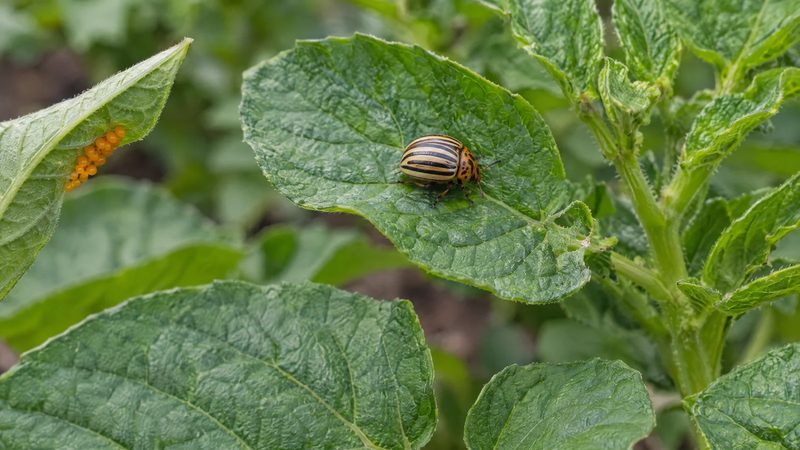
Adult Colorado potato beetles (Leptinotarsa decemlineata), often called potato bugs, are robust, oval beetles about 3/8 inch long.1,4 They are yellowish orange with five black stripes on each wing cover, a triangular black spot on the head and irregular dark markings on the thorax.1
Eggs are bright orange to yellow, football-shaped and laid upright in clusters on the underside of leaves, usually 20 to 60 per cluster, so a mass looks like a bunch of small sausages standing on end.1,2 Larvae are plump and humpbacked with two rows of black spots along each side; young larvae are crimson, large larvae turn orange, and mature larvae reach about 1/2 inch.1,2,3
The false potato beetle (Leptinotarsa juncta) is a close lookalike found mainly in the eastern United States.1 It feeds mainly on horse-nettle and other wild nightshades, and it is not considered a major pest.1,2 The table shows how to separate them.
| Feature | Colorado potato beetle | False potato beetle |
|---|---|---|
| Wing cover stripes | Stripe 1 short; stripes 2 to 5 long and distinct | Stripe 2 short; stripes 3 and 4 joined at the tip |
| Pits on wing covers | Coarse, in irregular rows | Coarse, in very regular rows |
| Legs | Mostly dark, no black spot | Mostly orange, black spot on the femur |
| Larvae | Reddish, two rows of black side spots | Paler, almost white, one row of spots |
| Main hosts | Potato, eggplant, tomato and other nightshades | Horse-nettle and other wild nightshades |
| Pest status | Major pest of potato and eggplant | Not considered a major pest |
In North America overwintered adults emerge in early May in Pennsylvania and egg-laying runs from early to late June, with summer adults appearing in late July and August and later adults entering the soil to overwinter after mid-August3; in eastern Virginia egg-laying starts by early May and larvae peak in mid to late May2. The beetle's recorded range covers North and Central America, Europe and parts of Asia1, so no Southern Hemisphere season is given here; where potatoes are grown south of the equator, spring emergence timing would run about six months offset.
What plants does the Colorado potato beetle damage?
Potato is the preferred host, but the beetle feeds and survives on many other members of the nightshade family, including eggplant, tomato, ground cherry, horse-nettle, nightshades, tobacco, its first recorded host buffalo-bur, and rarely pepper.1 It is a major pest of potato and eggplant and a minor pest of tomato.2 In Pennsylvania, pressure is usually much greater in eggplant and potatoes than in tomatoes, and in one study a summer generation did not develop on tomatoes but did on neighboring potatoes.3
Adults and larvae feed on foliage in the same way.2 Early adults can clip small tomato or eggplant transplants and emerging potato shoots at ground level, and large third and fourth instar larvae and first generation adults do the most damage.2 Heavy populations completely defoliate plants and then feed on stems, reducing tuber and fruit yield.2 Potatoes are most sensitive during tuber formation, which coincides with flowering, and less so during vegetative growth.3 Plants can lose up to 30% of their foliage without yield loss.4
What is the Colorado potato beetle life cycle?
Adults overwinter in the soil and emerge in spring as temperatures rise.4 In spring they find host plants mostly by walking, but they can fly long distances when temperatures exceed 80°F.2 Overwintered adults feed for five to ten days before mating, and each female can lay 500 or more eggs over four to five weeks.1,4
Eggs hatch in four to nine days, larvae feed in groups through four instars over two to three weeks, and mature larvae drop to the soil to pupate for five to ten days.2,4 The beetle can go from egg to adult in as little as 21 days.4 There are one to three generations a year depending on latitude; Pennsylvania has two.1,3 Adults that emerge after mid-August usually feed briefly and then burrow into the soil or fly to woodlot edges to overwinter.3
| Stage | Where to find it | Approximate duration |
|---|---|---|
| Overwintering adult | In the soil of last year's field or nearby woodlot edges | Emerges in spring; feeds 5 to 10 days before mating |
| Egg | Clusters on leaf undersides | 4 to 9 days |
| Larva (four instars) | Feeding in groups on foliage | 2 to 3 weeks |
| Pupa | In the soil under the plant | 5 to 10 days |
| Summer adult | On foliage; later adults enter the soil | Starts a second generation or overwinters |
Why is the Colorado potato beetle so hard to control?
The beetle is notorious for developing resistance to insecticides that are used repeatedly.4 The first case was resistance to DDT in 1952, and since the middle of the last century it has developed resistance to more than 55 insecticides, including organophosphates, pyrethroids, neonicotinoids and spinosad.6 A 2020 review counts resistance to 56 compounds across all major insecticide classes.5 Resistance varies from field to field, so a product that fails in one location may still work nearby.4
Many control failures also come from timing and coverage rather than resistance alone.4 Overwintering beetles arrive over several weeks, so an early spray hits only part of them, while waiting until larvae are nearly full grown also raises the chance of failure; small larvae are much easier to control.4 Rotating among insecticide classes, switching IRAC mode of action groups with each application, slows resistance, and the IRAC group appears on the front of most commercial labels.4
How do you control Colorado potato beetles without insecticides?
Cultural control is the foundation, because the beetle feeds only on nightshades and walks into fields in cool weather.2 These tactics have the strongest support:
- Crop rotation: move potatoes, tomatoes and eggplant away from last year's plantings. A field 1,500 feet away can delay infestation by about seven days, and 1/4 to 1/2 mile is best where possible.3
- Straw mulch: a thick layer spread after planting creates a barrier to adult beetles in small potato plantings, and no-till or straw mulch has worked in several tomato studies.2,3
- Handpicking: picking adults and immature stages by hand helps delay resistance and is especially useful against overwintered beetles arriving at young plants.4 In home gardens, handpicking and row covers are effective.3
- Trenches: plastic-lined trenches at least 12 inches deep with sides sloped at 46 degrees or more, placed where overwintered adults walk in, are effective early in the season.2 Trenches with a 45 degree or steeper slope can capture 50% or more of the beetles.1
- Natural enemies: the spined soldier bug, two-spotted stinkbug, the ladybird beetle Coleomegilla maculata and Lebia ground beetles eat eggs or larvae, a tachinid fly parasitizes late-season beetles, and the fungus Beauveria bassiana can kill many pupae and overwintering adults.1,2 On their own they do not hold large populations below damaging levels.1,2
Which sprays work on Colorado potato beetles in the garden?
Spray only when numbers justify it. Kentucky guidance is that insecticides are generally not needed unless there is more than an average of one beetle or larva per plant.4 Penn State bases potato thresholds on large larvae and adults, the stages it calls big eaters, with a much lower threshold during flowering.3
Options for organic growers include spinosad, azadirachtin products and products containing Bacillus thuringiensis subsp. tenebrionis (Btt).2 Btt works on small larvae under 1/4 inch and should be applied at egg hatch or when larvae first appear; larger larvae are harder to control with it.4 Its Cry3A protein is specific to certain beetles including the Colorado potato beetle, but Bt sprays break down quickly in sunlight, which limits how long they protect plants.5 Neem seed extracts containing azadirachtin prevent larvae from developing normally.4 For foliar sprays, aim just after most eggs have hatched and before serious damage occurs, cover plants thoroughly, and follow the product label.4 Because spinosad resistance has been reported, rotate it with materials from other mode of action groups.4,6
| Crop and stage | Consider treatment when |
|---|---|
| Potato, general guide (Kentucky) | More than 1 beetle or larva per plant on average |
| Potato during flowering (Pennsylvania) | 4 large larvae or adults per 10 plants |
| Potato before or after bloom (Pennsylvania) | 15 large larvae or adults per 10 plants |
| Established tomato, overwintered adults (Pennsylvania) | More than 15 adults per 10 plants |
| Established tomato, after egg hatch (Pennsylvania) | More than 20 adults or larvae per 10 plants |
Key takeaways
- The Colorado potato beetle (Leptinotarsa decemlineata) has five black stripes on each wing cover; its red, humpbacked larvae do most of the feeding.
- It has resisted more than 55 insecticides, so rotation of modes of action and good timing matter more than any single product.
- Crop rotation, straw mulch, trenches and handpicking reduce numbers before sprays are needed.
- Bt tenebrionis works only on small larvae at egg hatch; follow the product label for any spray.
- Potatoes tolerate up to 30% defoliation, but flowering is the sensitive window.
References
- Colorado Potato Beetle, Leptinotarsa decemlineata (Say), and False Potato Beetle, Leptinotarsa juncta (Germar) (Insecta: Coleoptera: Chrysomelidae) (EENY146/IN303)
- Colorado Potato Beetle (VCE Publication 444-012, ENTO-582NP)
- Colorado Potato Beetle
- Colorado Potato Beetle Management (ENTFACT-312)
- Modern Techniques in Colorado Potato Beetle (Leptinotarsa decemlineata Say) Control and Resistance Management: History Review and Future Perspectives
- Six-year monitoring of pesticide resistance in the Colorado potato beetle (Leptinotarsa decemlineata Say) during a neonicotinoid restriction period