


Last updated:
Hornworms are the large green caterpillars of sphinx moths, and they strip tomato leaves and chew green fruit, mostly in midsummer1,2. Find them by looking for bare stems and large black or green droppings under the plant, then searching the foliage above1,3. Handpicking controls most garden infestations, Bt works on small larvae, and a hornworm carrying white wasp cocoons is already parasitized and eats far less5,6.
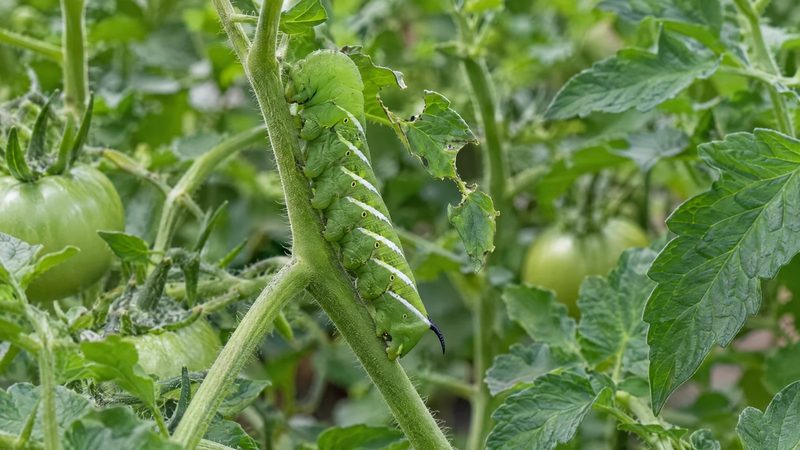
How do you identify a hornworm?
Two closely related caterpillars go by the name hornworm on tomatoes: the tomato hornworm (Manduca quinquemaculata) and the tobacco hornworm (Manduca sexta)2,3. Both are green, both carry a horn on the last abdominal segment, and both feed on tomato and other nightshade crops3. Mature caterpillars reach 3 to 4 inches long, which makes them the largest caterpillars most gardeners find in a vegetable bed1,7.
The side markings separate them. The tomato hornworm has eight V-shaped, chevron stripes on each side and a black or bluish black horn, while the tobacco hornworm has seven diagonal white stripes and a red horn2,3,5. Despite its name, the tomato hornworm is uncommon in the Southeast, where the tobacco hornworm replaces it, and in Florida hornworm damage on tomato is typically caused by the tobacco hornworm3.
Eggs are laid singly on leaves, often on the undersides, and are small, round to oval and green to white with a pearly look, about 1 to 1.5 mm across2,3,7. The adults are heavy-bodied hawk moths with a wingspan of up to 5 inches that hover at flowers at dusk like hummingbirds2,7.
| Feature | Tomato hornworm (Manduca quinquemaculata) | Tobacco hornworm (Manduca sexta) |
|---|---|---|
| Side markings on the caterpillar | Eight V-shaped (chevron) stripes per side2,5 | Seven diagonal white stripes per side2,5 |
| Horn color | Black to bluish black3,5 | Red3,5 |
| Adult moth | Five-spotted hawkmoth, five pairs of orange-yellow abdominal spots3 | Carolina sphinx moth, usually six pairs of spots3 |
| Where it dominates | Uncommon in the Southeast3 | Replaces the tomato hornworm in the Southeast3 |
In North America, hornworm moths emerge from overwintering pupae in early summer, and caterpillar damage peaks from July onward, with a smaller late-summer generation in many areas. Where hornworm species occur in the Southern Hemisphere, the same midsummer window falls around January and February.
How do you find hornworms on a tomato plant?
Hornworms are hard to see because their striping blends into the foliage, so the damage and the droppings usually give them away first1. Large black or green droppings on the ground or on lower leaves under a tomato plant usually mean hornworms are feeding above1. Look up from the droppings to the stripped stems and search the nearby leaves, stems and fruit closely.
Feeding tends to start higher in the canopy3. Caterpillars consume entire leaves and small stems, and they chew large pieces out of green fruit1. Fruit damaged this way does not mature properly3. Larvae stay close to where the egg was laid and generally do not leave the host plant until late in development, so one damaged plant is the place to search3.
- Bare stems and missing leaves, often in the upper canopy1,3
- Large black or green droppings on the soil or leaves below1
- Deep chewed cavities in green fruit1,2
- Tiny single eggs on leaves, mostly undersides2,7
When do hornworms show up, and where do they go in winter?
Hornworms spend the winter as pupae in the soil2,5. In North Carolina, adult moths begin to emerge in early June, and most damage occurs in July and later5. In California, larvae are usually most common in midsummer with a smaller peak in late summer, and infestations tend to be worse in warm inland areas2.
Caterpillars hatch in about 7 days and pass through five growth stages over 3 to 4 weeks before burrowing 3 to 4 inches into the soil to pupate7. Development takes about 2 months in summer, which gives two generations a year in most areas and two to three in North Carolina, depending on temperature2,5.
| Stage | Where to find it | Timing |
|---|---|---|
| Pupa | 3 to 4 inches deep in soil7 | Overwinters; adults emerge from early June in North Carolina5 |
| Egg | Singly on leaves, often undersides2,7 | Hatches in about 7 days7 |
| Caterpillar | Foliage, stems and green fruit1 | Feeds 3 to 4 weeks; most damage in midsummer2,7 |
| Adult moth | Flowers at dusk, attracted to lights7 | Two generations a year in most areas2 |
What are the white eggs on a hornworm's back?
The white objects on a hornworm's back are not eggs. They are silk cocoons of a small black parasitic wasp, Cotesia congregata5,6. Female wasps lay their eggs inside hornworm caterpillars while the caterpillars are small, less than an inch long6. A single egg-laying bout puts about 65 eggs into the caterpillar, with a recorded range of 5 to 1624.
The wasp larvae feed inside the caterpillar for about 12 days, then chew their way out and spin white cocoons on its skin6. The venom and a symbiotic virus injected with the eggs suppress the caterpillar's immune response and arrest its development4. A parasitized hornworm eats roughly one fifth as much as a healthy one5. Adult wasps emerge from the cocoons after about 3 to 8 days, depending on temperature, and go on to find new hosts4.
Leave cocoon-covered hornworms on the plant or move them to a spot where the wasps can still emerge. Each one is a source of the next generation of a natural enemy that targets hornworms4,6.
How do you get rid of hornworms?
In a home garden, handpicking or snipping hornworms with shears is the first step, and natural enemies normally keep populations in check1. Hornworm eggs are attacked by Trichogramma wasps and the larvae by the parasitoid Hyposoter exiguae1,2. Stilt bugs feed on hornworm eggs, paper wasps (Polistes species) use caterpillars as food for their young, and tachinid flies attack hornworms and kill them in the pupal stage5.
When handpicking is not practical, Bacillus thuringiensis (Bt) and spinosad are effective against smaller larvae1. Bt must be eaten to work: the toxin activates in the caterpillar's alkaline gut and breaks down the gut lining, and death follows within 1 to 5 days3,8. Sunlight breaks Bt down on leaf surfaces, with typical foliage half-lives of 1 to 4 days, and rain or irrigation can wash it off, so repeat applications may be needed3,8. Bt is most effective on newly hatched larvae, so timing matters2. Follow the product label for any insecticide, including Bt and spinosad.
In commercial fields, treatment is recommended only when hornworms cause extensive foliage damage or feed on fruit, and spot treatment is worth considering because an entire field is rarely infested2. Avoiding disruptive pesticides early in the season protects the natural enemies that keep hornworms below damaging levels2.
| Option | Best fit | Notes |
|---|---|---|
| Handpicking or snipping | Any garden infestation1 | Search where droppings and bare stems appear1 |
| Leave parasitized caterpillars | Hornworms carrying white cocoons5,6 | They eat about one fifth as much as healthy larvae5 |
| Bacillus thuringiensis (Bt) | Small, newly hatched larvae1,2 | Must be eaten; follow the product label3,8 |
| Spinosad | Small larvae1 | Follow the product label |
| Tilling after harvest | Preventing next season's moths1,2 | Destroys pupae in the soil1 |
How do you stop hornworms from coming back next year?
Discing or rototilling after harvest destroys pupae in the soil and prevents adults from developing1,2. Rotating to crops that hornworms do not attack helps keep numbers low in a given field2. Controlling nightshade-family weeds such as jimsonweed (Datura stramonium) removes alternative hosts3.
Conserving natural enemies is the other half of prevention2,3. Parasitoids such as Cotesia congregata locate hornworms by following chemical cues released from plant leaves while caterpillars feed, so a garden that keeps its beneficial insects has a built-in search team4.
Key takeaways
- Hornworms are 3 to 4 inch green caterpillars of sphinx moths that defoliate tomatoes and chew green fruit, mostly in midsummer.
- Large black or green droppings under a plant are the quickest sign; search the stripped foliage above them.
- White objects on a hornworm's back are Cotesia wasp cocoons, not eggs, and parasitized hornworms are best left to release the wasps.
- Handpicking handles most gardens; Bt and spinosad work best on small larvae, used according to the product label.
- Tilling after harvest destroys overwintering pupae, and crop rotation and weed control cut next year's numbers.
References
- Hornworms (Home and Landscape)
- UC IPM Pest Management Guidelines: Tomato, Hornworms (UC ANR Publication 3470)
- Tomato Hornworm Manduca quinquemaculata (Haworth) (Insecta: Lepidoptera: Sphingidae), EENY700/IN1206
- A Parasitoid Wasp Cotesia congregata (Say) (Insecta: Hymenoptera: Braconidae), EENY598/IN1042
- Insects: Tobacco and Tomato Hornworm (Tobacco Growers Information)
- Cotesia Congregata, Bug's Eye View Vol. 6, No. 25
- Tomato hornworm (Field Guide to Common Texas Insects)
- Bacillus thuringiensis Fact Sheet