

Last updated:
Cucumber beetles are yellow beetles about 1/4 inch long, either striped (Acalymma vittatum) or spotted (Diabrotica undecimpunctata), that chew cucurbit seedlings, flowers and fruit and spread bacterial wilt.1,2 Control them by covering young plants with row covers until bloom, scouting weekly, planting Blue Hubbard squash as a trap crop and, past threshold, using kaolin clay, pyrethrins or spinosyns such as spinosad, following the product label.1,2
How do you identify cucumber beetles?
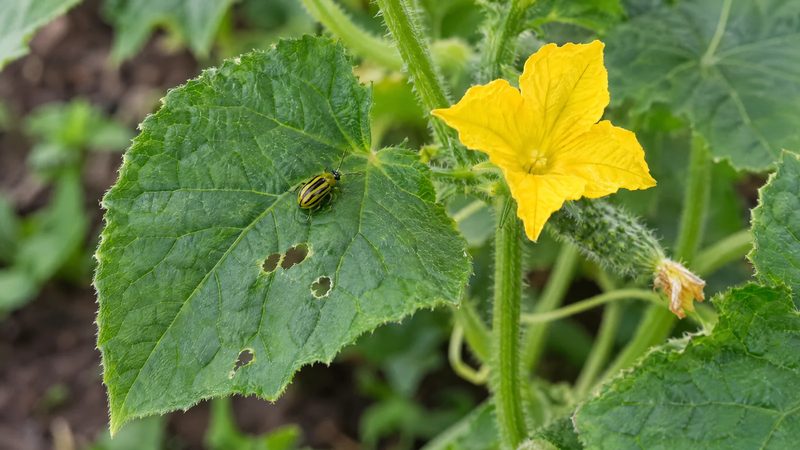
Two native North American beetles do most of the damage.2 The striped cucumber beetle (Acalymma vittatum) is yellow with three clean black stripes running the length of its back and a black underside, and the spotted cucumber beetle (Diabrotica undecimpunctata) is yellow with 12 black spots and a yellow-green underside.2 Striped adults are about a quarter of an inch long with a black head.1 The spotted species, also about 1/4 inch long, is the same insect known as the southern corn rootworm.3 In California the western spotted cucumber beetle is the most abundant species, and the western striped cucumber beetle (Acalymma trivittata) can also cause damage.4
Several less damaging insects look similar. Western corn rootworm also has yellow and black markings, but its stripes are less clean, and the middle segment of its hind leg is black, where the striped cucumber beetle's is yellow.2,3 Northern corn rootworm is green with no markings.2 Lady beetles have short, stubby antennae, while cucumber beetles have long, threadlike antennae.4 If you are trying to name a yellow and black "cucumber bug" on your vines, check the stripes, spots and antennae against the table below.
The larvae live in the soil and are rarely seen; adults are usually the only stage noticed.2 They are slender white grubs with a brown head capsule, or whitish with a darker head and abdomen tip and three pairs of short legs.4,5
| Insect | Key features | Pest status on cucurbits |
|---|---|---|
| Striped cucumber beetle (Acalymma vittatum) | Yellow, three clean black stripes, black underside, yellow hind tibia | Key pest and main bacterial wilt vector |
| Spotted cucumber beetle (Diabrotica undecimpunctata) | Yellow-green, 12 black spots, yellow-green underside | Pest; numbers build later in summer |
| Western corn rootworm | Yellow and black, less clean stripes, black hind tibia | Not considered a damaging cucurbit pest |
| Northern corn rootworm | Green, no markings | Lookalike only |
| Lady beetles | Rounded, short stubby antennae | Predators, not pests |
In North America striped cucumber beetles leave their overwintering sites in spring once average daily temperatures reach about 55°F, and a new generation of adults appears around late July in New York, with a second in early September1; spotted cucumber beetles peak in midsummer2. In the Southern Hemisphere the equivalent spring seedling window for cucurbits falls about six months later, roughly October to December.
What damage do cucumber beetles cause?
Ohio State groups the damage into four parts: killing seedlings, transmitting bacterial wilt, interfering with pollination and scarring fruit.2 Early feeding can defoliate seedlings and damage their stems, and severe feeding stunts or kills young plants; larger plants are less affected by direct feeding.2 Striped beetles often feed in groups that can number in the hundreds, and their feeding leaves a characteristic lacy, webbed pattern on leaves and flowers.1
Beetles gather in blossoms to feed on flower tissue and pollen, and high numbers can deter wild bees from visiting infested flowers.2 Later in the season, feeding on fruit leaves rough, corky scars on the rind, and heavy feeding makes fruit unmarketable.2 Striped cucumber beetle larvae feed only on cucurbit roots and can damage plants when infestations are heavy, while spotted cucumber beetle larvae feed on the roots of corn, beans, small grains and grasses and seldom cause noticeable garden damage.4
Beetles also move plant diseases besides bacterial wilt. Cucurbit-feeding beetles, including the striped cucumber beetle, are the main spreaders of squash mosaic virus; cucumber beetles also carry spores of the fungus that causes gummy stem blight and black rot, and striped beetle larvae increase the incidence of Fusarium wilt.1 UC IPM adds that cucumber beetles may spread cucumber mosaic virus.4
Why does bacterial wilt matter, and can you save a wilting plant?
Bacterial wilt, caused by Erwinia tracheiphila, is the main reason cucumber beetles worry melon and cucumber growers, and it has no curative treatment.2,3 The bacterium survives winter in the gut of adult beetles and spreads when contaminated beetle excrement enters feeding wounds on leaves and in flower nectaries.1 It cannot enter through natural openings in the plant, so wounds are needed, and once inside it multiplies in the water-conducting vessels and blocks them until leaves and vines wilt.7 Beetles prefer to feed on infected leaves, which helps them pick up the bacterium and carry it to healthy plants.1,3
The first sign on cucumber and muskmelon is flagging of single leaves, followed by neighboring leaves and finally the whole vine.3 To check, cut a runner near the crown, press the cut ends together for a moment and pull them slowly apart: sticky strands between the surfaces indicate bacterial wilt.6 There is no treatment for an infected plant, so the only management is to stop beetle feeding.1,3 Pull wilted plants so beetles do not feed on them and spread the disease to neighbors.2
Crops differ in risk. Cucumbers, cantaloupe and honeydew are the most susceptible, squash and pumpkin are less threatened, and watermelon has low susceptibility and tolerates more beetles.1,2,6 The bacterium is not seedborne, and there is no evidence that it survives in soil.6 A review of beetle-borne plant pathogens notes that bacterial wilt can cause losses of up to 80% in cucurbit crops.7
When do cucumber beetles appear?
Adults overwinter under leaf litter, in fence rows, near buildings and in wood lots.1,3 In New York, striped beetles leave the leaf litter in spring once average daily temperatures reach 55°F, typically several weeks before cucurbits are planted, and feed on other plants such as willow, goldenrod and apple until cucurbit foliage appears.1 In Kentucky, beetle activity usually peaks each spring for two to four weeks, the most important period for control.3
Adults live about two months, and an average female lays around 125 eggs.1 Striped cucumber beetles complete one to three generations a year depending on region, with egg to adult taking 40 to 60 days.2 Spotted cucumber beetles survive winter poorly in Ohio, so most arrive from southern regions later and peak in midsummer.2
| Stage | Where it lives | Approximate duration |
|---|---|---|
| Overwintering adult | Leaf litter near cucurbit plantings | Emerges at about 55°F average daily temperature |
| Egg | Soil at the base of cucurbit plants | Hatches within a week |
| Larva (three instars) | Feeding on cucurbit roots | 3 to 4 weeks |
| Pupa | Underground | About a week |
| Adult | Foliage, flowers and fruit | About two months; second generation emerges in early September |
How do you get rid of cucumber beetles without chemicals?
UC IPM suggests that covering emerging plants with protective cloth, then removing it once plants can tolerate damage, may be the best strategy for most vegetable gardens.4 Several cultural and biological tools add to it.
- Row covers or insect netting: put them over seedlings or transplants and remove them when flowers open so pollinators can reach the blooms.1,5 Parthenocarpic varieties, which set fruit without pollination, can stay covered through fruiting.5 In muskmelon, row covers have reduced bacterial wilt transmission and increased yield.2
- Transplants instead of direct seeding shorten the time plants spend at the most vulnerable stage.2
- Perimeter trap crops: Blue Hubbard and buttercup squash are especially attractive and can be planted on the edges two weeks before the main crop, then managed there.1
- Black plastic mulch around plants can reduce larval survival, but only when temperatures exceed a critical threshold.1
- Sanitation: remove debris and mulch at the end of the season to reduce overwintering sites.2
- Natural enemies: wolf spiders, harvestmen, ground beetles and lady beetles eat striped cucumber beetles, and a tachinid fly and a braconid wasp parasitize them, though how much they reduce damage is unknown.1
- Insect-parasitic nematodes (Steinernema riobravis) applied to soil in early summer or early fall can reduce adult emergence.1
What organic pesticides work on cucumber beetles?
Scout before you spray. Older plants can support substantial numbers of beetles without serious damage, so thresholds depend on the crop and its wilt risk.4,1 Check under leaves and inside blossoms, because beetles move into flowers once plants bloom.2
Three materials are approved for organic use against cucumber beetles: kaolin clay, pyrethrins and spinosyns.1 Kaolin clay must be applied before beetles arrive, because it deters colonization and disorients beetles looking for host plants, and it needs repeat applications after rain.1 Ohio State notes that pyrethrins and kaolin clay can be effective in organic operations.2 For any product, follow the product label, rotate modes of action, and avoid spraying when pollinators are active: spray before flowering, or late in the day or at night if plants are in bloom.1,2,5
Baited traps are another option. In organic fields, traps baited with floral attractants caught more striped cucumber beetles than unbaited traps but also caught more bees and hoverflies, and smaller trap holes cut those unwanted catches sharply.8 Cornell likewise warns that attract-and-kill traps baited with flower scents can kill pollinators.1
| Crop | Seedlings | After the four-leaf stage |
|---|---|---|
| Cucumber and muskmelon (wilt susceptible) | 1 beetle per 2 seedlings | 1 beetle per plant |
| Pumpkin and squash | 1 beetle per seedling | Up to 5 beetles per plant |
| Watermelon (low wilt susceptibility) | Protect while small | Up to 5 beetles per plant |
Key takeaways
- Striped (Acalymma vittatum) and spotted (Diabrotica undecimpunctata) cucumber beetles chew seedlings, flowers and fruit of cucurbits.
- They spread bacterial wilt, which has no cure, so preventing feeding on cucumbers and melons is the priority.
- Row covers until bloom, transplants and Blue Hubbard trap crops are the core nonchemical tools.
- Kaolin clay, pyrethrins and spinosyns are organic options; follow the product label and protect pollinators.
- Scout weekly and treat only past crop-specific thresholds.
References
- Striped Cucumber Beetle (Acalymma vittatum) Vegetable IPM Fact Sheet
- Cucumber Beetles in Cucurbits: Identification, Damage, and Strategies for Control (ENT-0108)
- Cucumber Beetles (ENTFACT-311)
- Cucumber Beetles (Home and Landscape)
- FS225: Cucumber Beetles
- Bacterial Wilt of Cucurbits
- Beetles as Plant Pathogen Vectors
- Optimization of a Mass Trapping Method against the Striped Cucumber Beetle Acalymma vittatum in Organic Cucurbit Fields