

Last updated:
Squash bugs (Anasa tristis) are best controlled early: scout from planting, crush the bronze egg clusters on leaf undersides, handpick adults or trap them under boards, and cover young plants until bloom.3,4 Clear crop debris after harvest to remove overwintering sites.4 Sprays such as insecticidal soap or oils work mainly on small nymphs, so time them to egg hatch and follow the product label.1,4
How do you identify squash bugs and their eggs?
Squash bugs (Anasa tristis) are sap-feeding true bugs in the leaf-footed bug family, Coreidae.4 Adults are flat, about 5/8 inch long, gray to brownish black, with orange and brown stripes along the edges of the abdomen.4 A dense covering of fine hairs makes them look almost black.1 Both adults and nymphs give off a foul odor when disturbed, which is why they are sometimes called stink bugs, but true stink bugs belong to a different family.4
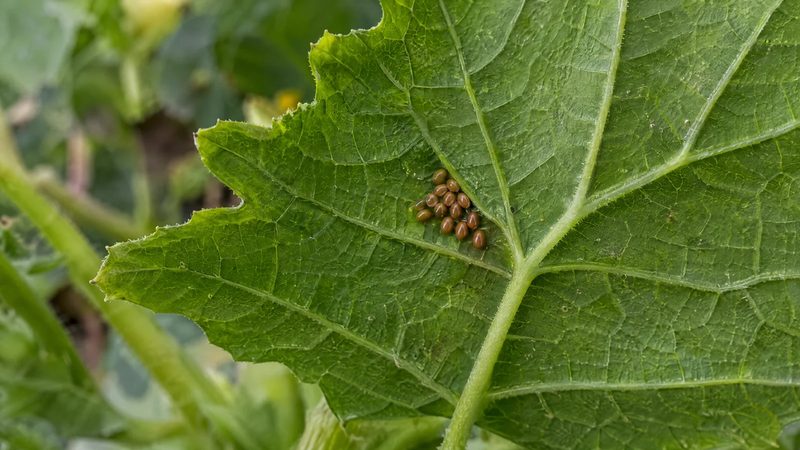
The eggs are the easiest stage to find and the best one to destroy. They are oval, about 1/16 inch long, and laid in clusters on the undersides of leaves, usually between the leaf veins.4 Fresh eggs are pale and darken to a shiny coppery or brick-red brown.3,4 A mass averages about 18 eggs and can hold more than 40.3 Newly hatched nymphs have red legs and heads with greenish bodies, and older nymphs turn gray with black legs.3,4 Young nymphs are strongly gregarious and feed in groups.2
| Stage | What to look for | Approximate duration |
|---|---|---|
| Egg | Bronze to brick-red ovals in clusters on leaf undersides | About 7 to 10 days |
| Nymph (five instars) | Red-legged green young, then gray nymphs in groups | About 4 to 6 weeks |
| Adult | Flat, 5/8 inch, gray-brown, striped abdomen edges | Long-lived; about 75 to 130 days |
| Full generation | Egg to egg-laying adult | About 6 to 8 weeks |
In North America overwintered squash bugs reach cucurbits in late spring to early summer (April to May in Utah, early to mid-June in New York), lay eggs through midsummer, and the new generation of adults appears from late June into August before seeking winter shelter4,5,6. In the Southern Hemisphere the same sequence follows the warm season, with egg-laying from about late spring in November through midsummer.
What damage do squash bugs cause?
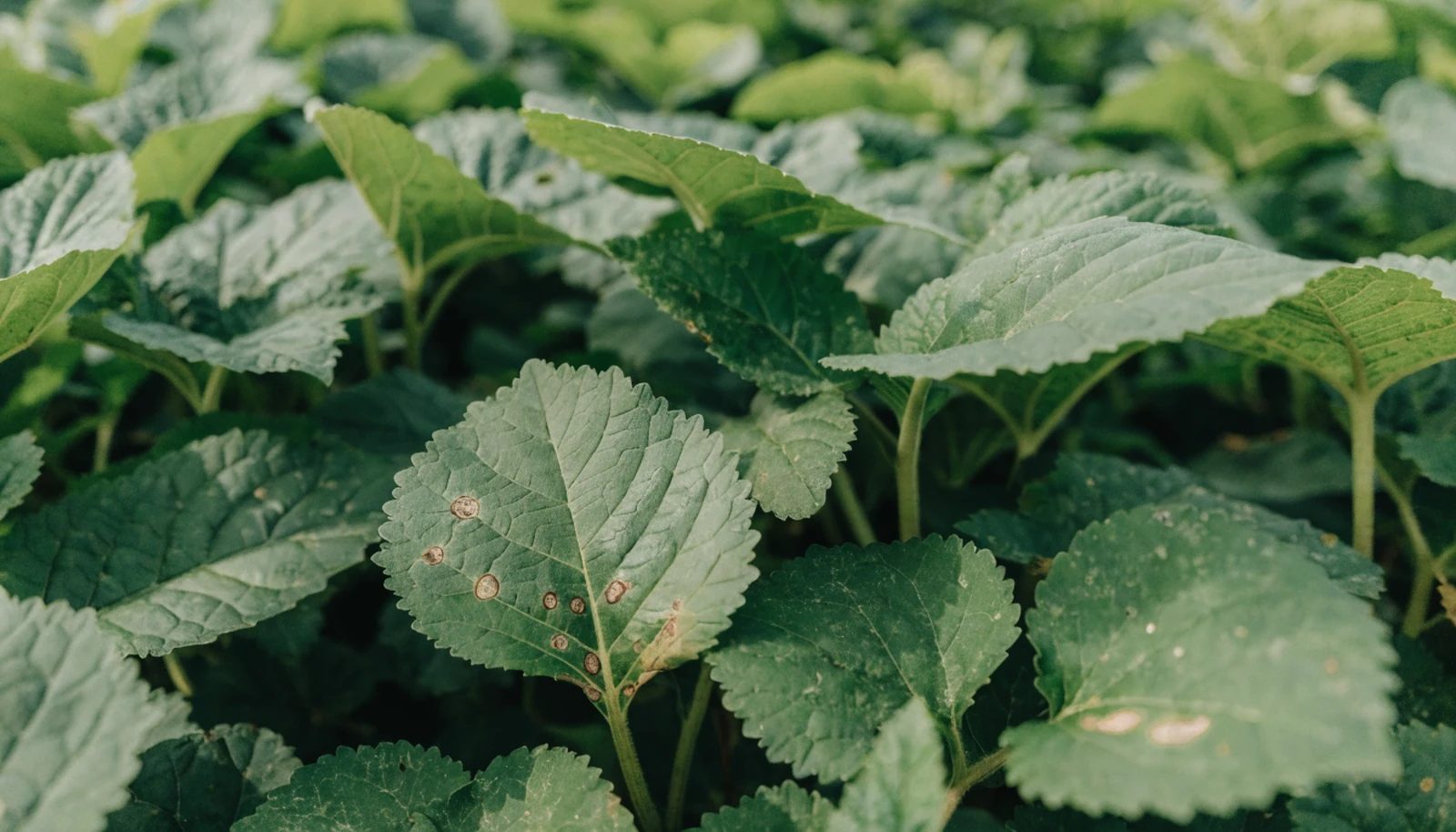
Adults and nymphs pierce leaves, vines and fruit and suck the sap.4 Leaves first show yellow spots that turn brown, and heavy feeding turns whole leaves black and crisp.4 Small plants can be killed outright, while larger plants lose runners.1 Feeding on fruit leaves scars and sunken areas that cut quality and increase rot in storage.4 In one study cited in a 2016 review, untreated summer squash invaded at flowering and fruit set lost more than half its yield.3
The sudden collapse of vines is often called anasa wilt.2 It was once blamed on a toxic saliva, but no salivary toxin has been confirmed, and the wilting is now explained mainly by disruption of the water-conducting xylem where the bugs feed.3,4 This wilt resembles bacterial wilt, a disease spread by cucumber beetles, so check vines and leaf undersides for the bugs before deciding what you are dealing with.1
Squash bugs also carry the bacterium that causes cucurbit yellow vine disease, and overwintering adults hold it inside their bodies until spring.2,6 Losses from the disease range from 5% to 100%, no resistant cucurbit varieties are available, and yellowing of the leaves and vines separates it from bacterial wilt.6
When do squash bugs appear in the garden?
Squash bugs spend the winter as unmated adults under plant debris, in compost piles, around building foundations and in woodpiles.2,4 In late spring to early summer they fly to young cucurbit plants to feed, mate and lay eggs.4 In Utah, overwintered adults typically emerge in April in the south and in May in the north, and in New York they usually emerge in early to mid-June.4,6
Egg-laying continues from late spring through midsummer, so eggs, nymphs and adults overlap.4,5 There is one generation a year in northern areas and two to three in warmer regions.2 Infestations tend to build about the time plants reach 2 to 3 feet across, and numbers are highest during bloom and fruit set.2,4 Warm winters favor adult survival and larger populations the following year.4
How do you get rid of squash bugs naturally?
Cultural and mechanical controls are the first line of defense, and they work best when started early.4 Each adult removed in spring can prevent several hundred offspring later in the season.4
- Scout at least once a week from seedling emergence or transplanting, checking leaf undersides for eggs and the plant base for adults.1,4
- Handpick adults and nymphs and crush egg clusters every 2 to 3 days early in the season.4
- Drop bugs into soapy water, and lift eggs off leaves with the sticky side of duct or packing tape.5
- Lay boards, shingles or heavy cardboard beside the rows; squash bugs shelter under them at night and can be destroyed in the morning.2,4
- Cover plants with floating row covers until they flower, then remove the covers so bees can pollinate.4,5
- Remove vines, old fruit and debris right after harvest, and rotate cucurbits to a new spot.4
- Remove wilted plants and check the plants next to them for squash bugs.4
Do row covers, trap crops and natural enemies help?
Row covers delay colonization, but bugs move in quickly once covers come off for pollination.2 Straw and other mulches can harbor squash bugs, so weigh their benefits against that risk.3,4
Trap crops use the bug's preferences. Squash and pumpkin are preferred hosts and can protect melons and cucumbers planted nearby.2,3 Hubbard squash on plot edges can help reduce cucurbit yellow vine disease in the main planting.6 Destroy the bugs on the trap crop before their eggs hatch.4
Natural enemies add real pressure. The tachinid fly Trichopoda pennipes lays eggs on older nymphs and adults, and about 20% of squash bugs collected in Connecticut in late summer were parasitized.2,3 Tiny wasps parasitize the eggs, with up to 30% egg parasitism reported in Florida.2 Avoiding broad-spectrum insecticides and growing flowering plants that feed these parasitoids helps preserve them.4
What organic pesticides work on squash bugs?
Target the nymphs. Adult squash bugs are unusually hard to kill and prone to developing resistance, while young nymphs are much more susceptible.2,4 Utah State University uses an average of one egg cluster per plant as the threshold for treating.4
UC IPM lists pyrethrins, insecticidal soaps and certain oils as options acceptable in organic production.1 Soaps and narrow-range oils need thorough coverage and control small nymphs but are not as effective on older nymphs or adults.1 Pyrethrins and azadirachtin, the active compound in neem products, can suppress nymphs, but under heavy pressure they have not given effective or consistent control in the field.3 Spinosad has been evaluated and shown to be not very effective against squash bug.3
Protect pollinators. Spray in the early morning or evening, avoid spraying open blossoms during the day, and choose materials with little residual activity when flowers are present.2,4,5 Cover the tops and undersides of leaves, fruits and vines, ideally before the canopy closes.4 Whatever you use, follow the product label.
Key takeaways
- Squash bugs (Anasa tristis) overwinter as adults in debris and lay bronze egg clusters on leaf undersides from late spring to midsummer.
- Crushing eggs, handpicking and board traps work best when started early and repeated every 2 to 3 days.
- Row covers until bloom and fall cleanup reduce the next generation.
- Sprays such as soap, oils, neem and pyrethrins work mainly on small nymphs; follow the product label.
- Squash bugs can spread cucurbit yellow vine disease, which yellows and collapses vines.
References
- Squash Bug: Agriculture: Cucurbits Pest Management Guidelines
- Squash Bug, Anasa tristis (DeGeer) (Insecta: Hemiptera: Coreidae) (EENY077/IN234)
- Squash Bug (Hemiptera: Coreidae): Biology and Management in Cucurbitaceous Crops
- Squash Bugs (Utah Pests Fact Sheet)
- Squash Bug
- Cucurbit Yellow Vine Disease (Serratia ureilytica): Vegetable IPM Fact Sheet