

Last updated:
Chlorosis means yellowing leaves; when the leaf yellows but the veins stay green, the usual cause is iron deficiency, called iron chlorosis.1 It shows first on the newest leaves and is most common in alkaline soils, where iron is present but locked in forms roots cannot absorb.1,2 Fix it with a soil pH test, better watering, and a chelated iron matched to that pH.1,6
What does iron chlorosis look like?
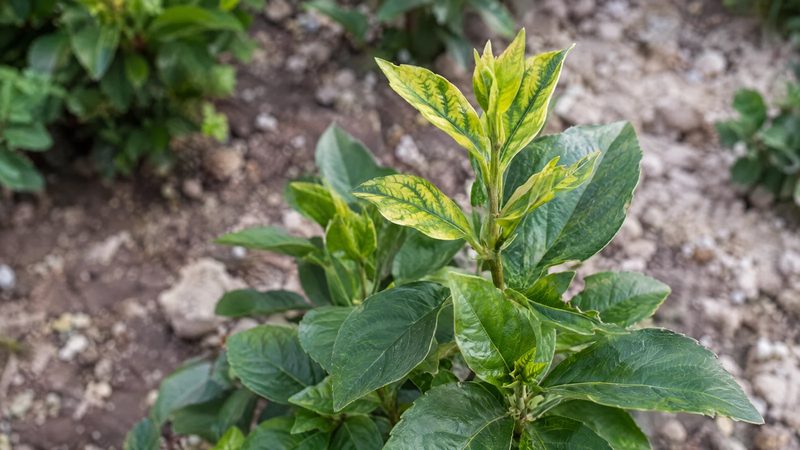
Iron chlorosis is a yellowing caused by iron deficiency in the leaf tissue, and its main symptom is interveinal chlorosis: the leaf yellows while the veins stay green.1 In severe cases leaves turn pale yellow or whitish with a greenish cast to the veins, angular brown spots form between the veins, and leaf margins scorch.1 Severely deficient leaves can also develop dead spots that look like a fungal infection, and untreated plants die back.2
Iron does not move readily within the plant, so chlorosis shows first and most severely on new growth at branch tips.1,3 Under severe deficiency it can progress into older leaves, and the whole leaf may turn yellow.4,1 Leaves may be smaller than normal, curl, dry and drop.1 It is common for iron chlorosis to appear on a single branch or one side of a tree, and on junipers, pines and other evergreens it shows as an overall yellowing of the needles.1
| Pattern | Where it starts | Likely cause |
|---|---|---|
| Yellow between green veins; only the vein itself stays green | Newest leaves at shoot tips | Iron deficiency |
| Similar interveinal yellowing | Older, interior leaves | Zinc or manganese deficiency |
| Yellowing from leaf tips moving between the veins, herringbone look | Oldest, lowest leaves | Magnesium deficiency |
| Uniform yellowing, veins included | Older leaves | Nitrogen deficiency |
| General yellowing, stronger on young leaves | Younger, upper leaves | Sulfur deficiency |
| Leaf tissue along the veins also stays green | Varies | Soil sterilant herbicide injury |
In North America iron chlorosis symptoms usually begin in spring as plants leaf out and become severe as summer heat builds2, and the problem is more prevalent after wet springs or springtime overwatering1. In the Southern Hemisphere the same pattern runs from leaf-out in about September through the January and February heat.
What causes iron chlorosis?
Plants need iron to form chlorophyll, the green pigment that drives photosynthesis.1,4 Most soils contain plenty of iron; the problem is availability. In alkaline soils (pH above 7.0), iron is rapidly converted into insoluble forms that roots cannot absorb, and soils naturally high in lime (calcium carbonate) often sit above pH 7.5.1 Bicarbonate in the soil solution adds to the problem: both high pH and bicarbonate can cause iron deficiency chlorosis in calcareous soils, and bicarbonate also impairs the chemical reduction of iron at root cell membranes.5 Iron chlorosis is common in fruit trees on alkaline and calcareous soils, where it limits fruit yield and quality.5
Soil water and air matter as much as chemistry. Iron chlorosis is a common symptom of overwatering and is more prevalent after wet springs, while compaction, crusting and plastic under rock mulch limit root area and soil oxygen.1 Cold, wet, poorly aerated soils favor the deficiency.3 Other contributors include trunk girdling roots, winter injury, high soil salt levels, high soil temperature and light intensity, and excessive phosphate, manganese, copper or zinc from over-application.1,4
Which plants get iron chlorosis?
Susceptibility varies widely by species and variety.1 Acid-loving plants such as blueberries, azaleas, rhododendron, flowering dogwood and heather are highly susceptible, and Colorado State lists maples, pin and red oak, birch, aspen, apple, peach, pear, grape, raspberry, spruce and pine among susceptible woody plants.1 Plants often submitted for iron chlorosis in New Mexico include photinia, willows, mulberry, maples, sycamores, roses, apples, pears, stone fruits and pecan.2 In Texas, red tip photinia, Indian hawthorn, pines and St. Augustine grass are common examples.4
In field crops, soybeans are sensitive and show yellowing between the veins of young leaves, iron deficiency is common on grain and forage sorghum, and corn is rarely affected because of its low iron requirement.3 In roses, iron and zinc deficiencies appear as interveinal chlorosis of new leaves when soils are too wet or too alkaline.7 Rootstock matters in fruit trees: in a 2023 study, the dwarfing pear rootstock quince A developed iron chlorosis in a bicarbonate solution while the vigorous rootstock Pyrus betulifolia did not.5
What is chelated iron, and which chelate should you use?
Chelated iron is iron bound to a chelating agent, which holds it in an available form up to a characteristic pH.6 Texas A&M AgriLife calls chelated iron the best solution and the longest lasting.4 Common chelating agents are EDDHA, EDDHMA, HEDTA, DTPA and EDTA, and the right one depends mainly on soil pH.4 EDTA is the most common iron chelate, but it is not effective in alkaline soils.2
A 2025 HortScience study puts numbers on the difference. Fe-EDDHA binds iron up to about pH 9, Fe-DTPA to about pH 7.5 and Fe-EDTA to about pH 6.5.6 In calibrachoa grown in soilless media, all three prevented chlorosis up to pH 6.5, but above pH 7.2 only Fe-EDDHA worked; Fe-EDDHA cost about four times as much as Fe-EDTA, and it also gave soybeans more dry mass at every pH tested.6 Colorado State guidance agrees: in soils above pH 7.5 only high-pH chelates such as EDDHA and EDDHMA are effective, while EDTA and DTPA lose effectiveness quickly as pH rises above 7.2 to 7.5.1
| Chelate | Holds iron to about | Best suited to |
|---|---|---|
| Fe-EDTA | pH 6.5 | Acid to slightly acid soils and media; foliar sprays |
| Fe-DTPA | pH 7.5 | Acid to slightly alkaline soils |
| Fe-EDDHA (and EDDHMA) | pH 9 | Alkaline and calcareous soils above pH 7.5 |
How do you fix iron chlorosis?
Start with a soil test for pH, and check for free lime by moistening a tablespoon of dry soil with vinegar: fizzing means free lime, which is typical above pH 7.5 and makes lowering the pH impractical.1 Soil testing and tissue analysis together confirm what the plant is short of.3 Then correct the conditions: cut springtime overwatering, relieve compaction, and where chlorosis keeps returning, choose species tolerant of high pH.1
- Soil chelate: a soil-applied chelate matched to pH can give a rapid response, with treatments lasting from less than a season to two years.1
- Foliar spray: iron sulfate or chelate sprays can green leaves within days, but results are often spotty and temporary, so repeat applications may be needed.1
- Timing: spring foliar applications work best because new leaves take up iron readily; avoid foliar sprays above 85°F, which can burn leaves, and use soil applications later in the season.2
- Spray in the evening or on cloudy days; chelated iron sprays are inactivated by sunlight, and iron can permanently stain concrete and stone.1,4
- Lowering pH with sulfur, or a mix of iron sulfate and sulfur, merits consideration only on soils without free lime and works over months to years.1
- Large trees: complete spray coverage is impractical, and arborists use trunk implants or injections instead.1
Key takeaways
- Yellow leaves with green veins on new growth point to iron chlorosis, because iron does not move from old leaves to new ones.
- The usual cause is alkaline or calcareous soil, where iron is present but unavailable, made worse by overwatering and compaction.
- Match the chelate to soil pH: EDTA up to about 6.5, DTPA to about 7.5, EDDHA to about 9.
- Foliar iron greens leaves quickly but briefly; soil chelates and better watering last longer; follow the product label.
References
- Iron Chlorosis of Woody Plants (CMG GardenNotes #223)
- Iron Chlorosis (Guide H-171)
- Diagnosing Nutrient Deficiencies in the Field (MF3028)
- Straight Talk About Iron Deficiency and Plants
- Bicarbonate rather than high pH in growth medium induced Fe-deficiency chlorosis in dwarfing rootstock quince A (Cydonia oblonga Mill.) but did not impair Fe nutrition of vigorous rootstock Pyrus betulifolia
- Fertigation with Fe-EDTA, Fe-DTPA, and Fe-EDDHA Chelates to Prevent Iron Chlorosis of Sensitive Species in High-pH Soilless Media
- Pest Notes: Roses: Diseases and Abiotic Disorders (UC ANR Publication 7463)
- Excessive Phosphorus In Garden Soils (excerpt from The Alabama Vegetable Gardener, ANR-0479)