

Why are my tomato leaves turning yellow?
Last updated:
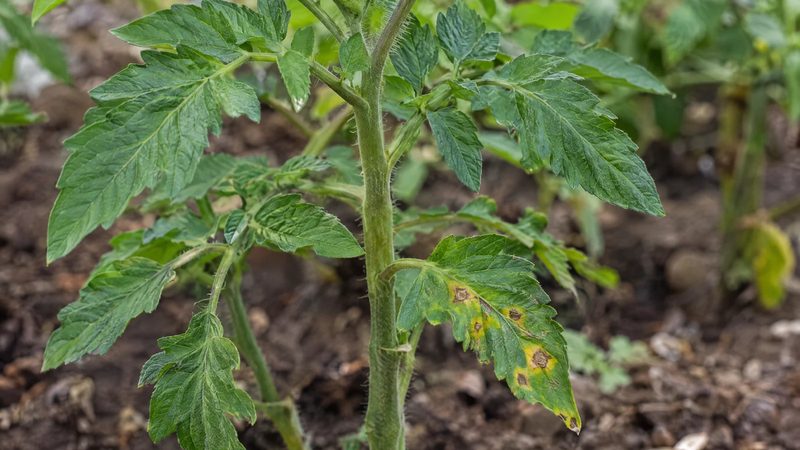
Yellow tomato leaves usually mean a leaf spot disease, a nutrient shortage or a wilt. Yellowing that starts on the lower leaves with brown spots points to early blight or Septoria leaf spot2,3. Even, pale yellowing of older leaves suggests nitrogen deficiency6. V-shaped yellow wedges or yellowing on one side of the plant point to Verticillium or Fusarium wilt5,1.
What does the yellowing pattern on tomato leaves tell you?
Where the yellow starts, and whether it comes with spots, narrows the cause quickly. On tomato (Solanum lycopersicum), the common leaf spot diseases begin on the lower leaves and move upward2,3, while tomato yellow leaf curl virus yellows the margins and the tissue between the veins of young leaves first8. Nutrient deficiencies tend to look uniform across a whole planting, whereas plants infected with that virus appear in patches8.
| What you see | Likely cause |
|---|---|
| Older, lower leaves turn evenly pale green to yellow; growth slow and weak6 | Nitrogen deficiency6 |
| Older leaves yellow between the veins while the veins stay green7 | Magnesium deficiency7 |
| Older leaves yellow and scorch at the margins7 | Potassium deficiency7 |
| Lower leaves with brown spots up to 1/2 inch, concentric rings and a yellow halo2 | Early blight (Alternaria linariae)2 |
| Lower leaves with many small round spots, tan to gray centers and dark borders, then yellowing3,1 | Septoria leaf spot (Septoria lycopersici)1 |
| Lower leaves yellow with V-shaped wedges from the leaf edge; afternoon wilting5 | Verticillium wilt5 |
| Leaves on one side of the stem turn golden yellow; plant wilts1 | Fusarium wilt (Fusarium oxysporum)1 |
| Pale green to yellow spots on the upper leaf surface with gray, velvety growth underneath1 | Leaf mold (Passalora fulva)1 |
| Young leaves yellow at the edges and between the veins, crumpled and curled; plant stunted8 | Tomato yellow leaf curl virus8 |
In North America, yellow tomato leaves are searched most in June, as canopies close and early blight and Septoria leaf spot take hold in warm, wet weather; Septoria usually follows the start of fruit set. In the Southern Hemisphere, the same window falls around December.
Why are my tomato leaves yellow at the bottom?
Bottom-up yellowing has three common causes. The first is nitrogen deficiency: nitrogen is a mobile nutrient that moves to new growth when supplies run short, so older, lower leaves turn pale green to yellow first, and over time more of the plant yellows6. Stems may be thin, and a severe or prolonged shortage can cause leaf drop and lower yields6.
The second is leaf spot disease. Early blight lesions first develop on the lower leaves, the area around them may turn yellow, and as the disease progresses the whole leaf may yellow2. Septoria leaf spot usually infects the lower leaves near the ground after plants begin to set fruit, and severely spotted leaves turn yellow, die and fall off1. Both diseases tend to start as plant canopies close, because denser foliage keeps leaves wet longer4.
The third is a wilt disease. Verticillium wilt starts with yellowing of the lower leaves, wilting and stunting, and lower leaves die and drop as it advances5. Check the leaves for spots or V-shaped wedges before you fertilize, because those signs point to disease rather than a nutrient shortage2,5.
Why are my tomato leaves yellow with brown spots?
Brown spots on yellowing leaves point to a fungal or bacterial leaf spot disease2,1. Early blight, caused by Alternaria linariae (formerly A. solani), produces brownish-black spots of about 1/4 to 1/2 inch with characteristic concentric rings, a bull's-eye pattern2,1. It is favored by temperatures above 80°F and moderate to heavy rain, and in later stages it can strip the lower plant, leaving fruit exposed to sunscald2.
Septoria leaf spot produces smaller spots, under 1/8 inch, that are round with tan to gray centers, dark brown borders and sometimes a yellow halo3. Tiny black specks in the center are the spore-producing bodies of the fungus3. It is most active between 68°F and 77°F in high humidity, and it rarely infects the fruit1,3.
Bacterial spot causes numerous small, angular to irregular, water-soaked spots that may have a yellow halo and whose centers dry out and tear1. Compared with early blight, bacterial spot lesions are smaller, about 1/16 inch, and may look water-soaked on the leaf underside2. Late blight is different again: its lesions are lighter tan with a light green halo, and it appears all over the plant, including young leaves2.
Could a nutrient shortage be turning tomato leaves yellow?
Yes, and the leaf position tells you which nutrient. Nitrogen deficiency yellows older leaves evenly6. Magnesium deficiency gives older leaves yellow tissue between green veins, sometimes with leaf curling, sudden browning between the veins and early leaf drop7. Potassium deficiency usually yellows and scorches the margins of older leaves7. Iron deficiency, by contrast, affects young leaves first7, and shortages of micronutrients such as iron, zinc, manganese and boron can cause yellowing and deformed young leaves8.
Do not guess with fertilizer. Avoid adding magnesium unless a recent soil test shows a deficiency, because excess magnesium and potassium compete with calcium uptake and raise the risk of blossom end rot1. A soil test also guides liming, which Clemson Extension recommends to bring garden soil to about pH 6.5 for tomatoes1.
How do you tell Fusarium wilt from Verticillium wilt?
Both are soil-borne fungi that attack the water-conducting tissue, and both brown the inside of the lower stem1,5. Fusarium wilt, a warm-weather disease, often turns the leaves on only one side of the stem golden yellow first, followed by wilting and death of the plant1. Verticillium wilt prefers cooler weather, around 75°F to 85°F, and neutral to alkaline soil; its V-shaped leaf lesions are its distinguishing sign, and plants often wilt in the afternoon and seem to recover by morning5.
Neither can be cured once a plant is infected1,5. Grow cultivars with resistance, shown by letters after the cultivar name such as FF for Fusarium races 1 and 21. Raising soil pH to 6.5 to 7.0 and using nitrate nitrogen rather than ammonium nitrogen slows Fusarium wilt1. Verticillium can survive in soil for up to 10 years, so rotate away from susceptible crops for 4 to 5 years and remove infected plants promptly5.
How do you stop tomato leaves turning yellow from disease?
Prevention matters most, because control is difficult once leaf spot symptoms appear4. For early blight, use resistant or tolerant cultivars, rotate crops, remove weeds and volunteer tomatoes, space and mulch plants, avoid wetting the foliage when watering, and trim off infected lower branches and leaves1. Volunteer tomatoes can carry early blight between seasons, so removing them reduces disease2.
For Septoria leaf spot, rotate away from tomato for 2 or more years, remove crop debris, stake plants so leaves dry faster, use mulch to keep leaves off the soil, avoid working among wet plants and clean tools afterward3. Thinning plants or removing selected branches improves airflow and shortens the time leaves stay wet4. Where a fungicide is needed, use one labeled for vegetables, start early, before symptoms if possible, and follow the product label4.
Key takeaways
- Yellowing that starts low with brown spots is usually early blight (target-like rings) or Septoria leaf spot (many small, pale-centered spots).
- Even, pale yellowing of older leaves suggests nitrogen deficiency; yellow between green veins on older leaves suggests magnesium deficiency.
- V-shaped yellow wedges mean Verticillium wilt; yellowing on one side of the stem points to Fusarium wilt; neither can be cured.
- Test the soil before adding magnesium or other fertilizers.
- Rotation, spacing, mulch, dry foliage and removal of infected lower leaves are the core of prevention.
References
- Tomato Diseases & Disorders (HGIC 2217)
- Early Blight of Tomato
- Septoria Leaf Spot of Tomato
- Early Blight (UW Plant Disease Facts D0046)
- Verticillium Wilt of Tomato and Eggplant
- Identifying Plant Nutrient Deficiencies: Nitrogen
- Identifying Plant Nutrient Deficiencies: Magnesium
- Tomato Yellow Leaf Curl Virus
Frequently asked questions
Should I remove yellow leaves from tomato plants?
For early blight, Clemson Extension recommends trimming off and disposing of infected lower branches and leaves1. Removing selected branches also improves airflow and shortens the time leaves stay wet, which can slow leaf spot diseases4. Remove infected plants entirely when Verticillium wilt is the cause5.
Does Epsom salt fix yellow tomato leaves?
Only if magnesium is actually short. Epsom salt is a magnesium source, and Clemson Extension advises not applying it to garden soil unless a recent soil test shows a magnesium deficiency, because excess magnesium competes with calcium uptake1.