


Last updated:
Spotted lanternfly (Lycorma delicatula) is an invasive planthopper whose egg masses, about 35 eggs under a flat, mud-like gray-brown coating, are laid from September to December.1 Scrape reachable egg masses into rubbing alcohol or hand sanitizer, or smash them, then use circle traps on trunks for spring nymphs and registered insecticides only where numbers stay high, following the product label.1
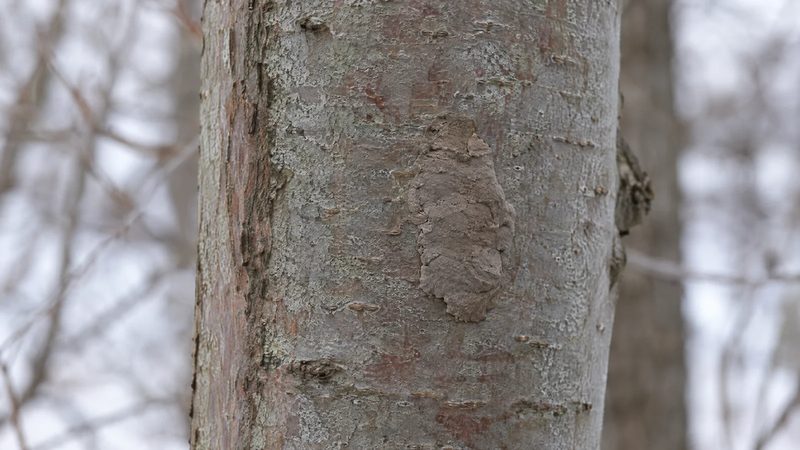
How do you identify spotted lanternfly?
Spotted lanternfly (Lycorma delicatula) is a planthopper native to parts of Asia that was first detected in North America in 2014 in southeastern Pennsylvania and has since spread to other U.S. states.1 It appears to have been present in the United States for two to three years before that first detection.7 There is one generation per year in Pennsylvania, with eggs laid in fall and hatching in spring.1
Newly hatched nymphs are about 1/8 inch long and can be mistaken for small ticks or spiders; the first three nymphal stages are black with white spots, and the fourth stage is red with white dots and black stripes and about 1/2 inch long.1 In New Jersey, young black nymphs can also be confused with second-stage brown marmorated stink bug nymphs.4 Adults are about 1 inch long, with gray forewings marked with black spots and hind wings patterned red, black and white; because they walk more than they fly, the wings often stay closed and only the gray forewings show.1 Nymphs and adults are strong jumpers, and spotted lanternflies cannot bite or sting.1
| Stage | When it is present | What to look for |
|---|---|---|
| Egg mass | Laid September to December; hatches late April to June | Flat patch of about 35 eggs under a gray-brown, mud-like coating |
| Early nymphs (first to third stage) | Late spring into summer | Black with white spots, about 1/8 inch at hatch |
| Fourth-stage nymph | Summer | Red with white dots and black stripes, about 1/2 inch |
| Adult | July until hard freezes | About 1 inch, gray spotted forewings, red, black and white hind wings |
In North America, Pennsylvania timing is the guide: eggs are laid from September to December, nymphs hatch from late April to June, and adults are active from July until hard freezes1, so egg scraping runs from fall through early spring and circle traps go up at hatch. Spotted lanternfly is native to Asia and invasive in North America, so these dates follow the Northern Hemisphere calendar; Southern Hemisphere readers should treat them as a reference for the northern season only.
What do spotted lanternfly egg masses look like, and where are they laid?
Egg masses are flat and covered with a gray-brown, mud-like substance, and they vary in appearance.1 Under the coating, eggs sit in parallel rows, and the species overwinters as eggs in masses of 35 to 50 eggs.5 A Pennsylvania study found eggs arranged in a single layer of 1 to 13 columns, with average egg mass size between about 27 and 35 eggs depending on the sample.6
Females lay eggs on trees, decks, houses, outdoor equipment and rocks.1 Red maple, silver maple and willows, which spotted lanternflies favor in fall, are good places to start looking, and eggs also turn up under rocks and on lawn furniture, fences and rusty metal.1 In New Jersey woods, egg masses sat near the base of narrow trunks, mainly on the underside of branches on larger trees, and in crevices along the trunk of trees with peeling bark; there was an 88% probability of finding an egg mass near a wild grapevine, falling to 9% where wild grapes were absent.5
Egg masses can also ride on vehicles, including underneath and in wheel wells, so check vehicles and outdoor items from fall to summer.1
How do you destroy spotted lanternfly egg masses?
Scrape each egg mass off its surface into an alcohol solution, such as rubbing alcohol or hand sanitizer, and leave it there permanently, or smash the eggs thoroughly.1 Each destroyed egg mass removes about 35 insects from the next year's generation.1
Scraping has limits. Researchers found that less than 2 percent of egg masses laid on trees were within reach, up to 10 feet from the ground, and Penn State Extension does not recommend ladders or tree climbing to reach the rest.1 Dormant or horticultural oil applied directly to egg masses has killed some eggs in experiments, with inconsistent results, and fall applications were not more effective than applications from February to April.1 For egg masses within reach, scraping or smashing works better than currently available ovicides; if you use an oil, follow the product label, because not every plant tolerates oil sprays.1
If you find egg masses or insects outside the known range, photograph them, destroy them if you can and report them to your state agriculture department.1,3
How do you kill spotted lanternfly nymphs and adults?
Scout first. Low numbers may not need treatment, a few spotted lanternflies feeding on a large, healthy tree are unlikely to cause permanent damage, and Penn State Extension suggests trapping or swatting them on individual trees instead of using insecticides.1 Nymphs and adults are fairly easy to kill with insecticides, including lower-toxicity registered products such as soaps and oils, but these need thorough coverage of the insect's body and work for a short period.1 In Penn State trials, insecticidal soap, neem oil and horticultural oil showed good activity and natural pyrethrins excellent activity against spotted lanternfly, all with poor residual activity.1
Systemic insecticides such as dinotefuran and imidacloprid are usually applied by licensed professionals as trunk injections, trunk sprays or soil drenches, and they are mostly used against adults on favored "hot" trees, applied after bloom to protect pollinators.1 Never spray any insecticide on plants that are blooming, use only products registered for the site, and follow the product label.1 Homemade sprays from cleaning, automotive or cooking products can harm plants or the environment more than people expect.1 Using insecticides on nymphs or adults does not keep more from coming onto the property later in the season.1
| Life stage and timing | Option | What the guidance says |
|---|---|---|
| Egg masses, fall to spring | Scrape into alcohol or smash | Most effective for reachable masses; most masses are above reach |
| Egg masses, fall to spring | Horticultural or dormant oil | Inconsistent; follow the product label |
| Nymphs, late April through June | Circle traps on trunks | Catch large numbers of nymphs without sticky material |
| Nymphs and adults | Soaps, oils, pyrethrins and other contact sprays | Kill on contact; short residual; never on blooming plants |
| Adults, summer to fall | Systemic insecticides on favored trees | Usually applied by professionals after bloom |
| All stages | Removing tree-of-heaven | May reduce local populations; herbicide is needed to kill the roots |
Do sticky traps work for spotted lanternfly?
Nymphs and adults crawl up tree trunks to feed higher in the tree, so trunk traps intercept them.1 Nymphs are often blown out of the canopy and then walk back to the trunk and climb, which is the behavior traps exploit.2 Sticky bands do capture spotted lanternflies, but Penn State Extension does not recommend them on their own because the glue is not selective and catches pollinators, butterflies, birds, squirrels and other animals.1
The recommended trap is a funnel-style circle trap made of insect screening that guides insects into a collection bag or jar, with no sticky material at all.1,2 Place it about four feet above the ground on a smooth-barked tree, because deep bark grooves let insects crawl underneath, and set traps out as soon as eggs hatch, from late April through June; adults may avoid traps later in the season.1
If you use a sticky band, always cover it with a wildlife barrier of window screening that extends several inches above and below the band, check it every day, and take any trapped animal to a wildlife rehabilitation center rather than freeing it yourself.1 Chicken wire does not work as a barrier, and homemade bands of duct tape or petroleum jelly lose their stickiness and let insects escape.1
Which plants does spotted lanternfly damage?
Spotted lanternfly has been recorded feeding on more than seventy plant species, including grapevines, hops, ornamental landscape plants and many trees, while conifers are poor hosts.1 Tree-of-heaven (Ailanthus altissima) is a key host, and black walnut, red maple, river birch, willow, grapes, apples and peaches are also fed on.1,4 Heavy feeding has contributed to the death of grapevines, tree-of-heaven and black walnut saplings, but the insect is not known to kill other plants directly and is considered mainly a nuisance pest in home landscapes.1 Some Pennsylvania grape growers report direct vine losses through reduced cold hardiness and plant health.4
Feeding produces large amounts of sugary honeydew that falls from trees and is colonized by sooty mold, which covers leaves, can kill understory plants under dense populations, and stains decks, patios and vehicles.1 Nymphs also feed on vegetable, fruit and herb plants such as cucumber, basil and raspberries, though damage is seldom reported unless populations are very high.1 The pest is regarded as a serious economic threat to grape, fruit tree, ornamental and timber industries, and many states have quarantines that require inspection of items moved out of infested areas.7,1
Key takeaways
- Spotted lanternfly (Lycorma delicatula) lays flat, gray-brown egg masses of about 35 eggs from September to December on trees, stone, metal and vehicles.
- Scrape reachable egg masses into rubbing alcohol or hand sanitizer, or smash them; most egg masses on trees sit above reach.
- Circle traps on smooth-barked trunks catch spring nymphs without the bycatch risk of unprotected sticky bands.
- Soaps, oils and other contact insecticides kill on contact but do not persist; follow the product label and never spray blooming plants.
- Check vehicles and outdoor items before leaving an infested area, and report finds outside the known range.
References
- Spotted Lanternfly Management Guide
- How to Build a Spotted Lanternfly Circle Trap
- Spotted Lanternfly
- Spotted Lanternfly
- Characterizing location of spotted lanternfly egg masses in wooded habitat during early invasion stages
- Oviposition selection in spotted lanternfly: impact of habitat and substrate on egg mass size and hatchability
- Spotted Lanternfly