

Last updated:
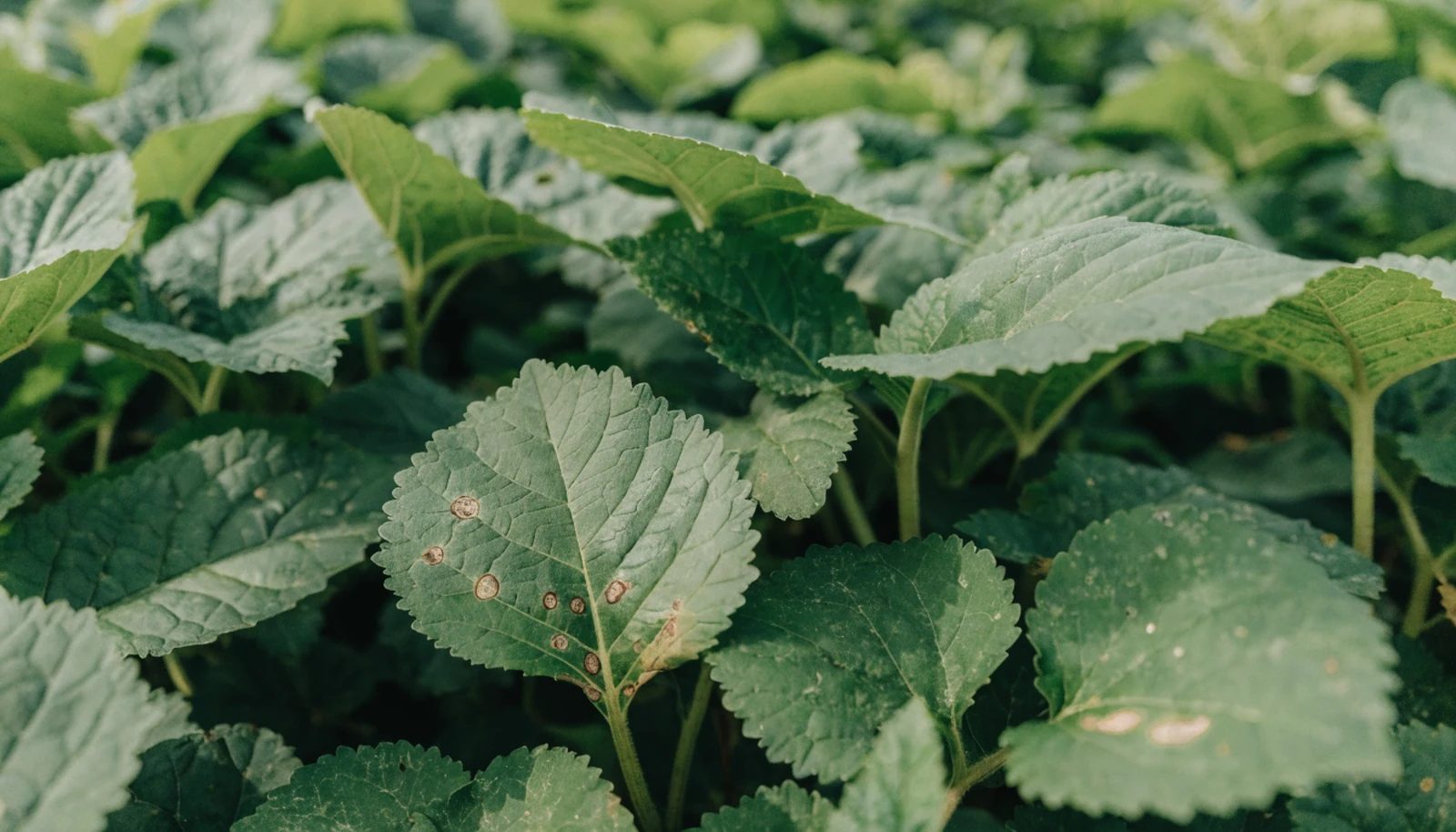
Septoria leaf spot is a fungal disease, caused on tomato by Septoria lycopersici, that produces many small circular spots with gray or tan centers, dark margins and tiny black pycnidia. It starts on the lowest leaves and moves up with splashing water. Remove affected lower leaves early, mulch, switch to drip irrigation, improve airflow, rotate, and protect the remaining canopy through wet spells.
Crops affected
How do you identify septoria leaf spot?
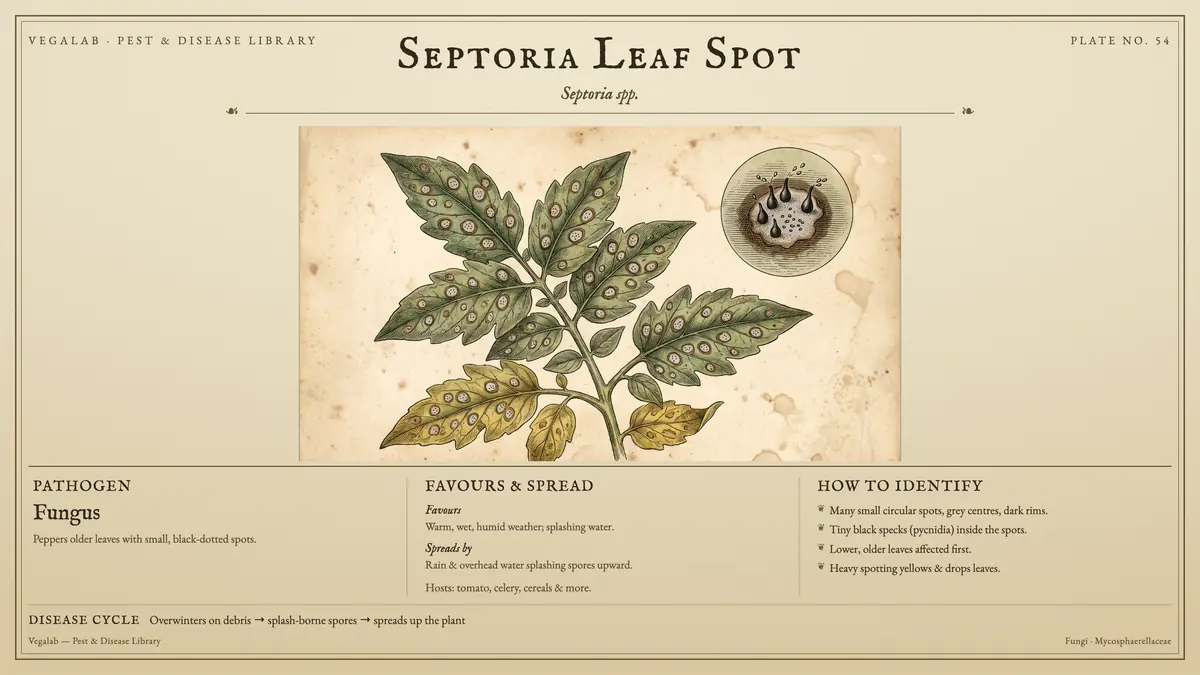
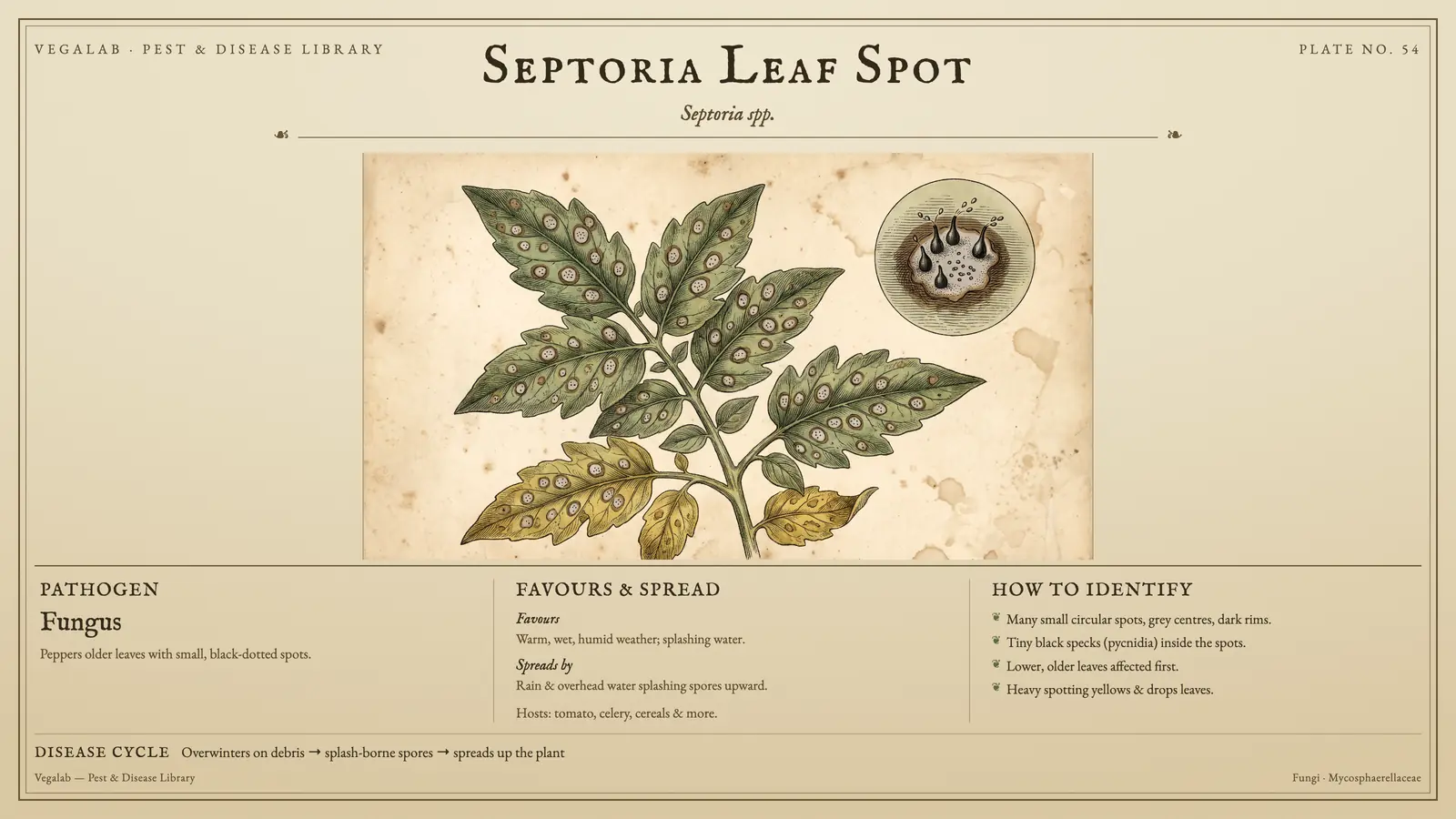
- Tiny black specks (pycnidia) inside the spots.
- Heavy spotting yellows & drops leaves.
What causes septoria leaf spot?
Septoria fungi infect leaves (and sometimes stems), producing distinctive small spots with gray/tan centers dotted with tiny black fruiting bodies. They survive in debris and seed and spread by splash, favoring prolonged leaf wetness.
What does septoria leaf spot look like?
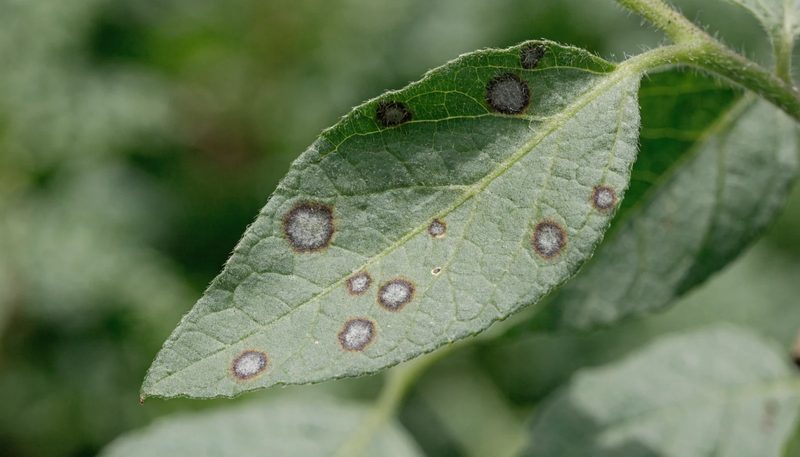
- Numerous small (2-5 mm) circular spots with pale tan/gray centers and darker margins.
- Tiny black pycnidia (fruiting bodies) speckling the spot centers - diagnostic under a hand lens.
- Lower, older leaves affected first, yellowing and dropping as the disease moves upward.
- Heavy defoliation exposing fruit to sunscald in severe cases.
How does septoria leaf spot spread?
Survives in crop debris and on seed; spores spread by rain splash and overhead irrigation to lower leaves, then progress up the canopy in repeated wet cycles.
What conditions favor septoria leaf spot?
Warm, wet, humid weather; prolonged leaf wetness; dense canopies and splashing irrigation; carry-over inoculum in debris.
What damage does septoria leaf spot cause?
Progressive defoliation reduces photosynthesis and yield, weakens plants and exposes fruit to sunscald; in cereals, leaf blotch cuts grain fill.
How do you scout for septoria leaf spot?
Scout lower leaves in warm wet spells; confirm with a hand lens (look for black pycnidia in spots); act preventively as conditions favor disease.
How do you control septoria leaf spot?
- Improve airflow, avoid overhead wetting, remove debris and rotate;
- apply protectant programs preventively and at first symptoms, starting low in the canopy.
How do you treat septoria leaf spot?
- Remove the lowest affected leaves early. The disease starts on the oldest, lowest foliage; taking those leaves off in the first week or two removes the launch pad and buys weeks.
- Mulch the soil surface. Straw or plastic mulch physically blocks spores splashing up from infested soil and debris, and it is one of the highest-return measures available.
- Stop wetting the leaves. Drip rather than overhead irrigation, and water early in the day. Rain you cannot control; irrigation you can.
- Space and stake for airflow. Trellised, pruned plants dry faster; sprawling plants stay wet and lose their lower canopy.
- Protect the remaining canopy through wet spells and renew after rain · applications are preventive and cannot cure an existing spot.
- Clear debris and rotate. Septoria lycopersici overwinters on tomato debris and on solanaceous weeds such as nightshade and horsenettle; a two- to three-year break away from solanaceous crops plus weed control reduces the starting inoculum.
- Do not work a wet crop. Hands, clothing and tools move the spores along the row as effectively as rain does.
Septoria works from the bottom of the plant upwards, spread by splashing water. Almost everything effective either interrupts the splash or removes the lower-leaf inoculum it starts from.
Defoliation is the real cost. The spots themselves matter far less than the loss of the canopy that should be sizing and protecting the fruit - fruit on a defoliated plant sunscalds and finishes small.
Septoria, early blight or bacterial spot?
- Septoria leaf spot: many small circular spots, 2–3 mm, with a distinctly gray or tan center and a dark border, and tiny black pinprick fruiting bodies (pycnidia) visible in that pale center. Rarely affects fruit.
- Early blight: fewer, larger, darker lesions with concentric rings - the target-spot pattern - often with a yellow halo, and it attacks stems and fruit as well as leaves.
- Bacterial spot and speck: smaller, angular, water-soaked and greasy-looking lesions, often with a yellow halo, and it does hit fruit with raised scabby spots.
- Late blight: large, irregular, greasy gray-green patches that expand fast in cool wet weather, with white sporulation at the lesion margin on the underside - a much faster and more destructive disease.
All three start on the lower leaves of a tomato crop in wet weather, and they are routinely confused. Look at the individual lesion with a hand lens.
The pinprick black pycnidia in a pale center are the confirmation for septoria. See Early Blight, Bacterial Spot & Speck and Late Blight (Phytophthora).
Why does septoria always start at the bottom of the plant?
The pattern is diagnostic and it tells you where to intervene. The inoculum overwinters in debris and soil at ground level, and it is moved upward by splashing rain and irrigation. So the lowest leaves are infected first, and each subsequent rain event moves the front a little higher up the plant.
That geometry is why mulching and lower-leaf removal are disproportionately effective here compared with a wind-dispersed disease, and why a mid-canopy application that ignores the bottom of the plant tends to disappoint. It also means the disease is predictable: if you know it was present last year and the block is unmulched, you know where it will appear and roughly when.
When is septoria worth treating?
- Act: wet season ahead, lesions on lower leaves, crop still setting or sizing fruit, indeterminate variety with weeks of picking left
- Probably not worth it: final pick imminent, dry weather forecast, damage confined to leaves already senescing
- Act on prevention next season instead: the block had septoria this year and is unmulched - mulch and rotation will do more than any in-season application
Septoria rarely kills a plant, so the decision is economic rather than existential, and it turns on one thing: how much canopy the crop still needs. Early infection on a crop that has not yet set and sized its fruit is worth acting on, because the leaves lost are the leaves that would have filled that fruit. The same level of infection on a determinate crop already finishing its last pick usually is not.
The practical threshold most growers can work to is the lower third of the canopy. Once lesions are established there and the weather is staying wet, the disease will keep moving upward, and intervention aimed at protecting the middle and upper canopy is justified. Waiting until the middle canopy is affected means accepting a smaller, more sunscald-prone crop - fruit on a defoliated plant has no shade.
Is septoria in tomato the same as septoria in wheat?
Searches for "septoria" mix two quite different diseases, and the distinction matters if you grow both. This page covers Septoria lycopersici, the tomato leaf spot pathogen. Septoria tritici blotch in wheat is caused by Zymoseptoria tritici, a different pathogen with a different host range, a different epidemiology and - importantly - its own well-documented fungicide resistance profile.
They share the genus history, the splash-dispersed, bottom-up progression and the black pycnidia in pale lesions, so the diagnostic habits transfer. Almost nothing else does: a program, product choice or resistance strategy built for one is not transferable to the other, and neither host is a source of inoculum for the other.
If your crop is a cereal, the relevant pathogen is Zymoseptoria tritici and local cereal-specific guidance applies. Our cereal programs are linked from Wheat.
Recommended Vegalab solution: Spore Control
Spore Control · natural broad-spectrum fungicide (thymol) applied preventively under favorable conditions and at first symptoms, with thorough coverage of the lower canopy; combine with airflow and sanitation.
| Role | Product | Use |
|---|---|---|
| Primary control | Spore Control |
By crop
How do you prevent septoria leaf spot next season?
Airflow/canopy management, drip vs overhead irrigation, debris removal, rotation and clean seed, plus preventive sprays in wet periods.
Key takeaways
- Tiny black pycnidia in pale spot centers, seen with a hand lens, confirm septoria.
- The disease works from the bottom of the plant up, carried by rain splash and overhead irrigation.
- Mulch and early removal of the lowest affected leaves are among the highest-return measures.
- Protectant applications are preventive and cannot cure an existing spot.
- Defoliation is the real cost: fruit on a defoliated plant sunscalds and finishes small.
Claims and product availability vary by jurisdiction. Always read and follow the product label.