


Feed and Grain Storage
Stored feed spoils from moisture and temperature first and from pests second. Mites, beetles, weevils and molds all accelerate once grain is warm and damp, and rodents contaminate what they do not eat. Control starts with bin condition and moisture, then hygiene of empty structures, then targeted treatment of the building rather than the feed.
Moisture and temperature decide the outcome
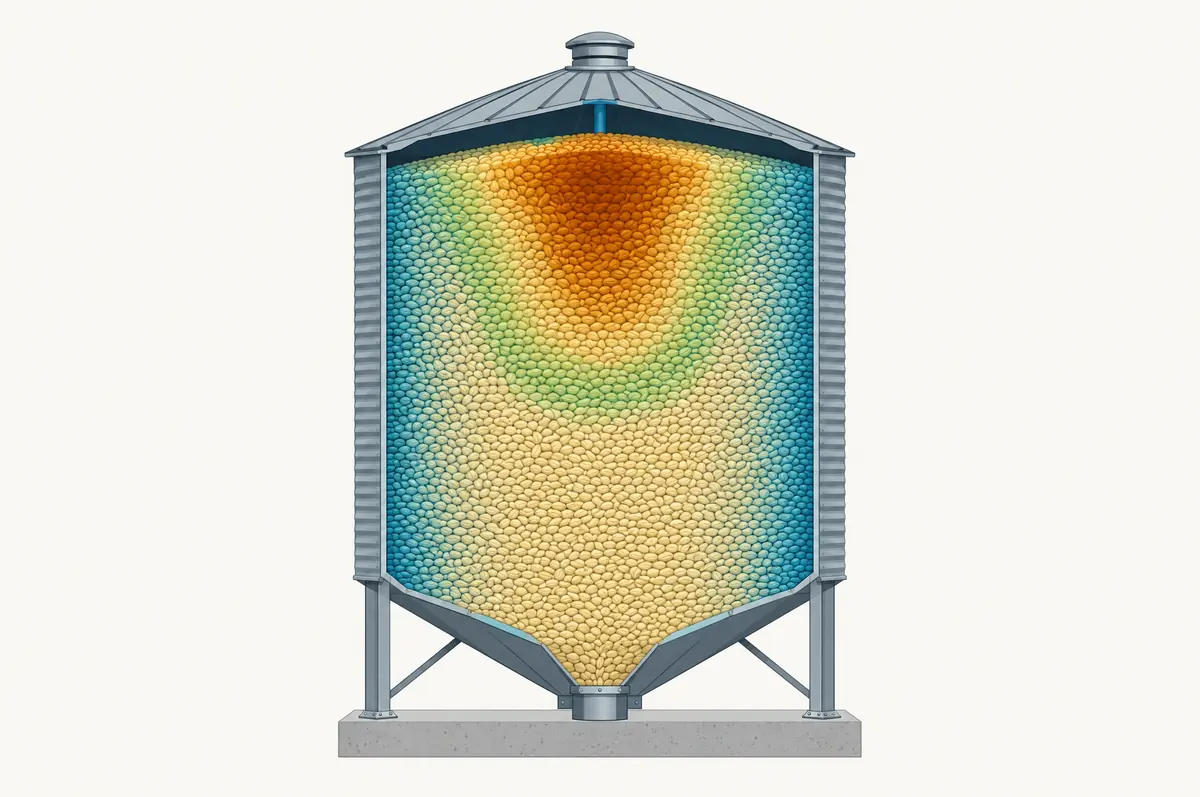
Stored-product insects and mites breed fastest in warm, moist grain and slow sharply as grain is cooled. Drying to a storage-stable moisture for the crop, aerating to cool the mass, and monitoring temperature with cables finds hot spots before they spread. Condensation under roofs and at bin walls creates damp layers where molds start. Feed rooms on livestock units face the same problem at smaller scale, especially with bagged feed stored on floors.
Empty-bin and building hygiene
Residual grain in augers, sweep channels, floors and cracks carries infestations into the new crop. Before filling, remove all residue, sweep and vacuum, and treat empty structures with a product labeled for that use. Seal gaps that let rodents and birds in, and keep a clear strip around bins and feed stores. Spilled feed around feeders and silos is the most common reason rodent programs fail. Record cleaning dates for each bin so the next fill starts from a known condition, and inspect again two weeks after filling.
Molds, mycotoxins and pests together
Insect and mite feeding opens kernels to mold and raises moisture locally, so pest pressure and mycotoxin risk rise together. Once mycotoxins form, cleaning does not remove them. Test incoming and stored feed where risk is high, rotate stock first in first out, and discard caked or heated material. Surface disinfection of feed rooms and bins supports this but does not correct wet grain. Keep sampling records with bin numbers so problem structures can be identified and repaired before the next harvest.
Key facts
- Cooling stored grain below about 15 C (60 F) slows development of most stored-product insects, which is the basis of aeration control (Hagstrum and Subramanyam 2006, Fundamentals of Stored-Product Entomology, AACC International).
- The FDA action level for aflatoxin in most animal feeds and feed ingredients is 20 ppb, with higher levels allowed only for specific finishing livestock (FDA Compliance Policy Guide Sec. 683.100).
- Stored-product mites such as Acarus siro thrive at high relative humidity, so keeping stored feed and grain dry limits their development (Hagstrum and Subramanyam 2006, Fundamentals of Stored-Product Entomology, AACC International).
- Pesticide products may be applied to stored commodities or feed only when the label permits that use, since use inconsistent with labeling is unlawful (FIFRA Section 12(a)(2)(G), 7 U.S.C. 136j).
How our delivery technology applies
Empty-structure treatments with volatile botanicals usually disappear before the next fill because the vapor escapes through vents and gaps. Multi-layer encapsulation holds the active in a deposit on walls and floors and releases it slowly, which is the mechanism we are evaluating for residual in empty bins and feed rooms. For surface hygiene, stabilized chlorine dioxide gives a consistent working solution without on-site generation.
Feed mills and integrators: talk to us about empty-structure residual trials.
Related reading
Last updated: