


Geraniol
Last updated:
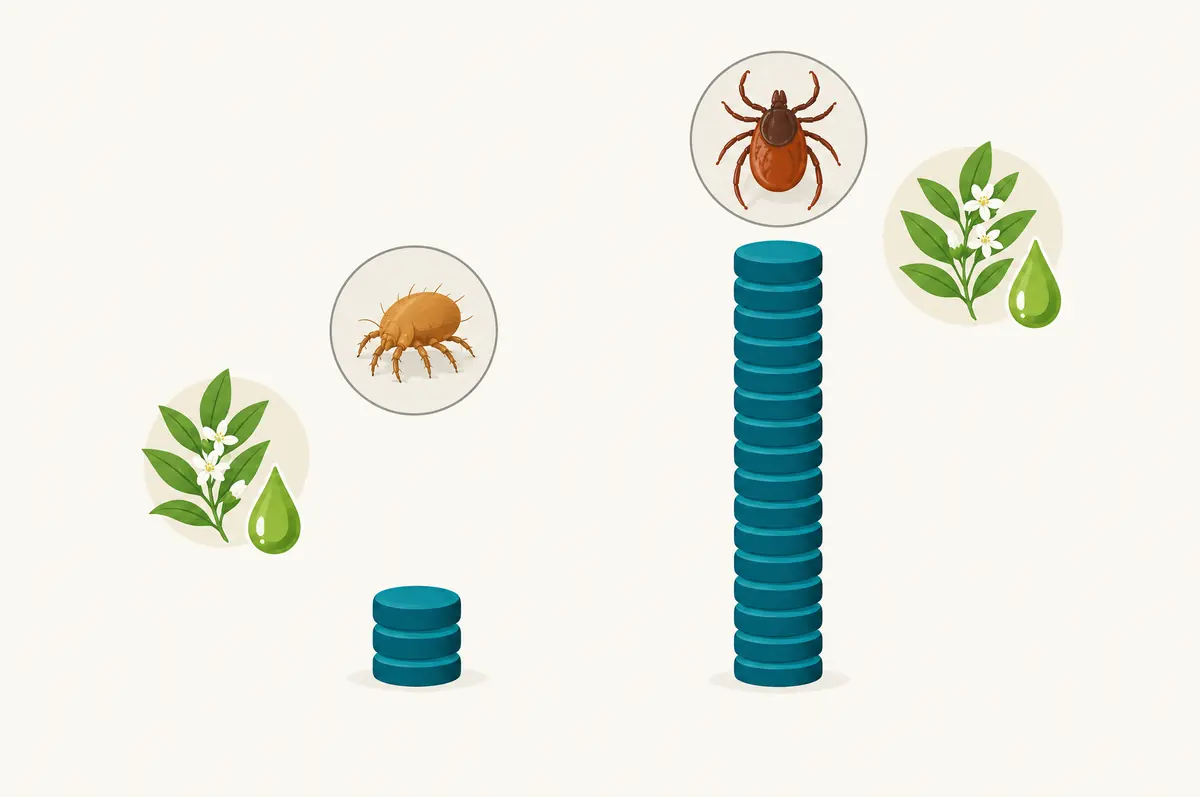
Geraniol (CAS 106-24-1) is a monoterpene alcohol from rose, palmarosa and citronella oils and a permitted FIFRA 25(b) active. It kills mites on contact at low concentrations, repels ticks strongly, and needs much higher doses to kill ticks. It is volatile, oxidizes in air and is toxic to cats.
Properties and mode of action
Geraniol is an acyclic monoterpenoid alcohol (C10H18O) with a boiling point near 230 C and moderate lipophilicity, which lets it partition into the waxy arthropod cuticle. Proposed actions include membrane disruption and effects on octopamine signaling. It evaporates and oxidizes when spread as a thin film, which limits residual. In Vegalab products it is the main active in Spider Mite Control (30%) and Mildew Control (17%). Its moderate lipophilicity also favors uptake through the waxy cuticle of mites.
Ticks: repellency strong, killing costly
Repellency evidence is strong: 1% geraniol on cattle reduced Hyalomma counts by 98.4, 97.3 and 91.3% at days 7, 14 and 21. Kill endpoints are higher: larval LC50 of about 6.6 mg/mL for pure geraniol (R. microplus), higher estimated values for unfed adult R. sanguineus, higher again for engorged female R. annulatus (estimated from geranium-oil studies), and larval LC95 about 11.1 mg/mL for R. microplus. Spider Mite Control at 1:500 delivers about 0.57 mg/mL. We found no published geraniol mortality data for tick nymphs.
Interactions and species sensitivity
Geraniol is not additive with every oil: it was antagonistic with thyme and savory oils against Ixodes ticks, so blends need testing. Geraniol is toxic to cats, and products containing it are for premise, housing, bedding and perimeter use only, never on animals. Minimum-risk products using geraniol may not make public-health claims. Workers applying concentrated geraniol products should follow label protective equipment requirements, since geraniol is a known skin sensitizer and must be declared as a fragrance allergen in EU cosmetics.
Key facts
- Geraniol is a permitted active for FIFRA 25(b) minimum-risk pesticides (40 CFR 152.25(f)(1)).
- 1% geraniol applied to cattle reduced Hyalomma tick counts by 98.4, 97.3 and 91.3% at days 7, 14 and 21 (Khallaayoune et al. 2009, Parasite 16:223).
- Geraniol larval LC95 against a susceptible Rhipicephalus microplus strain was about 1.1% (Singh et al. 2018, Ticks Tick Borne Dis 9:201).
- Geranium oil (about 10% geraniol) was antagonistic in binary mixtures with white thyme and savory thyme oils against Ixodes scapularis (Anholeto et al. 2024, Ticks Tick Borne Dis 15:102309).
How our delivery technology applies
Geraniol's two limits are volatility and dose. Multi-layer encapsulation slows evaporation and oxidation, extending the time a deposit stays above the effective concentration. It does not remove the dose gap: ticks need roughly 1:50 for median kill and 1:25 for reliable kill, 10 to 20 times the spider mite rate. Our planned USDA-ARS larval packet test with an I. scapularis nymph arm will measure encapsulated versus neat residual at days 1, 7, 14 and 28.
Researchers and registrants: ask about our geraniol tick trial design.