

Does hydrogen peroxide help plants with root rot and fungus gnats?
Last updated:
Only weakly. Root rot comes from soilborne water molds and fungi such as Pythium and Phytophthora in waterlogged soil, so drainage and watering address the cause.4 In a controlled study, a 3% hydrogen peroxide root dip caused minor root damage and did not clear algae, while stronger dips damaged roots permanently.1 Against fungus gnats, one hydroponic trial reduced adults but also affected lettuce germination.2
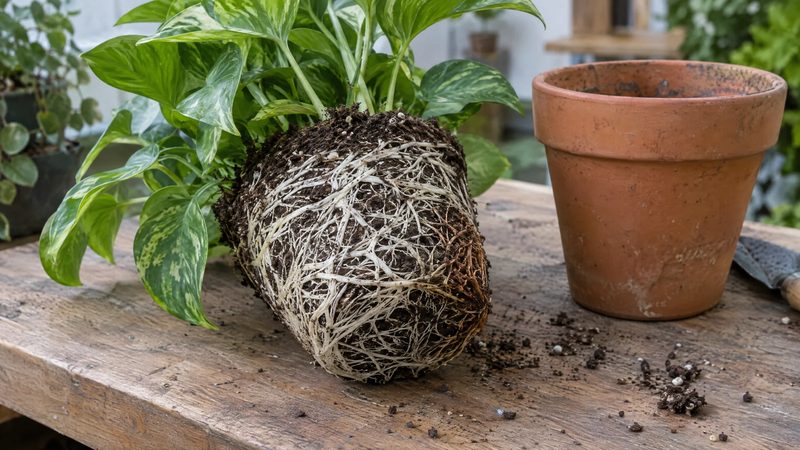
What causes root rot, and can hydrogen peroxide cure it?
Root rot in potted plants is caused by soilborne organisms, most commonly Pythium spp., Phytophthora spp., Rhizoctonia solani and Fusarium spp., which have wide host ranges.4 Pythium and Phytophthora produce spores that persist in soil or plant debris for long periods, and all of these organisms grow and reproduce best in saturated soil.4 Typical signs are wilting even when the soil is wet, stunting, yellow or red leaves that can look like a nutrient deficiency, and soft brown roots that may smell foul.4
Hydrogen peroxide is popular with home growers as a remedy for root decay and as a way to encourage root growth, and researchers set out to measure its effects on roots.1 University of Wisconsin guidance on houseplant root rot does not list it: the advice is that discarding an affected plant is often the most practical option, and that a plant you keep needs less soil moisture, with enough water for growth but no overwatering.4 The same guidance does not recommend fungicides for houseplants.4
In North America, hydroponic and greenhouse root rot pressure rises in summer: dissolved oxygen in nutrient solution falls as it warms and Pythium root rot is most severe at moderate to high root zone temperatures7, so growers chill water to 68 to 72°F especially in summer6; fungus gnats thrive wherever potting mix stays moist8. In the Southern Hemisphere the same warm-season risk falls from about December to February.
What happened when roots were dipped in hydrogen peroxide?
A peer-reviewed study in HortTechnology dipped the roots of hybrid Phalaenopsis orchids once for 3 minutes in 0%, 3%, 6% or 12% hydrogen peroxide and followed them in a greenhouse for 27 days.1 The 6% and 12% dips damaged root health permanently, and plants in those treatments showed foliage wilt by week 4.1 Fresh weight of roots and leaves fell as the concentration rose.1
The 3% dip caused only minor root damage, but it did not kill the algae in the root zone, and its long-term effects on plant health are unknown.1 The authors concluded that growers should be wary of using hydrogen peroxide to improve orchid root health and should change care and watering practices instead.1
| Concentration | Root health rating (5 = very healthy) | Outcome |
|---|---|---|
| 3% | Fell from 5 to 4.13 | Minor root damage; algae not killed |
| 6% | Declined; damage permanent | Root health damaged permanently; foliage wilt by week 4 |
| 12% | Fell from 5 to 1.13 | Root health damaged permanently; foliage wilt by week 4 |
Does hydrogen peroxide help with root rot in hydroponics?
In hydroponic systems the most common root disease is Pythium root rot, with Fusarium, Phytophthora and Rhizoctonia less often involved.5 Pythium is a water mold whose swimming spores, called zoospores, move through water toward damaged root tips, especially roots stressed by low oxygen or high nutrient salt levels.6
Hydrogen peroxide has a defined role here: Colorado State University Extension lists hydrogen peroxide products made for hydroponics, alongside 10% chlorine bleach, for disinfecting trays, rafts, beds and troughs, following the label directions.5 Extension specialists also list oxidizers such as hydrogen peroxide among water treatment options, with the caution that some treatments alter nutrient solution pH, interfere with nutrient availability or are phytotoxic to some crops.6
A review of Pythium root rot in hydroponic crops lists activated hydrogen peroxide among measures that disinfest the nutrient solution as it recirculates outside the crop, and notes that such measures commonly have a minor impact on epidemics compared with treatments that suppress Pythium in the root zone itself.7 The same review describes oxygenation of the nutrient solution as one of the few practical measures once root rot is well advanced.7 Keeping dissolved oxygen high through aeration and holding the root zone at about 68 to 72°F are standard extension advice.5,6
Does hydrogen peroxide kill fungus gnat larvae?
Fungus gnats (Bradysia spp.) are small, dark flies whose larvae live in moist potting mix, feeding mainly on fungi and organic matter but also chewing roots.8 A Cornell Cooperative Extension county guide describes pouring diluted 3% hydrogen peroxide over the soil, where it fizzes as it reaches the larvae, and then letting the soil dry.3
The peer-reviewed evidence is thin. In a commercial hydroponic lettuce system, hydrogen peroxide sprayed on phenolic foam plates right after seeding reduced adult fungus gnats and shore flies and left fewer larvae than water, and it held back algae, which attract these flies, over 15 days.2 It also affected lettuce seed germination, as did the spinosyn insecticide, which was the only treatment that left no larvae.2 The trial was run in foam rather than potting soil, so it does not show how a soil drench performs.2 If you use any product on gnats, follow the product label.
How are fungus gnats and root rot connected?
Both problems are driven by wet growing media, and they feed each other.4,8 Fungus gnats and shore flies have been reported to pick up Pythium, and Pythium oospores have been found in the digestive tracts of their larvae and adults.7 In fungus gnats, oospores acquired as larvae stay in the gut through pupation and can be carried by the flying adults and excreted in their frass.7 Larval feeding on roots and root hairs also makes wounds that pathogens can enter.7
Algae in hydroponic systems harbor shore flies and fungus gnats, which is one reason extension advice for root disease includes keeping algae and insect pests to a minimum.6 Wilting, however, is more often caused by too much or too little water, root decay fungi or poor drainage than by fungus gnat larvae, so check the roots before treating for gnats.8
What works better than hydrogen peroxide for root rot and fungus gnats?
The common fix for both is moisture control, backed by sanitation and, for gnats, a larval treatment.4,8
- Buy plants from a reputable source and check that they are free of root rot.4
- Disinfest tools, work surfaces and clay pots with a 10% bleach or detergent solution, or with alcohol.4
- Bacillus thuringiensis subsp. israelensis (Bti) does not persist indoors, and Steinernema feltiae is more effective against fungus gnats than other commercial nematode species; follow the product label for either.8
| Problem | First step | Further options |
|---|---|---|
| Root rot in pots | Reduce soil moisture; use pots with drainage holes and no gravel layer | Discard badly affected plants; use pasteurized commercial mix; do not reuse old mix, drainage water or plastic pots; disinfest tools and clay pots |
| Root rot in hydroponics | Start with a disinfected system and discard infected plants early | Aerate for high dissolved oxygen; keep the root zone near 68 to 72°F; balanced nutrient solution |
| Fungus gnats | Let the soil surface dry between waterings; improve drainage | Yellow sticky traps; Bti or Steinernema feltiae nematodes as a soil drench; pasteurized potting mix |
Key takeaways
- Root rot is caused by Pythium, Phytophthora, Rhizoctonia and Fusarium in saturated soil, so watering and drainage address the cause.
- In a controlled study, 6% and 12% hydrogen peroxide root dips damaged orchid roots permanently, and a 3% dip did not clear algae.
- In hydroponics, hydrogen peroxide products are used for disinfection and water treatment, and disinfesting recirculating solution has commonly had only a minor effect on Pythium epidemics.
- The only peer-reviewed fungus gnat trial found fewer adults with hydrogen peroxide but also reduced lettuce germination.
- Fungus gnats can carry Pythium, so drying the soil surface, Bti or Steinernema feltiae, and sanitation help both problems.
References
- Characterizing the Phytotoxic Effects of Hydrogen Peroxide Root Dips on Hybrid Phalaenopsis Orchid Plants
- Hydrogen Peroxide for Insect and Algae Control in a Lettuce Hydroponic Environment
- A Spooky Houseplant Pest: Fungus Gnats
- Root Rots on Houseplants (D0096)
- Root Disease Problems and Management in Hydroponic Systems (PlantTalk 2043)
- Root disease management in hydroponic systems (e-GRO Edible Alert 7(6))
- Etiology and epidemiology of Pythium root rot in hydroponic crops: current knowledge and perspectives
- Pest Notes: Fungus Gnats (UC ANR Publication 7448)
Frequently asked questions
Does hydrogen peroxide add oxygen to plant roots?
The oxygen evidence in the sources reviewed comes from aeration. High dissolved oxygen reduces Pythium zoospore survival, and extension specialists advise aerating nutrient solution to saturation.6 A review of hydroponic root rot notes that dissolved oxygen falls as solution temperature rises and that injecting oxygen may be needed in recirculating systems.7