

Last updated:
Phytophthora root rot is a disease caused by Phytophthora species, water molds (oomycetes) whose swimming spores move through saturated soil to attack roots and crowns. Plants wilt in wet soil and fail to recover after irrigation, with brown, brittle roots and reddish-brown crown lesions. Control centers on drainage: raised beds, planting high, careful irrigation, resistant rootstocks and clean planting material.
Crops affected
How to identify phytophthora
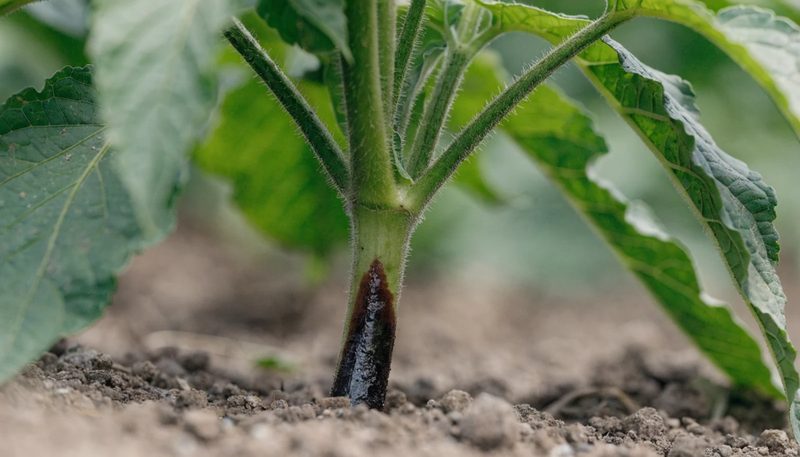
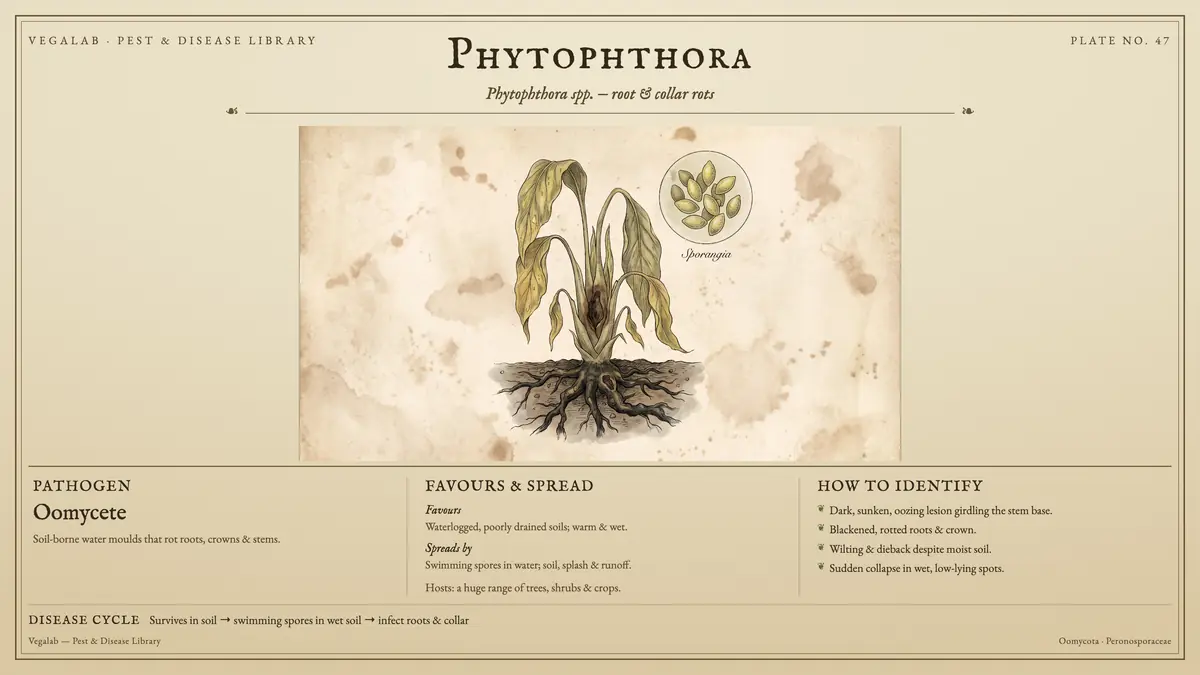
- Dark, sunken, oozing lesion girdling the stem base.
What is it?
Phytophthora species are oomycetes - not true fungi - that thrive in saturated soils and wet canopies. Different species attack roots, crowns, stems, foliage and fruit. They produce swimming spores that move in water, making wet conditions the key driver.
What are the signs of Phytophthora?
- Wilting despite moist or wet soil; plants that don't recover after irrigation.
- Dark, rotting roots and reddish-brown crown or collar lesions.
- Water-soaked foliar or fruit lesions that expand rapidly in wet weather.
- Rapid plant collapse, often starting in low-lying or poorly drained areas.
How does Phytophthora spread?
Survives in soil and infected debris as resting spores; produces swimming zoospores in free water that infect roots and splash onto foliage/fruit. Cycles rapidly under warm, wet conditions.
What conditions favor Phytophthora?
Saturated soils, poor drainage, overwatering, and prolonged canopy wetness. Low spots and compacted soils are hotspots.
What damage does Phytophthora cause?
Kills roots and crowns (plant death), and rots foliage and fruit. Can move from a few plants to a whole block quickly in wet weather.
How do you scout for Phytophthora?
Watch low/wet areas and recently irrigated blocks; check roots and crowns of wilting plants; act preventively when wet conditions are forecast.
How do you control Phytophthora?
- Improve drainage and airflow, avoid overwatering, and apply protectant programs preventively.
- Because oomycete infections can't be reversed once established, the goal is protecting healthy tissue and supporting plant defense.
How to manage phytophthora
- Fix the drainage. This outranks everything. Phytophthora zoospores swim, so saturated soil is a transport network. Raised beds, subsoiling compacted layers, grading to remove low spots, and avoiding planting in known wet hollows all directly remove its mobility.
- Irrigate to the crop, not to the schedule. Over-irrigation is the most common avoidable cause. Let the root zone drain between irrigations, and avoid keeping the crown wet.
- Plant high. Setting the crown or graft union above the surrounding soil level, on a mound or berm, keeps the most vulnerable tissue out of standing water.
- Use resistant rootstocks. In avocado, citrus, stone fruit and many ornamentals this is the single most effective long-term decision available.
- Buy and plant clean material. Phytophthora is very commonly introduced on nursery stock and in contaminated potting media or irrigation water.
- Treat the water. Recycled irrigation water and open reservoirs carry zoospores; filtration or disinfection matters in protected and container production.
- Sanitize equipment, boots and vehicles between blocks. This is how the pathogen crosses a farm and how new species arrive on a property.
- Build soil biological activity and root health. An active rhizosphere and a well-structured, freely draining soil support root regeneration and reduce pressure as part of a soil program.
- Remove and destroy infected plants with the root ball and surrounding soil, and do not replant the same spot with a susceptible host.
Phytophthora means "plant destroyer", and the genus earns it. Because it needs saturated soil to move, water management is not one control measure among several - it is the control measure, and everything else is secondary to it.
Because it is an oomycete rather than a true fungus, most broad-spectrum fungicides have little effect. Product choice must be specifically oomycete-active, and resistance to the main oomycete chemistry is documented - rotate.
How do you recognize Phytophthora root and crown rot?
- Cut the bark at the crown and just below soil level. Healthy tissue beneath is white or green; Phytophthora leaves a reddish-brown to dark discoloration with a distinct margin between diseased and healthy tissue.
- Examine the fine roots. They will be brown, sparse and brittle, with the outer tissue stripping away when pulled - very little functional feeder root remains.
- Note the site pattern. Affected plants concentrate in low spots, along irrigation lines, at the bottom of slopes and in compacted headlands. A wilt pattern that follows the water is a strong indicator.
- Distinguish from vascular wilt: Verticillium and Fusarium give clean brown staining of the vascular ring with intact roots; Phytophthora gives rotted roots and crown lesions.
- Distinguish from drought: drought-stressed plants recover after irrigation. A Phytophthora plant declines further, because irrigating it makes the disease worse.
The above-ground symptoms are non-specific - poor vigor, wilting, dieback, sparse pale canopy, sudden collapse in hot weather - and are routinely misattributed to drought, nutrition or simply a difficult site. The diagnosis is made below ground and at the crown.
Wilting in wet or poorly drained soil raises suspicion of Phytophthora, especially when plants fail to recover after irrigation, but it is not diagnostic. Inspect roots and crown for characteristic discoloration and decay and confirm with appropriate testing.
Which Phytophthora species matter most?
- P. infestans · potato and tomato late blight; foliar rather than root-attacking, and covered separately at Late Blight
- P. cinnamomi · the most widespread root-rot species; avocado root rot, and devastating in native ecosystems and ornamentals
- P. capsici · pepper, cucurbit and tomato crown and fruit rot; explosive after heavy rain in warm conditions
- P. ramorum · sudden oak death and ramorum blight; a quarantine pathogen with movement restrictions on nursery stock
- P. cactorum · crown rot of strawberry and apple collar rot
- P. nicotianae and P. citrophthora · citrus root rot, brown rot and gummosis
Several are regulated quarantine organisms with legal reporting obligations. If you suspect P. ramorum or another notifiable species, contact your plant health authority - do not simply treat and move on.
Recommended Vegalab solution: Spore Control
Spore Control · natural broad-spectrum fungicide (thymol) applied preventively or at first symptoms under wet conditions, with thorough coverage; pair with drainage and airflow management.
| Role | Product | Use |
|---|---|---|
| Primary control | Spore Control |
By crop
How do you prevent Phytophthora next season?
Site drainage, irrigation management, resistant rootstocks where available, and preventive application ahead of wet periods.
Key takeaways
- Phytophthora is an oomycete, not a true fungus, so most broad-spectrum fungicides have little effect.
- Saturated soil is its transport network, which makes drainage the main control measure.
- Plants with Phytophthora decline further after irrigation, while drought-stressed plants recover.
- Established infections cannot be reversed; the goal is protecting healthy tissue.
- Several species, including P. ramorum, are regulated quarantine organisms with reporting obligations.
Claims and product availability vary by jurisdiction. Always read and follow the product label.