


What do white spots on plant leaves mean?
Last updated:
White spots on plant leaves usually mean powdery mildew, a fungus that forms white to gray powdery patches; the pale feeding stipple of spider mites or thrips; cottony mealybugs; or mineral residue from hard water.1,5,6,7,8 On squash and zucchini, silver patches that follow the veins can be an inherited leaf pattern, not a disease.3
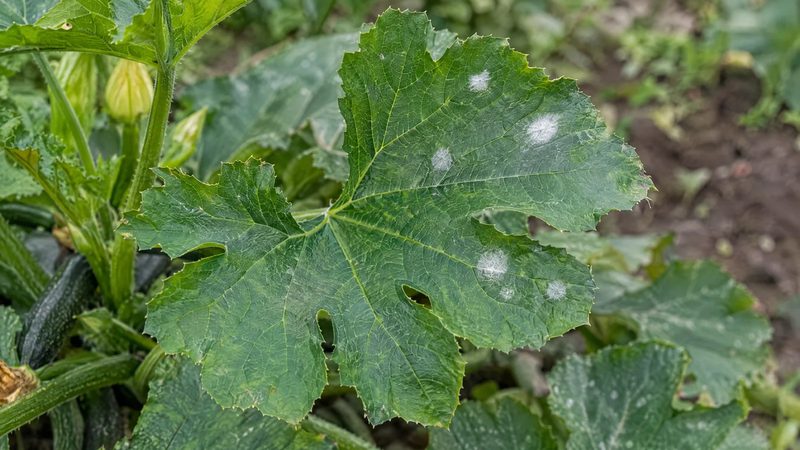
How do you tell what is causing white spots on leaves?
Look closely at whether the white sits on top of the leaf or is part of the leaf itself. Powdery mildew is mostly a fungal growth on the leaf surface, caused on vegetables by host-specific species such as Podosphaera xanthii and Golovinomyces cichoracearum on squash and Leveillula taurica on tomato.1,7 Spider mites and thrips do the opposite: they suck out cell contents and leave pale dots or silvery patches in the leaf tissue.5,6
A 10X hand lens and a look at the leaf underside settle most cases. Spider mites live in colonies mostly on leaf undersides and many species spin fine webbing, while thrips leave black, varnish-like specks of excrement next to their feeding scars.5,6
| What you see | Likely cause | How to confirm |
|---|---|---|
| White to gray powdery patches on upper or lower surface, older leaves first | Powdery mildew | Growth sits on the leaf surface |
| Fine stippling of tiny light dots, sometimes bronzing | Spider mites | Moving dots and webbing on the underside, seen with a 10X lens |
| Silvery flecking or scars with black specks | Thrips | Shake foliage over white paper to dislodge thrips |
| White cottony tufts in leaf axils and sheaths | Mealybugs | Tufts are white, cottony insects, not fungus |
| White crystalline crust on leaves, soil or pot | Hard water minerals or fertilizer salts | Crust also forms on the soil surface and the pot |
| Bleached, whitened areas on sun-facing leaves | Too much light or sunburn | Plant was recently moved into stronger light |
| Silver patches along the veins of squash leaves | Inherited silver mottle or silverleaf whitefly | Check leaf undersides for whitefly nymphs |
In North America, white spots from powdery mildew and spider mites build through summer: spider mites commonly become numerous from June through September5, and in California's Central Valley tomato powdery mildew outbreaks generally start in July or August2. In the Southern Hemisphere the same peak falls from about December to March.
Is it powdery mildew?
Powdery mildew is one of the easiest plant diseases to recognize: spots or patches of white to gray, powder-like growth on foliage, stems or fruit.1 About 700 species exist, and each is host-specific, so the mildew on one kind of plant usually cannot infect an unrelated one.1 The fungi are obligate parasites that need a living host.1
Unlike most fungi, powdery mildew spores spread and germinate without free water on the leaf.1 The white mix of threads and spores becomes visible 7 to 10 days after infection, and warm, dry days of 75 to 85°F with high evening humidity can lead to rapid spread, especially in crowded plantings.1 Older foliage is more susceptible and is usually infected first.1 Heavy infections cause leaf curling, yellowing and dieback, and fruit left without leaf cover can sunscald.1
What causes white spots on tomato leaves?
On tomato, the usual cause is powdery mildew caused by Leveillula taurica, which also infects onion and pepper.1 It does not look like the classic white coating at first. Infected tomato leaves develop irregular, bright yellow blotches, then spots of dead tissue, and abundant white sporulation may appear on the upper or lower leaf surface.2 This species grows partly inside the leaf rather than only on the surface.1
The fungus causes no lesions on stems or fruit, but as leaves die the fruit can sunburn and plants weaken.2 It is usually most severe late in the season, high relative humidity favors it, and plants stressed by other problems appear more susceptible.2 UC IPM reports no immune tomato varieties in California, though varieties differ in susceptibility.2 Fine pale stippling on tomato leaves, by contrast, points to spider mites, which are common on vegetables in hot, dusty conditions and on water-stressed plants.5
What causes white spots on squash leaves?
On squash, three causes are worth separating, and only one of them is a disease. Powdery mildew on cucumber, melon, summer squash and winter squash is caused by Golovinomyces cichoracearum and Podosphaera xanthii.1 P. xanthii has several races, so a variety labeled resistant may not resist all of them.1
Some squash and zucchini plants carry silver leaf mottle, an inherited trait controlled by a dominant gene.3 The silver areas have an irregular shape, run along the leaf veins, and come from air spaces between the upper epidermis and the cells below, which change how light reflects; the lower side of the leaf stays green.3 Because the silver is inside the leaf structure, it is not the powdery surface growth of mildew.1,3
The third cause is the silverleaf whitefly (Bemisia argentifolii). When its immature stages feed, their saliva can turn developing leaves silver, starting at the veins and moving outward, as the upper epidermis separates from the cells beneath.4 Even small numbers can silver young transplants, and leaves begin to recover once the whiteflies are controlled.4 Adults and nymphs sit on the undersides of leaves, particularly older ones, so check there.4
What causes white spots on indoor plant leaves?
Indoors, the University of Maryland Extension lists a white powdery coating as powdery mildew, fluffy white wax as mealybugs, bleached or whitened leaves as too much light, and fine stippling as spider mites.7 Mealybugs are white, cottony insects that can sit on foliage, in leaf axils and sheaths, and on roots.7
Hard water is the other common indoor cause. Mineral deposits from water high in dissolved calcium carbonate, sodium and iron, and salts from soluble fertilizers, form white crystallized coatings on leaves or a white crust on the potting mix and pot.8 These deposits compete for available moisture, can burn plant tissue, and can shift the pH of the mix.8
- Powdery mildew indoors: improve air circulation and pick off infected leaves.7
- Mealybugs: remove individual insects with a cotton swab dipped in rubbing alcohol.7
- Sunburn: move plants to stronger light gradually, especially when moving them outdoors in summer.7
- Mineral crust: use water low in dissolved minerals, wash fertilizer spills off leaves, and flush the pot from the top with at least three times its volume of water every 4 to 6 months.8
How do you get rid of white spots on leaves?
Treat the cause, not the spots. For powdery mildew in the garden, Utah State University Extension recommends resistant varieties, wider spacing for air movement, morning irrigation and removing infected plant material after harvest rather than composting it, because compost piles do not get hot enough to kill the fungus.1 Sulfur and potassium bicarbonate are organic fungicide options; oil and sulfur should not be mixed or applied within 2 weeks of each other, because the combination can injure plants.1 Follow the product label for any fungicide.
For spider mites, keep plants watered so they are not drought stressed, and spray water on leaf undersides at least once a day.5 If more is needed, UC IPM suggests insecticidal oil or insecticidal soap with full coverage of the undersides, only after confirming mites are present, and not on very hot days or on water-stressed plants.5 Some insecticides, including certain organophosphates and pyrethroids, kill mite predators and can trigger mite outbreaks.5 Follow the product label for any spray.
Key takeaways
- Powdery mildew grows on the leaf surface as white to gray powder, starting on older leaves, and does not need wet leaves to spread.
- Pale stippling with webbing on the underside means spider mites; silvery flecks with black specks mean thrips.
- On tomato, powdery mildew shows first as bright yellow blotches, with white sporulation on either leaf surface.
- Silver patches along squash leaf veins can be an inherited trait; silverleaf whiteflies cause a similar silvering.
- Indoors, white crust on leaves and soil usually comes from hard water or fertilizer salts; flush the pot with clear water.
References
- Powdery Mildew on Vegetables
- Powdery Mildew on Field-Grown Tomatoes (UC IPM Pest Management Guidelines: Tomato)
- Morphological Analyses and QTL Mapping of Mottled Leaf in Zucchini (Cucurbita pepo L.)
- ENTFACT-319: Silverleaf Whitefly on Squash
- Pest Notes: Spider Mites (UC ANR Publication 7405)
- Pest Notes: Thrips (UC ANR Publication 7429)
- Diagnose Indoor Plant Problems
- Mineral and Fertilizer Salt Deposits on Indoor Plants