


Why are my tomato leaves curling?
Last updated:
Most often, tomato leaves curl because of physiological leaf roll, a stress response to heat, drought, wet soil, heavy pruning or root damage1,2. Lower leaves cup upward, then roll inward toward the midrib, but stay green, and yield is barely affected1. Curling on new growth with yellowing, twisting or stunting points instead to herbicide drift, tomato yellow leaf curl virus or mites5,6,8.
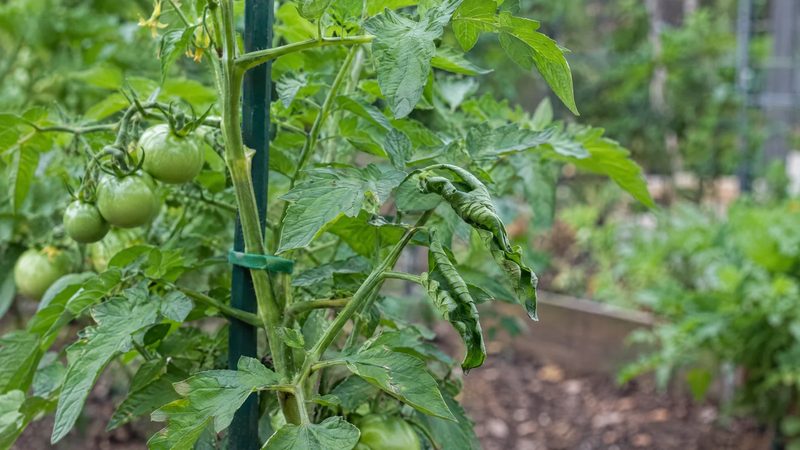
How do you tell what is making tomato leaves curl?
Start with where the curl is and what color the leaves are. Curling or rolling of tomato (Solanum lycopersicum) leaves can come from environmental stress, virus infection or herbicide damage1. Heat or drought curl usually shows first on the lower leaves without yellowing between the veins, while tomato yellow leaf curl virus yellows the margins and the tissue between the veins of young leaves first6. Curling of new leaves can also come from heavy aphid feeding or other viruses6.
| What you see | Likely cause | What else to check |
|---|---|---|
| Lower, older leaves cup upward and roll inward toward the midrib; leaves stay green, thick and leathery1 | Physiological leaf roll1 | Recent heat, drought, soggy soil, heavy pruning or root damage1,2 |
| Youngest leaves twisted, curled, strappy and small; stems bent5 | Growth regulator herbicide such as 2,4-D or dicamba5,4 | Other plant types affected; symptoms on only one portion of the planting5 |
| Young leaves small, crumpled, curled upward, yellow at the edges and between veins; plant stunted and bushy7,6 | Tomato yellow leaf curl virus, spread by whiteflies7 | Whiteflies on leaf undersides; scattered rather than uniform symptoms6,4 |
| Rolled leaves with light and dark mottling and small leaflets1 | Tomato mosaic virus1 | Internal browning of fruit1 |
| Newest leaves turn downward, coppery or purplish; terminal growth twisted and hardened8 | Broad mites8 | Mites on the newest leaves, visible only with a 10x hand lens8 |
In North America, tomato leaf roll shows up most as spring weather shifts to summer, and searches peak in June; 2,4-D drift injury also clusters in May and June. In the Southern Hemisphere, the same window falls around November to January.
Why are my tomato leaves curling up?
Upward curling of otherwise healthy, green leaves is the classic sign of physiological leaf roll1. It starts in the lower leaves with an upward cupping of the leaflets, which then roll lengthwise toward the midvein; the leaves thicken and turn leathery but keep a normal green color, and over time the whole plant can be affected1. The edges of many, but not all, leaves roll upward and inward, sometimes until the sides touch or overlap2.
Water relations are the suspected cause in many cases3. When water uptake drops or demand rises, the plant rolls its leaves, which reduces the leaf area exposed to strong sunlight3. Triggers include excess moisture and nitrogen, too little phosphorus, heat, drought, severe pruning, root damage from tilling or hoeing, early planting and transplant shock1. Severe pruning while the soil is dry, or wet soil combined with hot weather, has also been associated with the problem2.
Variety matters. High-yielding and indeterminate (vining) tomatoes appear more sensitive than other types2, and vining varieties show leaf roll more often than bush (determinate) varieties1. The disorder has minimal impact on fruit production and plant growth1, and it does not affect fruit yield or quality2.
Why are tomato leaves curling inward?
Leaves that roll inward along their length, with the margins moving toward the midrib, are showing the second stage of physiological leaf roll1. In tomatoes, the roll starts at the margins, which turn up and then roll inward, most commonly on the lower leaves3. The roll can be brief or can last for the rest of the season2.
To reduce it, keep soil moisture consistent with mulch, avoid excess nitrogen, apply phosphorus according to a soil test, harden off seedlings before planting, transplant once the weather has warmed, and avoid heavy pruning and root damage1. A well-timed irrigation schedule that prevents both overly dry and overly wet soil, protection from temperatures above 95°F, and planting determinate varieties also help2. Siting tomatoes where they get shade in the late afternoon, the hottest time of day, is another recommended practice1.
Can herbicide drift make tomato leaves curl?
Yes. Tomatoes are very sensitive to 2,4-D, and drift injury usually occurs in May and June; the youngest leaves become twisted, curled and strappy and stay small5. Growth regulator herbicides mimic the plant hormone auxin, and similar symptoms come from dicamba, triclopyr, picloram, clopyralid, aminopyralid and related products4. Typical 2,4-D symptoms on tomato include downward rolling of leaves and twisted growth, stems that turn white and split, and deformed fruit1.
Exposure comes from drift droplets, vapors after application or a contaminated sprayer4. Ester formulations tend to be more volatile than amine, choline or salt forms and can vaporize during or shortly after application4. Residues of some of these herbicides can persist in hay or in livestock manure and urine, so manure from livestock fed treated hay or pasture can carry them into a garden4.
Suspect herbicide injury when more than one type of plant is affected, when symptoms appear on only one portion of a plant or planting, and when nutrient problems, insects and diseases have been ruled out5. Exposed plants cannot be cured; plants that survive may grow out of the injury, but production can still be affected, and fruit from plants damaged by herbicides not labeled for tomatoes should not be sold or eaten4. Even a small amount of residual herbicide can injure tomatoes, so keep a dedicated sprayer for herbicides4.
Which viruses make tomato leaves curl?
Tomato yellow leaf curl virus (TYLCV), a threat to tomatoes in the southern United States, Mexico and the Caribbean, curls leaves upward and downward6. Infected plants are stunted, grow abnormally upright and look bushy, and their leaves are small, strongly crumpled, curl upward and turn yellow at the edges and between the veins7. Flowers commonly drop before fruit set, and losses can reach 100% in heavily infected fields7. Symptoms can take up to three weeks to appear after infection6.
TYLCV is spread by the sweetpotato whitefly, Bemisia tabaci, and not by other whitefly species; it is not spread by touch7. The common greenhouse whitefly does not transmit it7. Because symptoms overlap with other viruses, symptoms alone cannot confirm TYLCV, and a plant clinic or extension specialist should confirm the diagnosis7,6. Planting resistant varieties is an economical way to manage it6.
Other viruses curl leaves too. Tomato mosaic virus causes leaf rolling with mottled leaves, small leaflets and internal browning of the fruit1. Cucumber mosaic virus, spread by aphids, causes leaf and stem distortion that can be mistaken for 2,4-D damage4. There is no treatment for virus-infected plants; remove and destroy them, control weeds that host the viruses, and disinfect pruners used on diseased plants1.
Can insects and mites make tomato leaves curl?
Broad mites (Polyphagotarsonemus latus) cause curling that is easy to misdiagnose8. Tomato is one of their host crops, and their toxic saliva produces twisted, hardened and distorted growth at the tips of the plant; leaves turn downward and become coppery or purplish, and internodes shorten8. The mites gather on the newest leaves and small fruit and are hard to see without a hand lens of 10x or stronger, and their injury is easy to confuse with herbicide injury, boron deficiency or physiological disorders8. Insecticidal oils or soaps are usually as effective as labeled miticides against them8; follow the product label.
Heavy aphid feeding can also curl new tomato leaves6. When a virus is the cause of curled, distorted leaves, its insect vectors, aphids for cucumber mosaic virus and whiteflies for TYLCV, will usually be present and easy to see in the planting4. Check leaf undersides for these insects before blaming herbicide drift4.
Key takeaways
- Green lower leaves that cup upward and roll inward are usually physiological leaf roll, a stress response that barely affects yield.
- Steady soil moisture, moderate nitrogen, light pruning and late afternoon shade reduce leaf roll.
- Twisted, strappy, curled new growth points to growth regulator herbicides such as 2,4-D or dicamba.
- Small, crumpled, upward-curled young leaves with yellow edges suggest tomato yellow leaf curl virus; confirm with a plant clinic.
- Broad mites and heavy aphid feeding can also curl new leaves, so check leaf undersides with a hand lens.
References
- Tomato Leaves Rolling?
- Tomato (Solanum lycopersicum)-Physiological Leafroll, in Pacific Northwest Plant Disease Management Handbook
- Physiological Leaf Roll (Weekly Crop Update, Vegetable Crops 30:11)
- Herbicide Damage in Tomatoes (Publication 3679)
- Herbicide Damage on Vegetables
- Tomato Yellow Leaf Curl Virus
- Tomato Yellow Leaf Curl: A New Disease in California Tomatoes
- Broad Mite, Polyphagotarsonemus latus (Banks) (Arachnida: Acari: Tarsonemidae) (EENY-183/IN340)
Frequently asked questions
Will curled tomato leaves uncurl?
Does leaf curl reduce the tomato harvest?
Is tomato leaf curl contagious?
Physiological leaf roll and herbicide injury do not spread from plant to plant, because they are caused by growing conditions and chemicals rather than infectious agents1,4. Tomato yellow leaf curl virus spreads through whiteflies, not by touch7, while some other tomato viruses can spread mechanically on garden tools1.
Can you eat tomatoes from a plant with herbicide damage?
Mississippi State University Extension advises that tomatoes from plants damaged by herbicides or other pesticides not labeled for use on tomatoes should not be sold or consumed4. Prevention is the practical answer: use a dedicated herbicide sprayer and check the herbicide history of any manure or hay you bring into the garden4.