


Do calcium sprays fix blossom end rot?
Last updated:
No. Calcium travels to fruit only with water in the xylem and cannot move from leaves to fruit through the phloem, so calcium sprayed on foliage stays in the leaves1,3. In a tracer study, tomato leaves absorbed sprayed calcium quickly but moved almost none of it, and a field trial found no reduction in rot from calcium sprays2,4. Even soil moisture is the most effective prevention1.
What do people believe about calcium sprays?
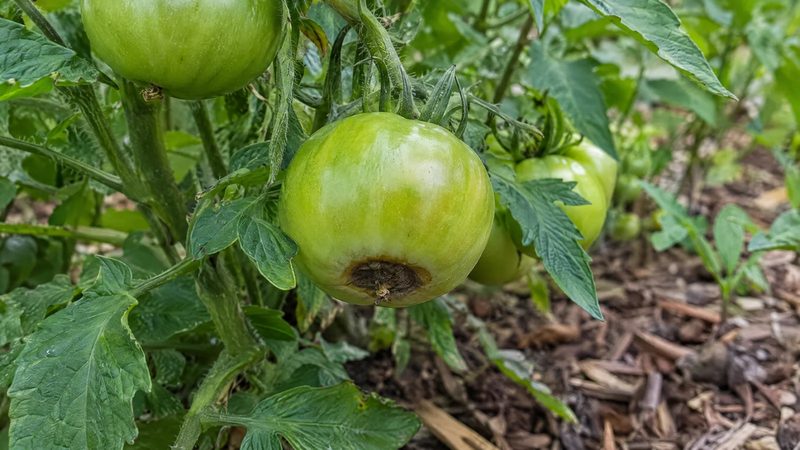
Blossom end rot (BER) is a dark, sunken, leathery patch on the blossom end of the fruit, the end opposite the stem5. It affects tomato, pepper, eggplant and vine crops such as squash and watermelon, and it is caused by a lack of calcium in the fruit5,6. Numerous foliar calcium sprays are sold with claims to solve the problem1.
The reasoning behind the sprays sounds straightforward: if the fruit is short of calcium, spray calcium on the plant. The flaw is that blossom end rot is a local shortage in the fruit, which may not reflect any shortage in the soil or in other parts of the plant1. It can occur even when soil calcium levels are adequate1.
In North America, searches about calcium sprays for blossom end rot peak in July and are lowest in February; the disorder tends to hit the first fruits of the season, so steady watering from fruit set through early summer matters most. In the Southern Hemisphere the same peak falls around January.
What does the evidence show?
Calcium moves through the plant only with water in the xylem, from the roots toward the leaves, and it does not move in the phloem3. Calcium that is already in the leaves therefore cannot travel through the phloem into the fruit1,3. University of California Cooperative Extension concludes that foliar applications of calcium are of little value, because calcium is poorly absorbed by leaves and does not move easily in the plant3.
A tracer study published in 1968 measured this directly with radioactive calcium. Tomato leaves rapidly absorbed calcium from calcium chloride sprays, but movement of that calcium away from the leaves was negligible, and repeated spraying failed to change it2. Adding a surfactant to the spray did not increase calcium absorption by leaves or fruits2.
Field results match. In a Brazilian field trial on tomato, foliar sprays of 0.4% calcium chloride and 0.6% calcium sulfate showed no effect in decreasing the rate of blossom end rot4. Liming the soil in the same trial reduced incidence by about 25% and raised yield by 18%, but it did not control the disorder4.
Can calcium sprayed directly on the fruit help?
This is the one point where the sources differ. The 1968 tracer study found that young tomato fruits did absorb calcium through the skin, and that absorption fell as the fruit aged2. Calcium chloride solution sprayed on fruit at the susceptible stage was estimated to raise calcium in the blossom end tissue by more than 30% within 48 hours, although most of the absorbed calcium stayed close to where it was applied2. The author suggested that this direct uptake through the fruit skin may explain why some growers saw less rot after calcium sprays2.
The timing is narrow. In that study, the first signs of blossom end rot appeared only 9 to 15 days after flowering, and older fruits did not develop external rot2. Clemson Cooperative Extension states that fruit skin is not able to directly absorb foliar calcium and that foliar calcium sprays are not effective1. University of Maryland Extension notes that spraying affected plants with a calcium chloride solution may offer some temporary relief, with regular, deep watering as the real fix where soil calcium is adequate6.
Sprays also carry a risk of injury. Calcium chloride sprays scorched tomato leaf margins and tips at higher concentrations, lower leaf surfaces burned more easily, and young fruits were the most easily damaged2. If you use a calcium product on plants, follow the product label.
Why do calcium sprays seem to work?
Blossom end rot usually appears early in the season and hits the first fruits hardest3,5. Its incidence often declines as the season goes on, which can lead growers to believe that calcium applications worked3. University of California Cooperative Extension attributes that decline more likely to slowing vegetative growth, changes in weather or better irrigation scheduling3.
Variety also plays a part. Pear or Roma tomatoes appear to be among the most susceptible, while cherry tomatoes are rarely affected3,6.
Why does blossom end rot happen when the soil has calcium?
More often than not, the soil holds plenty of calcium, but uptake and transport to the fruit are impaired5. Calcium movement depends on transpiration, and because leaves transpire more than fruits, calcium moves more easily into leaves, where it stays and is not later redistributed to fruits5. Fruit transpiration falls further once the waxy cuticle forms, when the fruit is about one half to three quarters of an inch across3. Fruits in the rapid expansion phase, at one third to one half of full size, are very susceptible to water stress, and even a temporary shortage can trigger the disorder3.
Blossom end rot is not caused by a pathogen, and there are no pesticide solutions for it7.
| Condition | Why it matters | What helps |
|---|---|---|
| Drought or swings between wet and dry soil | Calcium supply is interrupted when water uptake is interrupted1,5 | Water evenly and mulch1,5 |
| Damaged roots | Root injury inhibits calcium uptake5 | Avoid hoeing or cultivating close to plants1,5 |
| Excess nitrogen and fast leafy growth | More leaves draw calcium away from fruit5 | Do not over-fertilize3,5 |
| High ammonium, potassium or magnesium | These compete with calcium for uptake3,5 | Use nitrate rather than ammonium nitrogen3,5 |
| Salty or sandy soils | High soil salt and low moisture aggravate the disorder7 | Keep the root zone from drying out or staying saturated7 |
| Cold soil, or cool and cloudy weather | Low transpiration slows calcium movement3 | Expect more risk in early plantings3 |
| Humidity extremes with hot, windy weather | Limits transpiration and calcium delivery to fruit5 | Irrigate before periods of high heat3 |
What works instead?
The most effective way to prevent blossom end rot is to keep soil moisture uniform and avoid letting the soil dry out between waterings1. These steps address the cause:
- Water on a steady schedule; a drip system on a timer helps keep moisture consistent1.
- Mulch around plants to reduce evaporation and moderate soil moisture swings1,3.
- Monitor soil moisture so the root zone neither dries out nor remains saturated7.
- Irrigate before periods of high heat to reduce plant stress3.
- Avoid cultivating close to plants, which damages feeder roots3.
- Feed nitrogen to match plant use, and favor nitrate over ammonium forms3.
- Test the soil before planting and follow its lime and fertilizer recommendations; a pH of about 6.5 suits most vegetables1,5.
- Choose cultivars that are tolerant of calcium deficiency and less likely to show symptoms5.
Key takeaways
- Calcium moves to fruit only with water in the xylem; it cannot move from leaves to fruit through the phloem.
- Tomato leaves absorb sprayed calcium but move almost none of it, even after repeated sprays.
- A field trial found calcium chloride and calcium sulfate sprays did not reduce blossom end rot.
- Blossom end rot often fades as the season goes on, which makes sprays look effective when they are not.
- Even watering, mulch, root protection and sensible nitrogen are the proven prevention.
References
- Gardening Myths: Fix Blossom End Rot with Calcium Sprays
- Absorption and translocation of calcium foliar sprays in relation to the incidence of blossom-end rot in tomatoes
- Managing Blossom-End Rot in Tomatoes and Peppers (Publication 31-040C)
- Blossom-end rot in tomato
- Blossom End Rot (UW Plant Disease Facts D0022)
- Blossom End Rot on Vegetables
- Blossom End Rot (Home and Landscape)