

Is diatomaceous earth safe for cats?
Last updated:
Swallowed, diatomaceous earth is low risk for cats: very little is absorbed and the rest is quickly excreted1. The concern is the dust, which can irritate a cat's eyes, nose and airways1, and dust is one of the triggers linked to feline asthma7. Use only a product labeled for the intended use, follow the product label, and keep cats away until the dust settles1,4.
What is diatomaceous earth and how does it kill insects?
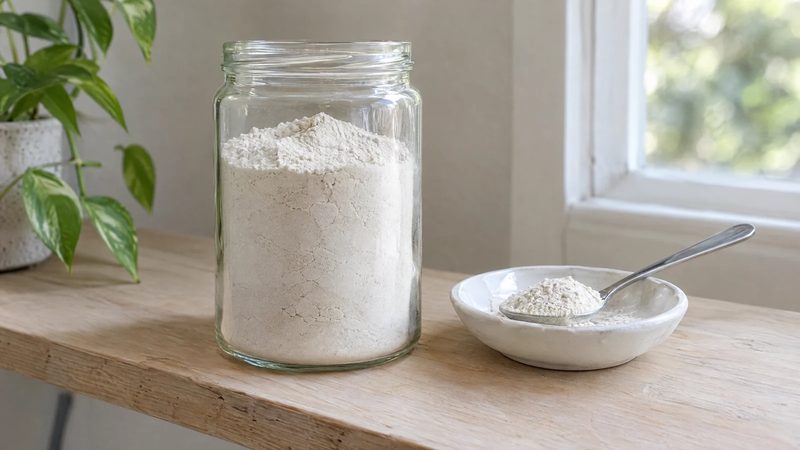
Diatomaceous earth (DE) is a powder made from the fossilized remains of diatoms, tiny aquatic organisms whose skeletons are made of silica1. Most of it is amorphous silicon dioxide, although it can contain very low levels of crystalline silicon dioxide1. The first pesticide products containing it were registered in the United States in 1960 to kill insects and mites1.
DE is not a poison and does not have to be eaten to work1. It absorbs the oils and fats from the insect's outer cuticle so the insect dries out and dies, and its sharp edges speed up the process1. EPA describes the same physical mode of action: the dust is abrasive and acts as a desiccant2. It remains effective only as long as it stays dry and undisturbed1.
In North America, searches about diatomaceous earth and cats peak in June and are lowest in December, which matches the spring and early summer rise in cat flea numbers described by UC IPM3. In the Southern Hemisphere the same seasonal rise falls around October to January.
What happens if a cat eats or licks diatomaceous earth?
When diatomaceous earth is eaten, very little is absorbed into the body and the remainder is rapidly excreted1. In EPA's review, silicon dioxide was placed in Toxicity Category III for acute oral and dermal effects, on a scale where Category I is the most toxic and Category IV the least2. Because of its low toxicity when ingested, silicon dioxide is exempt from pesticide residue tolerance requirements2.
Writing about essential oils, the Merck Veterinary Manual notes that cats' natural grooming behavior adds both skin and oral exposure8. For DE, the swallowed share matters less, because very little of it is absorbed1. On skin, DE can cause irritation and dryness1.
Why is the dust the main concern for cats?
Breathed in, diatomaceous earth can irritate the nose and nasal passages, and an extremely large amount can cause coughing and shortness of breath1. Its abrasive particles can also irritate the eyes1. The form of silica matters: amorphous DE is rapidly cleared from lung tissue, while the much smaller crystalline particles may accumulate in lung tissue and lymph nodes1. Long-term inhalation of crystalline silica is associated with silicosis, chronic bronchitis and other respiratory problems, whereas the amorphous form is associated only with mild, reversible lung inflammation1.
Crystalline silica is a well-documented occupational hazard in people: breathing its respirable particles causes silicosis, an incurable scarring lung disease that typically develops after 15 to 20 years of exposure6. Pesticide-grade DE is mostly amorphous1, and EPA notes that the amorphous silicon dioxide used in pesticide formulations has not been associated with silicosis2. Cats with airway disease need extra care: building dust, cat litter and strong chemical smells are among the environmental factors associated with feline asthma7.
| Exposure route | Typical source in a home | What the references report |
|---|---|---|
| Breathing the dust | Applying the powder, or entering a room before the dust settles | Irritation of the nose and nasal passages; coughing and shortness of breath only with extremely large amounts1 |
| Eyes | Airborne dust or powder on bedding | Irritation from the abrasive particles1 |
| Skin and coat | Lying on treated carpet or bedding | Irritation and dryness1 |
| Swallowing | Grooming dust off the coat, licking treated surfaces | Very little is absorbed and the rest is rapidly excreted1 |
Does diatomaceous earth work against fleas on cats?
Diatomaceous earth products are registered against fleas, ticks and many other pests, and some products can be used directly on dogs and cats1. EPA's review lists application to pets and their living and sleeping quarters among registered uses2. DE only works while it stays dry and undisturbed1, and many registered silicon dioxide products combine it with other active ingredients2, so read the full ingredient list on the label.
University of California IPM guidance on the cat flea (Ctenocephalides felis) ranks flea powders and dusts as less effective, and more hazardous to pets, people and the environment, than spot-on, oral and collar products3. Flea larvae develop in protected places with at least 75% relative humidity, such as carpets and pet bedding3. The same guidance stresses sanitation: vacuuming floors, carpets and upholstery every day or every other day, and laundering pet bedding in hot, soapy water at least once a week3. Ask your veterinarian which on-animal flea product suits your cat3.
- Never apply a product labeled for dogs only to a cat4.
- Products containing permethrin or amitraz should never be applied to cats3.
- Do not use a product designed for adult cats on kittens unless the label states it may be used on younger animals4.
Is food-grade diatomaceous earth different from other grades?
Food-grade diatomaceous earth products are purified, and they may be used as anticaking materials in feed or as clarifiers for wine and beer1. In animal feed, FDA permits diatomaceous earth as an inert carrier or anticaking agent at no more than 2% by weight of the total ration, with limits on lead, arsenic and fluorine content5. FDA also lists diatomaceous earth as Generally Recognized as Safe1.
These feed and food rules describe DE as an ingredient in a finished ration, not as a powder dusted around a room. A pesticide use is governed by its own EPA-registered label, which must list the active ingredient concentration and every site where application is permitted2. Buy a product labeled for the use you intend, whether that is a pest dust or a feed ingredient, and follow the product label.
How do you use diatomaceous earth in a home with cats?
Exposure to DE happens when people or pets breathe the dust, eat it, or get it on skin or in the eyes, for example when applying the dust or entering a treated area before it has settled1. The National Pesticide Information Center (NPIC) gives these precautions for any pesticide used around pets4:
- Move the cat, its toys, bedding and food and water bowls out of the area before you apply the product4.
- Keep the cat away for the time stated on the label, and keep it out of treated areas until the dust has settled4,1.
- Ventilate indoor rooms during and after the application4.
- Prevent the cat from licking or chewing treated items, because residues can remain on treated surfaces4.
- Store the product where pets cannot reach it4.
- Protect yourself as well: EPA required dust formulation labels to call for a dust mask during prolonged use2.
Key takeaways
- Swallowed diatomaceous earth is poorly absorbed and rapidly excreted.
- The dust is the main concern: it can irritate a cat's eyes, nose and airways.
- Dust is one of the environmental factors associated with feline asthma, so cats with airway disease need extra care.
- UC IPM ranks flea powders and dusts below spot-on, oral and collar products for cats.
- Use a product labeled for the intended use, follow the product label, and keep cats out until the dust settles.
References
- Diatomaceous Earth General Fact Sheet
- R.E.D. Facts: Silicon Dioxide and Silica Gel (EPA-738-F-91-107)
- Pest Notes: Fleas (UC ANR Publication 7419)
- Pets and Pesticide Use Fact Sheet
- 21 CFR 573.340 Diatomaceous earth
- Silica, Crystalline: Health Effects
- Determinant and conditioning factors of feline asthma: a questionnaire-base study
- Toxicoses From Essential Oils in Animals
Frequently asked questions
Is diatomaceous earth allowed in cat food?
FDA permits diatomaceous earth in animal feed as an inert carrier or anticaking agent at up to 2% by weight of the total ration5. Food-grade products are purified for this kind of use1. That rule covers DE as a feed ingredient, not loose powder added at home, so talk to your veterinarian before changing your cat's diet.
Can diatomaceous earth cause cancer in cats?
Amorphous diatomaceous earth has not been associated with any cancers in people, and rats fed silica at a high dose for two years showed no increase in cancer1. Mice forced to breathe DE for one hour a day for a year did show more lung cancers1. EPA's review noted that IARC found inadequate evidence linking amorphous silica with cancer in humans or test animals2.