


Is peppermint oil spray safe for cats?
Last updated:
No. Cornell University's College of Veterinary Medicine lists peppermint oil, including menthol, as toxic to cats4. Cats are more sensitive to essential oils than other pets because they are deficient in the liver enzyme glucuronyl transferase3,1. Never spray or rub peppermint oil on a cat, keep cats out of sprayed areas until surfaces are dry, and call a veterinarian after any direct contact3,5.
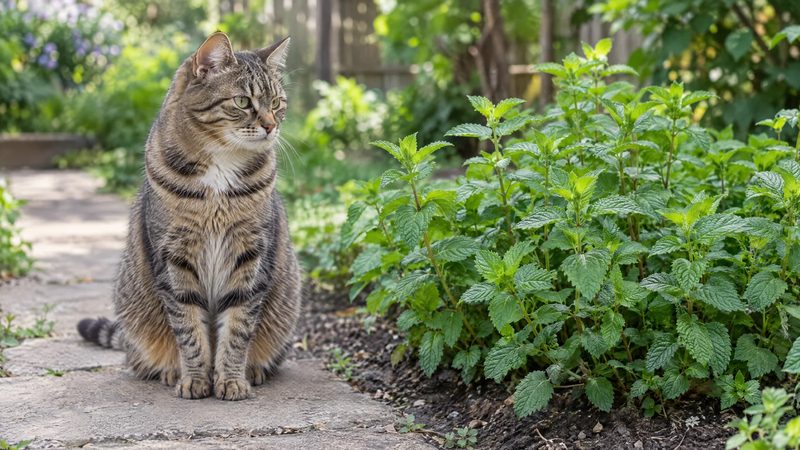
Why is peppermint oil a problem for cats?
Peppermint oil is the concentrated essential oil of peppermint (Mentha piperita), a plant the FDA lists among essential oils generally recognized as safe for their intended use in human food8. That status covers human food use, not cats. Cornell University's veterinary college lists peppermint oil, including menthol, as toxic to cats4, and the Merck Veterinary Manual notes that the higher the concentration of an essential oil, the greater the risk to the animal3.
The reason is metabolic. The Merck Veterinary Manual attributes cats' greater sensitivity to essential oils to a deficiency in the enzyme glucuronyl transferase3. Genetic work explains part of that deficiency: the domestic cat has a much lower capacity than most mammals to glucuronidate planar phenolic compounds, and UGT1A6, the gene for one key form of the enzyme, is a nonfunctional pseudogene in cats1. The study's authors linked this to the cat's highly carnivorous diet, which left the species with minimal exposure to plant defense compounds1.
In North America, searches about peppermint oil sprays and cats peak in April and are lowest in February, so the advice on keeping cats out of freshly sprayed rooms and gardens matters most in spring. In the Southern Hemisphere the same spring peak falls around September to November.
How does peppermint spray reach a cat?
A cat does not have to drink peppermint oil to be exposed. Essential oils are readily and rapidly absorbed through the digestive tract, skin, lungs and mucous membranes3. Cats' natural grooming behavior adds risk from both skin and oral exposure, because oil on the coat ends up being licked3. A pet's risk depends on how much pesticide it is exposed to and on how toxic that pesticide is to that specific type of animal5.
| Source | Main route | What the references say |
|---|---|---|
| Spray applied to the cat or its bedding | Skin, then mouth through grooming | Concentrated essential oils should never be applied directly to pets3 |
| Wet sprayed floors, furniture and plants | Skin, paws and mouth | Keep pets away until the spray has dried completely5 |
| Dried residue on treated surfaces | Licking and chewing | Residues can remain after drying, so prevent licking or chewing of treated items5 |
| Active diffuser running nearby | Lungs, plus droplets settling on fur | Ultrasonic and nebulizing diffusers emit microdroplets that can collect on hair3 |
| Open bottles and spills | Mouth and skin | Store pesticides where pets cannot get to them5 |
What are the signs of essential oil poisoning in cats?
Signs develop within minutes to hours by every route of exposure3. Most cases start with digestive or respiratory signs, and severe cases can progress to tremors, seizures, low body temperature, slow heart rate, and liver or kidney failure3.
Concentrated oil on the skin is a documented cause of serious illness. In a case series of 443 dogs and cats exposed to 100% tea tree oil, most of them through intentional use, signs began within 2 to 12 hours, lasted up to 72 hours, and were more severe in younger and lighter cats2. Tea tree oil is a different oil, but the series shows how fast an undiluted essential oil applied to a pet can cause harm2.
| Exposure route | Common signs | Signs that need emergency care |
|---|---|---|
| Swallowed or on the skin | Vomiting, lethargy, drooling, wobbliness (ataxia), loss of appetite3 | Tremors, seizures, hind-limb paralysis3 |
| Breathed in | Watery eyes and nose, nausea, drooling, vomiting, coughing or wheezing3 | Labored or rapid breathing3,5 |
| Any route | Onset within minutes to hours3 | Low blood pressure, slow heart rate, low body temperature, liver or kidney failure3 |
Does a natural or minimum risk label mean a spray was checked for cats?
No. Peppermint and peppermint oil are on the federal list of active ingredients allowed in minimum risk pesticides, a category exempt from EPA registration6. EPA states that it does not review exempted products, and it treats label wording that implies a government safety finding on these products as misleading7.
Every ingredient in an exempted product, active and inert, must be listed on the label7. Read that list to confirm whether a pest spray, repellent or cleaner contains peppermint oil or mint oil before you use it in a home with a cat.
How do you use a peppermint spray in a home with cats?
Follow the product label for where and how to apply the spray, and never apply peppermint oil to the cat itself4,3. The National Pesticide Information Center (NPIC) gives these precautions for any pesticide used around pets5:
- Move the cat, its toys, bedding, and food and water bowls out of the area before you mix or apply the product5.
- Keep the cat away for the time stated on the label or until the spray has dried completely, whichever is longer5.
- Ventilate indoor rooms while sprayed surfaces dry5.
- Stop the cat from licking or chewing treated plants and surfaces even after they dry, because residues can remain5.
- Store bottles closed, in places pets cannot reach5.
- Never use a product labeled for dogs only on a cat5.
What should you do if your cat is exposed to peppermint oil?
Veterinary references list bathing and fresh air as the decontamination steps for essential oil exposure3. Do not try to make the cat vomit, because of the risk that oil is inhaled into the lungs3. Call your veterinarian or an animal poison control center for advice4,5, and have the product label at hand so you can say exactly what the cat touched or breathed.
If the cat has difficulty breathing, tremors or seizures, or is unconscious, contact a veterinarian or animal poison control center immediately5. For questions about a pesticide product, NPIC can be reached at 800-858-73785. This page is general information and does not replace veterinary advice.
Key takeaways
- Cornell's veterinary college lists peppermint oil, including menthol, as toxic to cats.
- Cats are more sensitive to essential oils because they are deficient in glucuronyl transferase.
- Exposure happens through skin, lungs and grooming, not only by swallowing.
- A minimum risk or natural label does not mean EPA reviewed the product.
- After contact: fresh air, no induced vomiting, and a call to a veterinarian or poison control.
References
- Molecular genetic basis for deficient acetaminophen glucuronidation by cats: UGT1A6 is a pseudogene, and evidence for reduced diversity of expressed hepatic UGT1A isoforms
- Concentrated tea tree oil toxicosis in dogs and cats: 443 cases (2002-2012)
- Toxicoses From Essential Oils in Animals
- Small Animal Toxins
- Pets and Pesticide Use Fact Sheet
- 40 CFR 152.25 Exemptions for pesticides of a character not requiring FIFRA regulation (paragraph (f), Table 1, permitted active ingredients)
- Conditions for Minimum Risk Pesticides
- 21 CFR 182.20 Essential oils, oleoresins (solvent-free), and natural extractives (including distillates)
Frequently asked questions
Can I use a peppermint oil diffuser around my cat?
Keep the cat out of the room while any diffuser runs, and air the room afterward3. Active ultrasonic or nebulizing diffusers release microdroplets of oil that can settle on a cat's fur, while passive diffusers such as reeds and candles mainly pose a risk of respiratory irritation3. Because cats groom, oil that lands on the coat can also be swallowed3.
Are peppermint sprays a risk for dogs and other pets?
Concentrated essential oils can harm dogs too: in the tea tree oil case series, 337 of the 443 animals were dogs, and signs included drooling, lethargy, wobbliness and tremors2. NPIC advises keeping all pets out of treated areas until sprays have dried5. The dogs page covers how the guidance differs by species.
Is a few drops of diluted peppermint oil on my cat's fur acceptable?
No. Cornell lists peppermint oil as toxic to cats and gives no amount that is acceptable to apply4. The Merck Veterinary Manual advises that concentrated essential oils should never be applied directly to pets and that risk rises with concentration3. Grooming turns any oil on the coat into an oral exposure as well3.