


GHK-Cu
Last updated:
GHK-Cu is a copper-binding tripeptide with a long cosmetic track record and a thin clinical one. As a cosmetic ingredient (INCI: copper tripeptide-1) it is legal and widely used; as an injectable it is an unapproved compound. Its delivery challenge on skin is penetration of a charged, hydrophilic complex.
What GHK-Cu is
GHK (glycyl-L-histidyl-L-lysine, 340 Da) was isolated from human plasma in 1973 and binds copper(II) with high affinity. Plasma levels decline with age. In cell and animal studies GHK-Cu stimulates collagen and glycosaminoglycan synthesis, modulates metalloproteinases and supports wound contraction. Gene expression analyses suggest it influences many genes, but those are in vitro data. Controlled cosmetic studies report improvements in skin density and fine lines of modest size. It is also used in hair care for scalp conditioning, within cosmetic claim limits.
Regulatory status
Copper tripeptide-1 is an accepted cosmetic ingredient in the US and EU when used for cosmetic purposes. It has no approved drug use. Injectable GHK-Cu was placed in FDA's 503A Category 2 in 2023; in April 2026 FDA announced injectable GHK-Cu would be removed from Category 2 pending review, with non-injectable forms considered separately. That affects compounding only. Cosmetic products must not make drug claims such as wound healing or hair regrowth.
The delivery problem
GHK-Cu is hydrophilic and charged, so passive penetration through the stratum corneum is low. Free copper can catalyze oxidation of other ingredients, and the complex can dissociate in formulas containing strong chelators or at low pH, changing color and activity. Stability in a finished serum is as important as penetration. Blue-green color in formulas is a visible indicator of the copper complex, and color shifts often signal dissociation or interaction with other ingredients.
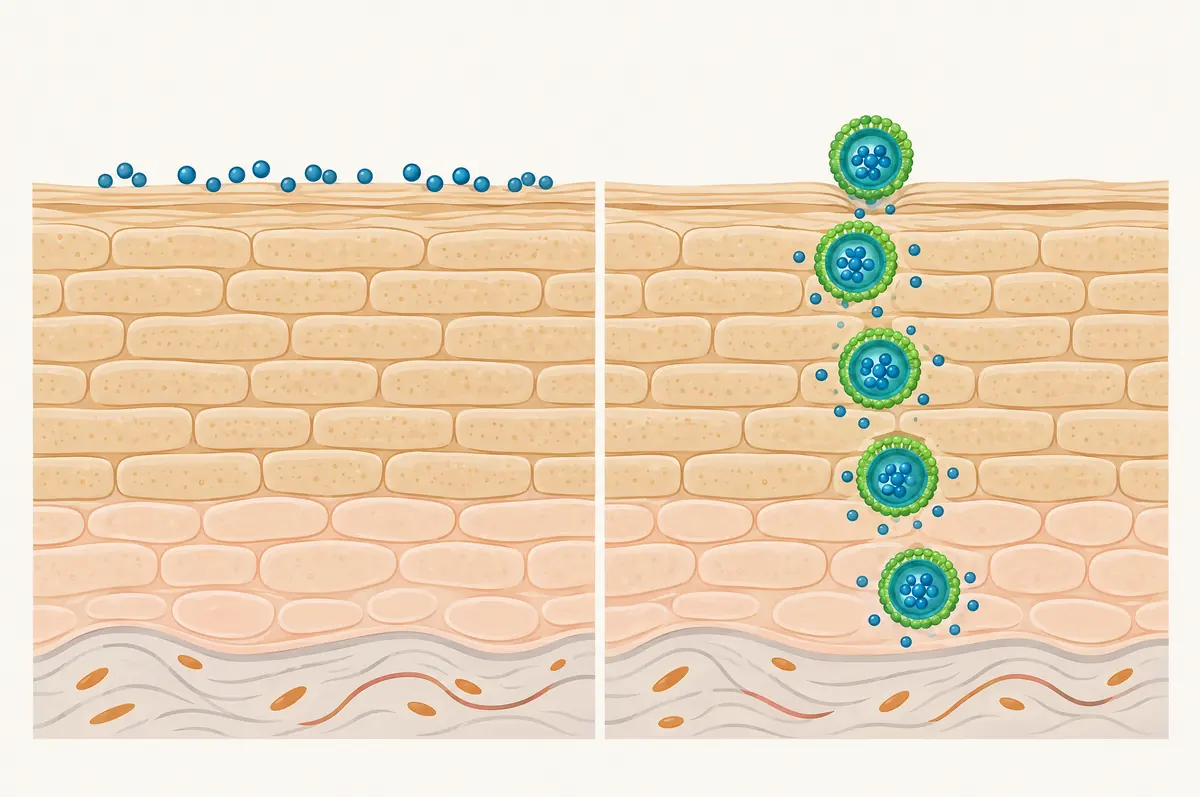
Formulation routes in use
Serums at defined pH with compatible chelator levels, liposomal forms, microneedle-assisted professional treatments, and palmitoylated or other lipidated analogs designed for better penetration. Palmitoylated analogs trade water solubility for skin affinity. Microneedling increases penetration but moves products into professional and sometimes medical-device contexts. Formula compatibility with vitamin C, retinoids and acids is limited, so layering guidance matters. Stability testing should monitor copper content, pH and color over time. Packaging should limit light exposure.
Key facts
- GHK was identified in human plasma and binds copper(II), and its gene-modulating and regenerative actions are reviewed in light of gene expression data (Pickart and Margolina 2018, Int J Mol Sci 19:1987)
- Copper tripeptide-1 is listed as a cosmetic ingredient in the EU cosmetic ingredient database (European Commission CosIng database)
- FDA announced in April 2026 that injectable GHK-Cu would be removed from Category 2 of the 503A bulks list pending further evaluation (FDA 503A bulk drug substances update, April 2026)
How our delivery technology applies
Vegalab already works with GHK-Cu in Beauty Science. Encapsulation addresses both of its weaknesses: a biopolymer shell keeps copper from catalyzing oxidation of other actives and protects the complex from chelators and pH swings in the formula, while nano-scale particles with lipid layers improve partitioning into the upper skin layers. Release is triggered by skin hydration and enzymes rather than in the bottle.
Formulate a stable, encapsulated GHK-Cu product with Vegalab Beauty Science.