


Transdermal and Topical Delivery
Last updated:
Skin is built to keep molecules out. The stratum corneum, 10 to 20 micrometers of dead cells in a lipid matrix, admits small, moderately lipophilic compounds and rejects nearly everything else. Topical products aim at the skin itself; transdermal products aim at the blood. The two need different designs and fall under different rules.
The barrier
Passive permeation favors molecules under about 500 Da with logP around 1 to 3 and low melting point. Nicotine, fentanyl, estradiol, testosterone, rotigotine and scopolamine patches all fit that profile. Hydrophilic, charged or large molecules such as peptides penetrate only superficially without physical enhancement (microneedles, iontophoresis). Follicular pathways offer a minor route for nanoparticles, mostly to the follicle rather than systemic circulation. Skin condition, site and occlusion also change permeation substantially between users.
Topical versus transdermal
A topical cosmetic acts at the skin surface or in the upper layers and is regulated as a cosmetic when claims are limited to appearance. A transdermal system that delivers a drug into the circulation is a medicine and requires full approval, including skin irritation and adhesion testing. The same encapsulated active can sit on either side of that line depending on dose, claim and intent. Vegalab Beauty Science formulates on the topical side.
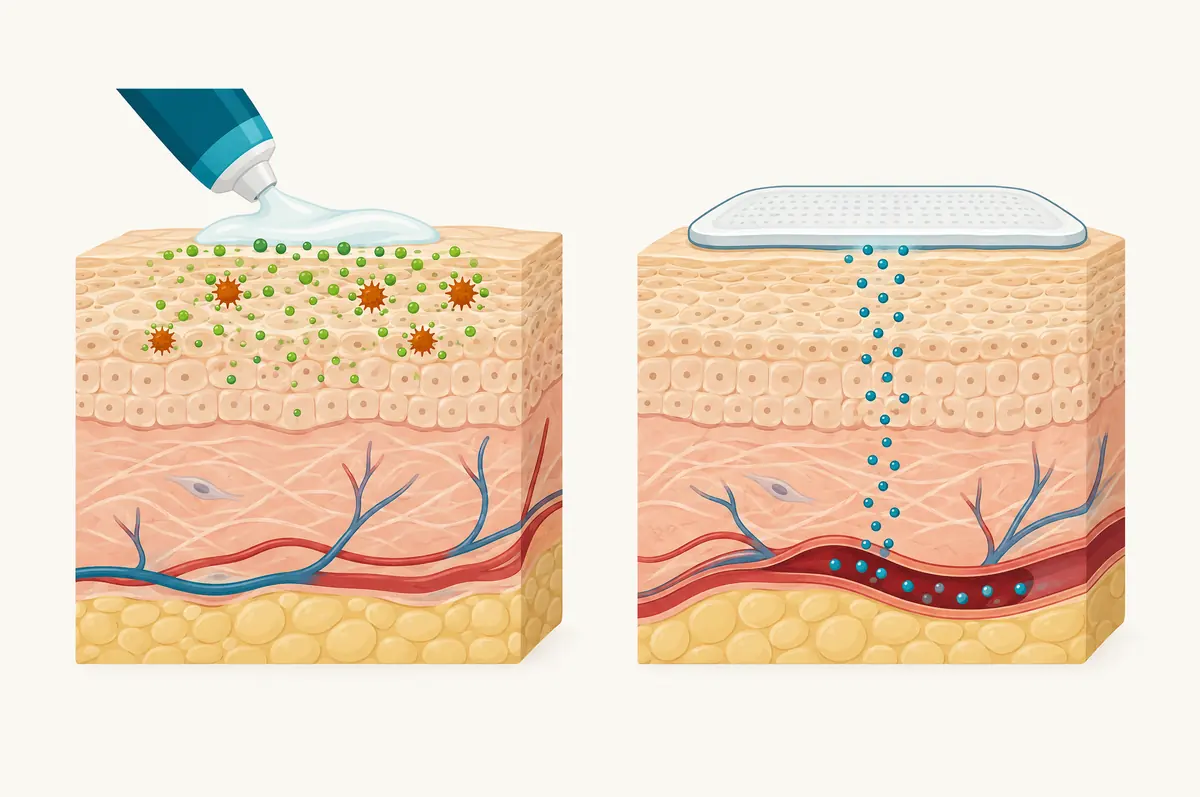
Delivery variables
Formulators control vehicle, occlusion, penetration enhancers, particle size and release rate. Encapsulated actives stay mostly in the upper skin layers, which suits cosmetics and local action. Microneedle patches for vaccines and peptides are in clinical development, but none has yet been approved in the US for systemic peptide delivery. For cosmetics, the practical targets are stability of the active in the product and controlled presentation at the skin surface, both of which can be measured by assay and release testing.
Key facts
- Compounds above about 500 Da rarely penetrate intact skin, which explains why common contact allergens and topical drugs are small (Bos and Meinardi 2000, Exp Dermatol 9:165)
- Transdermal delivery generations progress from small lipophilic drugs to chemical enhancers and physical methods such as microneedles (Prausnitz and Langer 2008, Nat Biotechnol 26:1261)
- Rotigotine transdermal system is FDA approved for Parkinson's disease and restless legs syndrome (FDA label, Neupro 2012)
How our delivery technology applies
Topically, multi-layer encapsulation holds an active in the upper epidermis and releases it gradually, raising local residence and reducing irritation from a high surface concentration. It also stabilizes oxidation-prone actives such as retinoids, vitamin C and NAD in the product. It does not make a peptide cross intact skin into the blood. This is the mechanism documented on the Beauty Science technology page.
Discuss topical or transdermal formulation work with Vegalab.