

Last updated:
Black spot on roses is caused by the fungus Diplocarpon rosae, which needs at least 7 hours of wet leaves to infect.2,4 Treat it by removing fallen and infected leaves, pruning out diseased canes, keeping foliage dry and airy, and applying a preventive fungicide such as neem oil, sulfur, potassium bicarbonate or chlorothalonil before wet weather, following the product label.1,5
How do you recognize black spot on roses?
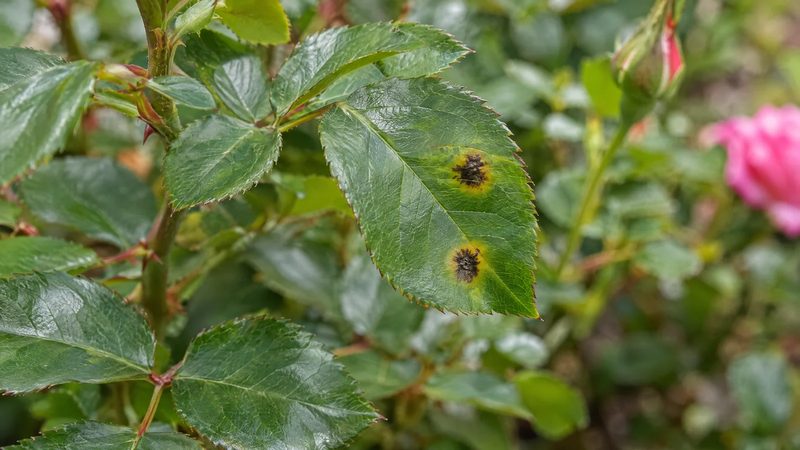
Black spot (Diplocarpon rosae) produces black spots with feathery or fibrous margins on the upper surfaces of leaves and on stems, and small black fruiting bodies are often visible in the spots; no fungal growth forms on the leaf undersides.1 The spots are circular or irregular and can reach 1/2 inch across.2 Yellow halos may form around them, then whole leaves turn yellow and drop early, and the defoliation weakens the plant and reduces flowering.4
The disease usually starts on lower leaves and spreads through the plant.5 On first-year canes it appears as raised, purple-red, irregular blotches that later turn black and blistered, and flower petals can develop red spots.3,4 Left unchecked, black spot progressively weakens a rose so that it forms fewer blooms, and weakened plants are more prone to winter injury.2 Heavy infections can completely defoliate a susceptible plant.7
| Problem | What you see | Key difference |
|---|---|---|
| Black spot (Diplocarpon rosae) | Black spots up to 1/2 inch with feathery, fringed margins; yellowing and leaf drop | Spots mainly on upper surface; nothing grows on the underside |
| Powdery mildew | White to gray powdery growth on leaves, shoots and buds | Does not need free water and can infect in warm, dry weather |
| Downy mildew | Angular purple, red or brown spots between veins | Pale, felty patches may form on the undersides |
| Rust | Small orange pustules on leaf undersides | Orange spores rather than black spots |
| Cercospora leaf spot | Circular lesions with tan or gray centers | Starts on older growth and moves to newer growth |
| Anthracnose | Red spots whose centers turn gray or white | Lesions may fall out, leaving a shot-hole look |
In North America black spot begins in spring, when spores splash onto newly emerging leaves in wet weather, and secondary infections build to a peak in late summer3; it is most severe after long, wet, warm spring periods6. In the Southern Hemisphere the same cycle runs from about September to March.
What causes black spot, and when does it spread?
The fungus Diplocarpon rosae (asexual stage Marssonina rosae) survives the winter in fallen leaves and at infection sites on the canes.2 Its spores do not survive in the soil, and an individual spore lives no longer than a month.2 In spring, spores are splashed onto new leaves, and many secondary infection cycles follow, peaking in late summer.3 Spores move to emerging leaves on wind and splashing rain.5
Free water drives infection. Spores need at least 7 hours of leaf wetness to germinate; about 65°F is ideal for germination, the disease develops fastest at about 75°F, and temperatures of 85°F and above inhibit its spread.2 Symptoms can appear as soon as 3 days after infection or take up to 2 weeks, depending on the weather.4 Black spot is ubiquitous in warm, humid regions, while in California it is usually not a problem in the dry interior and is more likely in humid coastal areas.7,1 The pathogen also exists as multiple races with different virulence, which complicates breeding and testing roses for resistance.7
How do you treat black spot on roses without spraying?
Sanitation and drier leaves come first, because the fungus overwinters on leaf litter and canes and needs wet foliage to infect.3,1 If a rose has little or no leaf drop and the weather is dry, University of Wisconsin guidance says no treatment is necessary.5
- Rake up and discard all fallen leaves in the fall, or before bud break the following spring.2,3
- Remove infected leaves as they appear, working in dry weather to slow spread.2,6
- Prune out infected stems during the dormant season; prune diseased branches 6 to 8 inches below visible infections, and only in dry weather.1,5
- Disinfest pruning tools between cuts for at least 30 seconds in 70% alcohol or a 10% bleach solution.5
- Water at the base with a soaker or drip hose and avoid sprinklers; if you must wet the leaves, do it in the morning or midday so they dry before evening.5,1
- Grow roses in full sun with enough space between plants for air to move and leaves to dry quickly.6,3
- In fall or winter, remove old mulch where infected leaves have fallen and lay a fresh layer before new growth begins.6
- Collect fallen leaves and diseased canes and discard or destroy them.4
Which fungicides control black spot, and does neem oil work?
Fungicides for black spot are used as a preventive program. Illinois Extension notes that multiple preventive applications are needed, beginning as new leaves appear and continuing into fall on highly susceptible varieties, with longer intervals or skipped sprays in dry weather.3 University of Kentucky guidance describes protective sprays from the start of the season at 7 to 12 day intervals until autumn, using the shorter intervals in wet seasons.4 The product label sets the interval and rate for each product, so follow the product label.5
Neem oil has evidence behind it. UC IPM reports that oils, including neem oil, and other fungicides such as potassium bicarbonate and sulfur have been shown to reduce black spot.1 University of Wisconsin guidance describes neem oil as an organic product shown to provide some black spot control, and Clemson lists clarified hydrophobic neem oil among home garden options.5,6 Do not apply oils to water-stressed plants or within two weeks of a sulfur spray.1
Among conventional fungicides, chlorothalonil, copper sulfate and myclobutanil can be highly effective, and Clemson also lists mancozeb and propiconazole.5,6 Alternate at least two active ingredients rather than relying on one, particularly with myclobutanil, to limit fungicide-resistant strains of the pathogen.5 Rose leaves are waxy, so University of Maine guidance recommends adding a spreader for better coverage.2
| Active ingredient | Type | Notes from the sources |
|---|---|---|
| Neem oil (clarified hydrophobic extract) | Botanical oil | Shown to reduce black spot; not on water-stressed plants or within two weeks of sulfur |
| Sulfur | Mineral | Listed as an alternative fungicide; shown to reduce black spot |
| Potassium bicarbonate | Mineral salt | Shown to reduce black spot |
| Copper sulfate and other copper fungicides | Mineral | Can be highly effective; listed as an organic option |
| Chlorothalonil | Synthetic protectant | Preventive option for the next season if cultural controls fall short |
| Mancozeb | Synthetic protectant | Listed for home garden black spot control |
| Myclobutanil, propiconazole | Synthetic systemic | Alternate with another active ingredient to limit resistance |
Do natural and home remedies work on black spot?
Some do, with limits. Clemson includes baking soda mixed with horticultural oil among home garden sprays for roses.6 A 2025 field study in Poland tested natural products on roses with a history of black spot: applied preventively every 14 days, a rapeseed oil product and UHT milk were among the most effective treatments, none of the products damaged the roses, and in spore germination tests the milk showed relatively low activity.8 The same authors note that fungicides have long been the main way to protect roses from black spot.8
The natural approach with the broadest support is cultural: remove what the fungus needs, namely overwintering leaves, long periods of wet foliage, and crowded, shaded plantings.2,1 Whatever you spray, start before symptoms build, as Illinois Extension advises for black spot sprays generally, and use any product sold as a pesticide only as its label directs.3,5
Which roses resist black spot?
Resistance ranges from highly susceptible to highly resistant between cultivars, so variety choice is the longest-lasting control.3 Black spot is common on hybrid teas, grandifloras and miniature roses, and miniature roses are generally more susceptible than other types, although a few varieties are reliably resistant to all strains.3,1 Breeders focus on resistant cultivars because they need fewer fungicide applications through the season.7
University of Wisconsin guidance names the hybrid shrub rose 'Meipotal' (Carefree Delight), rugosa roses such as 'Blanc Double de Coubert' and 'Fru Dagmar Hastrup', the climbers 'William Baffin' and 'Henry Kelsey', and the Knock Out series as having excellent resistance.5 Clemson notes that fungicide sprays may still be needed, even on resistant varieties.6 In large plantings where susceptible varieties must be grown, mixing susceptible and resistant cultivars helps.3
Key takeaways
- Black spot is caused by Diplocarpon rosae, which overwinters in fallen leaves and cane lesions and needs at least 7 hours of leaf wetness to infect.
- Removing leaf litter, pruning out infected canes and keeping foliage dry are the foundation of control.
- Neem oil, sulfur and potassium bicarbonate have been shown to reduce black spot; follow the product label for any fungicide.
- Fungicides work preventively, starting as new leaves appear, and alternating active ingredients limits resistance.
- Resistant shrub and rugosa roses are the longest-lasting answer.
References
- Pest Notes: Roses: Diseases and Abiotic Disorders (UC ANR Publication 7463)
- Black Spot of Rose (Pest Management Fact Sheet #5097)
- Black Spot (Plant Problems)
- Black Spot of Rose (Plant Pathology Fact Sheet PPFS-OR-W-10)
- Black Spot (UW Plant Disease Facts D0020)
- Rose Diseases (HGIC 2106)
- QTL discovery for resistance to black spot and cercospora leaf spot, and defoliation in two interconnected F1 bi-parental tetraploid garden rose populations
- A possible use of natural products in black spot control on rose (Diplocarpon rosae Wolf.)