

How does copper fungicide work?
Last updated:
Copper fungicide releases copper ions that denature proteins and enzymes in the fungal and bacterial cells they touch before those pathogens infect the plant1. It is a protectant only: it has no post-infection activity and does not move inside the plant, so it has to coat leaves before disease starts1. The ions are released only while the spray residue is wet3.
What is copper fungicide made of?
Copper fungicides are inorganic copper compounds that kill both bacteria and fungi, which is why they are one of the few tools growers have against bacterial leaf diseases1. Copper sulfate, the simplest form, has been registered in United States pesticide products since 19567. The copper binds to proteins in fungal cells, damaging the cells so they leak and die7.
Almost all copper fungicides sold today contain a fixed copper as the active ingredient, and copper hydroxide is the most common1. Fixed coppers dissolve poorly in water, so the dried spray deposit releases a small amount of copper ions every time the leaf is wetted, which gives them residual activity1,2. Copper sulfate pentahydrate is different: it is highly soluble1. The amount of active ingredient on a label does not tell you how much copper a product holds; the metallic copper equivalent (MCE) in the ingredient section does1.
| Form | What the sources report |
|---|---|
| Copper hydroxide | Fixed copper; small particles with rapid release of copper ions; the most common active ingredient1 |
| Copper oxychloride | Fixed copper; slightly larger particles with slower, longer release1 |
| Basic (tribasic) copper sulfate | Fixed copper1,3 |
| Copper octanoate (copper soap) | Lowest metallic copper equivalent among the products Cornell lists; named by UC IPM among the least toxic effective options for backyard peach trees1,3 |
| Copper sulfate pentahydrate | Not a fixed copper; highly soluble and, used alone, less effective on peach leaf curl than fixed coppers1,3 |
| Bordeaux mixture | Copper sulfate plus hydrated lime, which react to form a fixed copper; mixed just before use, not sold ready made3 |
In North America, interest in copper fungicide peaks in June, when warm, wet weather favors tomato leaf diseases; peach leaf curl sprays go on after leaf fall in late November or December. In the Southern Hemisphere, the same stages fall about six months later, with the tomato season around December and January.
How does copper stop plant disease?
Copper ions kill pathogen cells by denaturing proteins and enzymes, but only in pathogens they contact before infection; copper has no activity once a pathogen is inside the leaf1. Copper also kills plant cells if it is absorbed in sufficient quantity, so the cuticle, the leaf's waxy outer layer, is what protects the plant2.
Water drives the whole process. UC IPM notes that copper is active only when it is wet, when the ions are in solution3. Dew releases more ions from the deposit, while heavy rain can wash much of it off: Cornell University reports that a 2-inch downpour can remove a lot of residue1. Acidity raises the solubility of fixed copper, which makes it more effective at first but shortens its residual activity and increases the chance of plant injury1.
Because copper does not move inside plants, the spray protects only the surfaces it covers1.
How do you use copper fungicide on tomatoes?
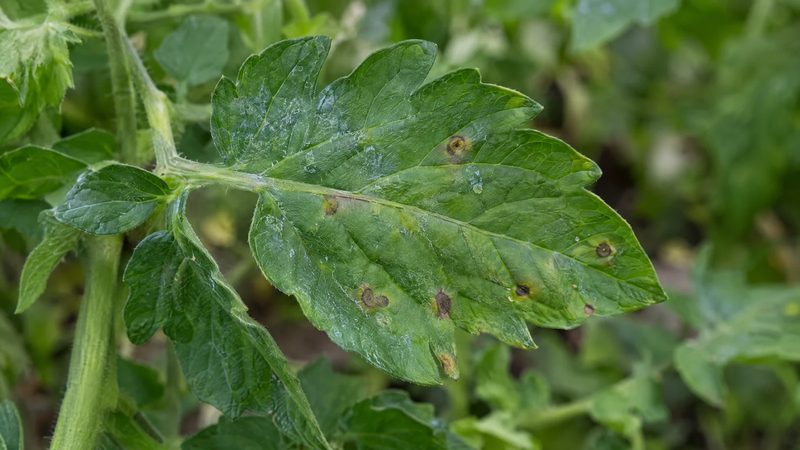
On tomatoes, copper is used mainly against bacterial spot (Xanthomonas species) and bacterial speck (Pseudomonas syringae pv. tomato), and as one option for fungal leaf spots such as Septoria leaf spot4,5,6,8. University of Missouri Extension reports that home gardeners control the bacterial diseases primarily with copper products, which come in formulations approved for organic production8.
Start before disease does. NC State Extension states that copper, chlorothalonil or mancozeb will help reduce Septoria leaf spot in gardens with a history of the disease, but they must go on before it appears because they give only preventive protection and will not cure the plant4. For bacterial spot, all labeled products work best applied preventively, and there are no curative products5. Cornell University places the best start before the first infection, which occurs at least 5 days before symptoms show1.
Coverage and weather decide how well a spray works. Cornell lists the factors: drying time before rain or overhead irrigation, rain amount and intensity, dew, how thoroughly the sprayer covers the plant, the rate used (higher label rates do better than lower ones) and how often applications are made1. Follow the product label for the rate, interval and days to harvest on tomatoes.
Spraying works alongside cultural controls. For bacterial spot, NC State Extension stresses disease-free seed and transplants, rotation away from tomatoes and peppers, and not handling plants while they are wet5. For Septoria leaf spot, it suggests rotating beds, mulching to stop soil splashing onto lower leaves, and removing the first affected leaves4.
| Disease | Cause | Role of copper |
|---|---|---|
| Bacterial spot | Xanthomonas species5 | Main home garden option; preventive only, no curative product exists5,8 |
| Bacterial speck | Pseudomonas syringae pv. tomato6 | Main home garden option; copper tolerant strains are common6,8 |
| Septoria leaf spot | Fungus4 | Copper may give adequate control if applied before disease appears4 |
| Early blight | Fungus; dark brown spots with concentric rings4,8 | Missouri Extension lists chlorothalonil, maneb or mancozeb rather than copper8 |
When is the best time to spray copper?
Timing depends on the disease. For tomato leaf diseases, sprays protect new growth through the wet weather that favors infection; NC State Extension notes that bacterial spot develops fastest at 75 to 86°F with high rain and humidity5.
Peach leaf curl is the clearest dormant season use. UC IPM advises treating susceptible peach and nectarine trees just after leaves fall, usually in late November or December, with a possible second application in late winter before buds swell3. Treating after symptoms appear in spring will not work, and fungicides applied during the growing season can harm foliage3. UC IPM adds that a 1% horticultural oil mixed with copper ammonium or copper soap improves effectiveness3.
| Use | When | Source note |
|---|---|---|
| Tomato bacterial spot and speck | Before first symptoms, repeated through wet periods as the label allows | No curative products exist5 |
| Tomato Septoria leaf spot | Before disease appears in gardens with a history of it | Preventive protection only4 |
| Peach leaf curl | Just after leaf fall (late November or December); optional second spray before bud swell | Spring sprays after symptoms are not effective3 |
Why does copper sometimes stop working?
Bacteria adapt. Cornell University notes that bacterial pathogens have proven adept at developing resistance to copper, which can make copper fungicides ineffective1. A systematic review of 133 publications found that 78.5% of Pseudomonas syringae pv. tomato isolates and 54.0% of Xanthomonas isolates screened were copper tolerant6.
Field results follow the same pattern. In the same review, only 38% of studies that tested copper alone, rather than mixed with other products, reported highly effective control of bacterial speck and spot; the rest reported variable, weak or no control6. For commercial growers, NC State Extension recommends full rates of fixed copper combined with mancozeb for bacterial spot5.
Weak results can also come from the application itself: spraying after infection has started, poor coverage, or rain before the deposit has dried1.
What are copper's risks to plants, soil and water?
Copper can burn the crop. Injury shows up most on new leaves and leaf edges, where cuticles are thin and copper can enter through pores, and it is worse when copper goes onto wet leaves or dries slowly2. Research has shown that adding surfactants to copper greatly increases leaf injury, and copper should not be used with spray acidifiers or other acid forming products2.
Copper does not break down. As an inorganic element, it can accumulate in soil when used intensively over many years1. UC IPM warns that this buildup can harm soil microorganisms and, through runoff, aquatic organisms3. Studies with several aquatic species have found copper highly to very highly toxic to fish and aquatic life, with trout and juvenile fish particularly sensitive7.
For people, copper sulfate can cause severe eye irritation7. The U.S. EPA considers copper practically nontoxic to bees, though Cornell University notes that copper sulfate is considered more toxic to native bees than other coppers7,1. Follow the product label for protective equipment, re-entry time and disposal.
Key takeaways
- Copper ions kill fungi and bacteria on contact, but only before infection; copper has no curative action.
- On tomatoes, copper is the main home garden option for bacterial spot and speck and one of several for Septoria leaf spot, applied before symptoms.
- Copper tolerance is common in tomato bacterial pathogens, so copper alone often gives weak control.
- Surfactants, acidifiers and wet, slow drying conditions raise the risk of leaf burn.
- Copper accumulates in soil and is highly toxic to fish, so keep it out of water and follow the product label.
References
- Copper Fungicides for Organic and Conventional Disease Management in Vegetables
- Caution with Copper Fungicides and Spray Surfactants in Vegetables and Fruits
- Pest Notes: Peach Leaf Curl (UC ANR Publication 7426)
- Septoria Leaf Spot of Tomato
- Bacterial Spot of Pepper and Tomato
- Copper-tolerance in Pseudomonas syringae pv. tomato and Xanthomonas spp. and the control of diseases associated with these pathogens in tomato and pepper. A systematic literature review
- Copper Sulfate General Fact Sheet
- Preventing Foliar Tomato Blights
Frequently asked questions
Is copper fungicide approved for organic gardening?
Some formulations are. University of Missouri Extension notes that copper products for home gardeners come in formulations approved for organic production, and NC State Extension notes that some copper formulations are certified for organic use8,4. Check the product label and any organic listing on the package.
What does metallic copper equivalent mean on a label?
Metallic copper equivalent (MCE) is the share of a product that is actual copper, listed in the ingredient section of the label1,3. Products differ widely in MCE, and the percentage of active ingredient does not indicate the amount of copper1. UC IPM notes that coverage, stickers and spreaders, and rain also affect how well a copper product performs3.