

Last updated:
Japanese beetles (Popillia japonica) are metallic green beetles with copper-brown wing covers whose adults skeletonize leaves and eat flowers from June into August.1,2 To get rid of them, shake beetles into soapy water, cover prized plants with fine netting, avoid lure traps, and treat lawn grubs with Heterorhabditis nematodes, following the product label for any spray.1,3,4
How do you identify Japanese beetles?
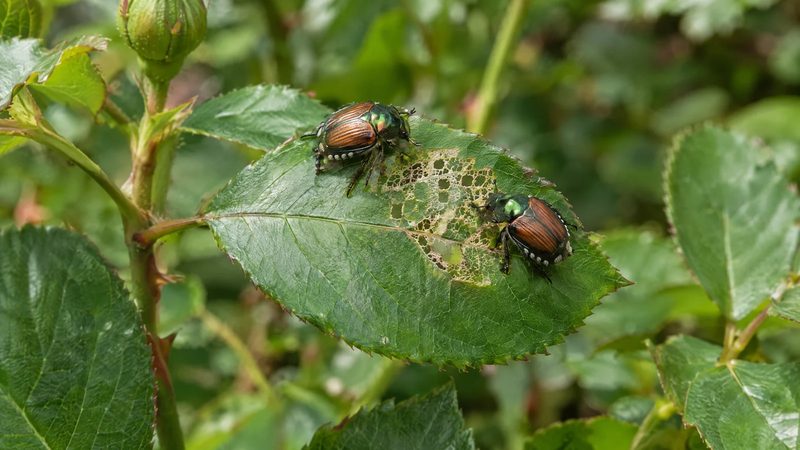
Japanese beetles (Popillia japonica) are scarab beetles native to Japan.6 Adults are about 3/8 to 1/2 inch long, oval and metallic green, with coppery-brown wing covers that do not quite cover the tip of the abdomen.2,4,5 The quickest field mark is the row of five white hair tufts along each side of the body.4,5
The larvae are white grubs: soft, C-shaped and creamy white with a light brown head, growing from about 1/16 inch at hatching to about 1 inch when mature.2,5 They look like the grubs of May or June beetles and masked chafers, and the reliable difference is a small V-shaped pattern of hairs (the raster) on the underside of the last abdominal segment, which needs a 10x hand lens to see.3,4,5
The beetle was first found in the United States in New Jersey in 1916 and has since spread to most states east of the Mississippi River and some beyond.7 It also occurs in the Azores, was first reported in mainland Europe in northern Italy in 2014, has since established in neighboring southern Switzerland, and is listed as a priority pest in the European Union.6
| Feature | Adult | Grub (larva) |
|---|---|---|
| Size | About 3/8 to 1/2 inch | 1/16 inch at hatch, about 1 inch mature |
| Color | Metallic green body, coppery-brown wing covers | Creamy white body, light brown head |
| Key mark | Five white hair tufts on each side | V-shaped hair pattern on the last segment |
| Where found | On leaves and flowers in full sun | In soil under turf, feeding on roots |
| Damage | Skeletonized leaves, eaten petals and fruit | Dead patches of lawn that lift like carpet |
In North America adults emerge in June, feed most heavily for 4 to 6 weeks from late June and can persist into September in northern states, while grubs feed in late summer and again in spring.1,3 The sources cited record the beetle in Japan, North America and parts of Europe rather than the Southern Hemisphere, where the equivalent summer window would fall from about December to February.6
What do Japanese beetles damage, and why do they love roses?
Adults feed on about 300 to more than 400 plant species, eating leaves, flowers and overripe or wounded fruit.1,2 On leaves they chew the tissue between the veins, leaving a lacelike skeleton, and badly hit trees can look scorched.1 They feed in groups, start at the top of a plant and work downward, and prefer plants in direct sun on warm days.1
Feeding draws more feeding: odors released from beetle-damaged leaves help pull other beetles onto the same plant, so the first beetles on a rose bush attract the next wave.1,5 Roses suffer twice, because beetles can consume whole petals as well as leaves, and rose flowers are listed as particularly susceptible.1,4 Grapes, lindens, Japanese and Norway maples, sassafras, flowering crabapples, birch and basil are other preferred hosts.1,3
Established trees and shrubs generally tolerate the damage with little effect on leaf-out the next season, but repeated severe defoliation can stress birch and linden enough to attract borers.3 Below ground, grubs chew grass roots, which leaves turf unable to take up enough water in hot, dry weather; dead patches can be rolled back like carpet.1,3
| Heavily attacked | Usually little feeding |
|---|---|
| Roses | Boxwood |
| Grapes | Holly |
| Linden (basswood) | Lilac |
| Japanese and Norway maple | Red and silver maple |
| Flowering crabapple and Prunus (cherry, plum, peach) | Magnolia |
| Birch | Flowering dogwood |
| Hollyhock and rose-of-Sharon | Arborvitae, junipers, pines and spruces |
When are Japanese beetles active?
Japanese beetles complete one generation a year.3,5 Adults begin emerging from the soil in June, and activity is most intense over a 4 to 6 week period beginning in late June; individual beetles live about 30 to 45 days.1 In Wisconsin, emergence starts in late June or early July at around 1,000 growing degree days, and some beetles are still around in September.3
After mating, females burrow 2 to 4 inches into moist soil, often under turf, and lay 40 to 60 eggs over their lives.1,3 Eggs hatch in about two weeks, and the grubs are almost full grown by late August.1,3 When soil cools they move deeper, usually 2 to 8 inches down and sometimes more, become inactive below about 50°F, and return to the root zone in spring to feed for 4 to 6 weeks before pupating.1,3
| Period | Stage | What to do |
|---|---|---|
| Mid-June to August | Adults feeding and laying eggs | Hand-pick, net prized plants, spray only if needed |
| July to mid-August | Eggs and newly hatched grubs | Avoid watering turf so eggs and young grubs dry out |
| Late summer to fall | Grubs feeding on roots | Sample turf; apply nematodes to active grubs |
| Winter | Grubs inactive deep in soil | No action |
| Spring | Grubs feed again for 4 to 6 weeks, then pupate | Sample turf before deciding to treat |
How do you get rid of Japanese beetles naturally?
Physical removal works for small plantings, especially when numbers are low.1 Shake beetles off plants into a container of water with a few drops of dish soap; the soap breaks the surface tension so they sink rather than escape.5 Beetles drop when disturbed, so a quick knock sends them into the container.4 Early morning, when beetles are sluggish, and early evening are both productive times.1,5 Removing beetles regularly also cuts the plant odors that attract more of them.1,4
Exclusion protects high-value plants. Cover roses, vegetables, herbs and small shrubs with cheesecloth or nylon insect screen with mesh of 1/4 inch or less from late June to early September, securing the edges to the ground.1,3 For the longer term, choose less-favored species when planting and remove wild hosts such as multiflora rose, wild grape, smartweed and poison ivy where practical.1
Homemade sprays have a poor record. University of Kentucky entomologists rate insecticidal soap, extracts of garlic, hot pepper or orange peel, and companion planting as generally ineffective against Japanese beetles.1 Lure traps are also a poor choice: they catch thousands of beetles but attract many more than they catch, so plants near the traps often suffer more damage than with no traps at all.1,2,4
Does neem oil work on Japanese beetles?
Neem works as a short-lived feeding deterrent rather than a kill. University of Kentucky guidance gives neem products about 3 to 4 days of feeding deterrence.1 Purdue describes azadirachtin neem products as effective repellents that can reduce defoliation when applied regularly, but no more than weekly, during beetle flight.2 West Virginia University notes that the neem and pyrethrin products allowed in organic production act only as repellents and give relatively short-term control.5
Plain neem oil fares worse than azadirachtin products. UW-Madison Extension rates horticultural oils such as neem oil as having very limited effectiveness against Japanese beetles.3 In vineyard trials in northern Italy, neem oil was largely ineffective as a repellent, while kaolin clay reduced the number of adults feeding on the vines.6
Other options with low impact on beneficial insects include Bacillus thuringiensis subsp. galleriae (Btg), a naturally occurring bacterium approved for organic production.3 Pyrethroid insecticides typically protect foliage for about two weeks but are broad-spectrum and can kill pollinators and predators.3 Whatever you use, spray in late evening after pollinators stop foraging, make sure the product is registered for the plant, and follow the product label, including any harvest interval on food crops.1,3
Do milky spore and beneficial nematodes control Japanese beetle grubs?
Grub control protects lawns, not roses. Adults fly in from miles away, so treating grubs in your lawn will not stop adult feeding on landscape plants.1,3 Purdue notes that lawns with 5 or fewer grubs per square foot rarely need treatment.2
Insect-parasitic nematodes are the strongest biological option. Heterorhabditis bacteriophora kills white grubs by carrying a bacterial pathogen into them.2 Apply it as a soil drench when grubs are present and active, preferably in cool, overcast conditions or early morning or evening, and water it in immediately; larger grubs are the best targets, and the live nematodes should be refrigerated and used promptly, following the product directions.2,4 In a large-plot field trial in Italy, a commercial H. bacteriophora product gave 46% larval mortality.6
Milky spore (Paenibacillus popilliae) is a bacterium that causes milky disease in Japanese beetle grubs, and commercial formulations are active only against Japanese beetle grubs.2,4 Commercial products have not proven very effective.2 Where it has long been established in the eastern United States, it infects a small share of grubs each year and reduces populations by less than 5%, and it does not give quick results.4
A cultural step helps too: not watering turf from July to mid-August, when beetles are most active, can discourage egg-laying and kill newly laid eggs and young grubs.3
| Method | Stage it targets | What the evidence says |
|---|---|---|
| Hand-picking into soapy water | Adults | Adequate for small plantings and low numbers |
| Lure traps | Adults | Not recommended; draw in more beetles than they catch |
| Neem and azadirachtin | Adults | Repellent for a few days; plain neem oil very limited |
| Heterorhabditis bacteriophora nematodes | Grubs | Good grub control when watered in on active grubs |
| Milky spore | Grubs | Slow; reduces populations by less than 5% where established |
| Withholding turf irrigation July to mid-August | Eggs and young grubs | Dry soil discourages egg-laying |
Key takeaways
- Japanese beetles (Popillia japonica) skeletonize leaves and eat flowers from June into August, and feeding beetles attract more beetles.
- Hand-picking into soapy water and fine netting protect roses and other favored plants in home gardens.
- Lure traps, homemade garlic or pepper sprays and insecticidal soap are not recommended or are generally ineffective.
- Neem gives only a few days of deterrence; follow the product label for any spray and apply after pollinators stop foraging.
- Heterorhabditis nematodes control grubs in lawns, milky spore acts slowly and weakly, and grub control does not stop adults flying in.