

Last updated:
Lawn grubs are the white, C-shaped larvae of scarab beetles such as the Japanese beetle (Popillia japonica) and masked chafers (Cyclocephala spp.) that feed on grass roots.1,3 To control them naturally, first confirm 5 to 10 or more grubs per square foot, then apply Heterorhabditis nematodes in late summer while grubs feed near the surface, and follow the product label.1,2
How do you identify lawn grubs?
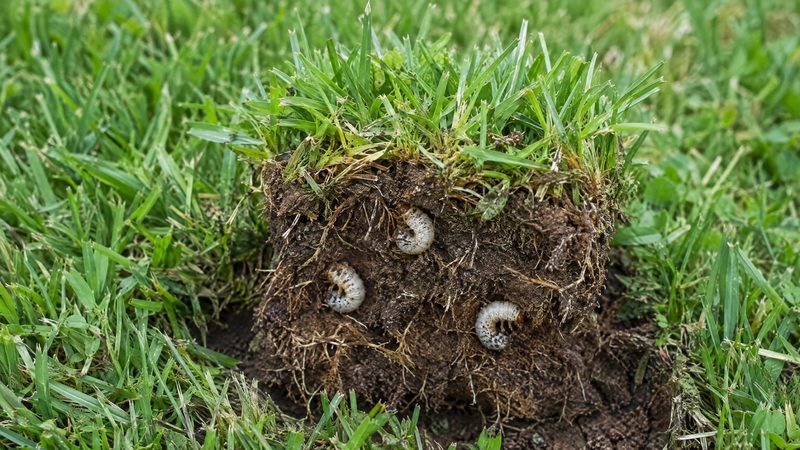
White grubs are the larvae of beetles in the scarab family (Scarabaeidae), and several species damage turfgrass, including the Japanese beetle (Popillia japonica), masked chafers (Cyclocephala spp.), European chafer, Asiatic garden beetle, oriental beetle, green June beetle and May/June beetles.1,3 Grubs are white and C-shaped, with a chestnut-colored head and three pairs of clearly visible legs, and older larvae range from 1/4 to 1 1/2 inches long.1 When you lift the turf they usually lie on their sides in a C shape.2
The species can be told apart by the raster, a pattern of short hairs and spines on the underside of the tip of the abdomen, which usually needs a hand lens.1 Japanese beetle grubs have a V-shaped raster, while northern masked chafer grubs have a random pattern.2 Identification matters because species differ in life cycle, damage threshold and response to biological controls.1,3
| Grub species | Origin | Life cycle | Notes |
|---|---|---|---|
| Japanese beetle (Popillia japonica) | Introduced | One year | V-shaped raster; adults also feed on ornamental plants |
| Masked chafers (Cyclocephala spp.) | Native | One year | Northern masked chafer has a random raster |
| European chafer (Rhizotrogus majalis) | Introduced | One year | Can damage turf at about 5 grubs per square foot |
| Oriental beetle and Asiatic garden beetle | Introduced | One year | Harder to control with nematodes |
| Green June beetle | Native | One year | Grubs leave small soil mounds at burrow entrances |
| May/June beetles (Phyllophaga spp.) | Several species | Two to three years | Larger grubs do most damage in their second season |
In North America, grub damage shows in April and May and again from late summer into fall, preventive treatments fit early to mid-July, and curative treatments fit August to mid-September while grubs feed near the surface1,2. In the Southern Hemisphere, seasons run about six months offset from these dates, so check local lawn grub species and timing with a regional extension service.
What are the signs of grubs in a lawn?
Grubs feed on roots, so the first signs are patches of wilting, discolored or stressed turf that does not respond to watering; wilting grass may take on a blue or purple cast before dying.1 Heavily damaged turf feels spongy and can be rolled back like a carpet, exposing the grubs beneath.2 Damage shows in spring (April and May) and in late summer and fall (September and October).2 Animals digging for grubs, such as skunks, raccoons and turkeys, often cause more visible damage than the grubs themselves and can be the first sign of an infestation.1
To confirm grubs, cut out one square foot of turf and soil two to four inches deep with a spade at several spots, check the soil, thatch and roots, then press the sod back and water it.2 Relatively high densities of 5 to 10 grubs per square foot are usually needed to cause significant damage, so a few scattered grubs are not cause for concern.1 Thresholds vary by species: European chafer can cause damage at about 5 grubs per square foot, while Japanese beetle and Asiatic garden beetle usually need 10 or more, and up to 20 per square foot may not cause visible damage in healthy turf.1
When are lawn grubs active, and when should you treat them?
Most lawn grubs complete one generation a year, while the common May or June beetle takes three years.2 Adults lay eggs in the soil in summer, the grubs feed on roots until cold weather drives them two to eight inches deeper to overwinter, and in spring they move back up to feed before pupating from May through early June.2 In the Midwest, eggs of annual species hatch by the end of July, large grubs are present by September, and damage can appear any time from August to November.1
Properly timing any grub treatment is critical.2 Curative treatments should go on in summer while grubs are small and feeding near the surface, which in Pennsylvania runs from August through mid-September, and the turf should be sampled first to confirm grubs are present.2 Spring treatments are usually less effective because the grubs are larger and harder to control, and they give no protection against eggs laid later that season.2 For preventive treatments, early to mid-July is almost always the best timing in the Midwest.1
| Period | What the grubs are doing | What to do |
|---|---|---|
| April to May | Moving up from deep soil to feed before pupating | Watch for damage; spring treatments are usually less effective |
| Mid-June to mid-July | Adults emerge and lay eggs in the soil | Preventive window; early to mid-July is usually best |
| Late July to August | Eggs hatch and small grubs feed in the root zone | Sample soil to decide whether treatment is needed |
| August to mid-September | Grubs grow and feed near the surface | Curative window for nematodes and other treatments |
| October to March | Large grubs move two to eight inches deeper to overwinter | Treatments lose effect once grubs stop feeding |
How do you get rid of grubs in a lawn naturally?
Healthy turf is the foundation: choosing grass species and cultivars suited to the site and mowing, fertilizing, irrigating and managing thatch properly lets a lawn tolerate grub feeding or recover quickly.1 Keeping a lawn dry during July and early August can make beetle eggs dry out and die, though the grass will also go brown until it is watered again.2
Insect-parasitic nematodes are available to curatively suppress various white grub species.2 Nematodes in the genus Heterorhabditis usually perform better against white grubs than Steinernema species, although field results have been inconsistent.2 Under favorable conditions, well-adapted strains of Heterorhabditis bacteriophora can control Japanese beetle grubs as well as standard insecticides, but oriental beetle, European chafer, Asiatic garden beetle and May/June beetle grubs are harder to control.3 Steinernema scarabaei, the one species that has given good control of those harder grubs, has not been mass-produced, which limits its commercial use.3
Nematodes are living organisms with a short shelf life: refrigerate them on arrival, check that they are moving before use, apply in the early morning or evening to limit sunlight, and water them in immediately so they wash off the grass into the soil.1,2 Larger grubs are the best targets, so nematodes fit curative treatments aimed at all but the smallest grubs rather than preventive ones.1 Two microbial products are also used: Bacillus thuringiensis galleriae, which works against both small and large grubs with efficacy that varies by grub species, and the fungus Metarhizium brunneum, which gives its most consistent results in fall against older grubs.1 In field trials on infested meadows in northern Italy, a registered Metarhizium brunneum strain persisted in the soil but did not reduce Japanese beetle larvae, and young third-stage larvae were not susceptible to spores applied to the surface.4 Follow the product label for any of these.1
| Option | Grubs it works on | Best timing | What the evidence says |
|---|---|---|---|
| Heterorhabditis bacteriophora nematodes | Best on Japanese beetle; weaker on several other species | Curative timing, watered in | Can match standard insecticides on Japanese beetle under favorable conditions |
| Bacillus thuringiensis galleriae | Small and large grubs | Early or late curative | Efficacy varies by grub species |
| Metarhizium brunneum fungus | Older grubs | Fall | Most consistent in fall; no reduction of Japanese beetle larvae in Italian field trials |
| Milky spore (Paenibacillus popilliae) | Japanese beetle grubs only | Repeated over several seasons | Not effective as a single stand-alone application |
| Healthy turf practices | All species | All season | Turf tolerates or recovers from moderate feeding |
Does milky spore work on lawn grubs?
Milky spore is the bacterium Paenibacillus popilliae, which causes milky disease in white grubs.1 Strains that infect other grub species exist, but commercially available milky spore products are active only against Japanese beetle grubs.1 It is of little or no value against other scarab species.2
Penn State Extension says it may take three to five years to establish in a lawn, it needs a Japanese beetle grub population to build up, and no insecticide should be applied before or after it.2 Purdue Extension notes that multiple applications over several seasons are usually recommended and that commercial products have not proven effective as a single, stand-alone application.1 Japanese beetle remains hard to manage: it is native to Japan, has invaded North America, the Azores and mainland Europe, and researchers describe no efficient, environmentally friendly control measure as yet available.4
How do you handle grubs in garden beds and in lawns used by pets?
White grubs also damage agricultural and horticultural crops, not only turf.1,3 In plantings, root feeding interferes with water and nutrient uptake, so the first symptoms resemble drought stress, with mild yellowing and wilting, and badly damaged plants can be pulled easily from the ground.6 Female May/June beetles prefer to lay eggs in weedy or mowed grassy areas.6 Dig and check the soil to confirm grubs, and identify the species, before choosing a treatment.1,2
Purdue Extension describes biological insecticides used properly as generally safer than chemical insecticides, though they cost more and give more variable results.1 Whatever product you choose, keep pets and their toys, bowls and bedding out of the area during application, and keep pets off treated areas until the product is completely dry.5 Granular lawn products may require keeping pets off the treated area for 24 hours or longer while the granules dissolve and the area dries, so check the label for specific instructions.5
Key takeaways
- Lawn grubs are the C-shaped larvae of scarab beetles, chiefly Japanese beetle and masked chafers, and the species decides which control works.
- Treat only after sampling confirms about 5 to 10 or more grubs per square foot.
- Late summer, while grubs are small and feeding near the surface, is the curative window; spring treatment is usually less effective.
- Heterorhabditis nematodes perform best on Japanese beetle grubs and must be watered in right away.
- Milky spore works only on Japanese beetle grubs and takes years to establish.
References
- Managing White Grubs in Turfgrass (E-271)
- White Grubs in Home Lawns
- New Strains of the Entomopathogenic Nematodes Steinernema scarabaei, S. glaseri, and S. cubanum for White Grub Management
- From lab to field: biological control of the Japanese beetle with entomopathogenic fungi
- Pesticide Use Around Pets
- White Grubs on Christmas Trees