


How do you disinfect for ringworm in animal facilities?
Last updated:
Ringworm (dermatophytosis, caused by Microsporum and Trichophyton fungi) is disinfected in three steps: remove hair and debris, wash with detergent until visibly clean and rinse, then apply a disinfectant proven against dermatophyte spores, such as diluted sodium hypochlorite, accelerated hydrogen peroxide or enilconazole1,2,3. Spores can stay viable for 12 to 20 months, so brushes, clippers and laundry need the same care as stalls1.
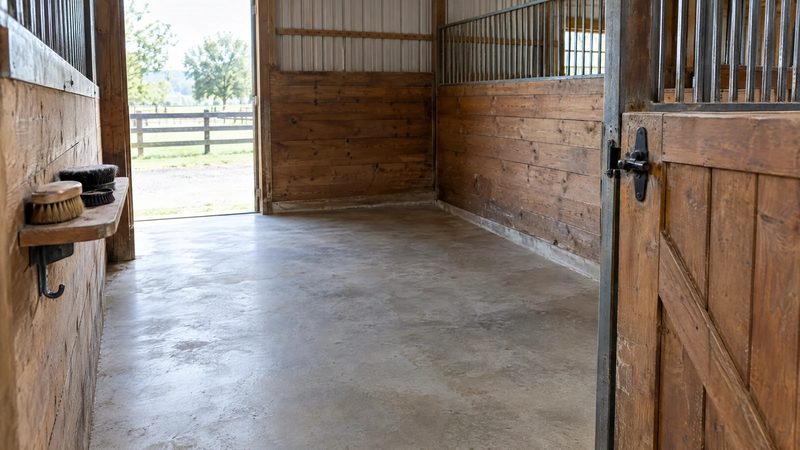
What causes ringworm in animal facilities, and how does it spread?
Ringworm is a contagious skin infection caused by keratin-digesting fungi, mainly in the genera Microsporum and Trichophyton1. Microsporum canis is the most common species in cats and dogs and is also found regularly in horses; Trichophyton verrucosum is the most important species in cattle; and Trichophyton equinum, adapted to horses, is an important cause of ringworm in that species1.
Infected animals shed infective arthrospores in hairs and skin scales, and fomites such as brushes and clippers are important in transmission1. Where livestock are in close contact, the fungi pass directly between animals and to farm workers, and shed spores contaminate the environment and can sustain herd infection for several years5. Show calves are frequently infected from spore-contaminated equipment that was not properly cleaned4.
Young animals, including puppies, kittens, calves and lambs, are more likely than adults to show signs1. Most or all of the animal-adapted species are thought to be transmissible to people1.
In North America, cattle ringworm builds while animals are housed indoors through late fall and winter and tends to resolve after spring turnout, which makes early fall, before housing, the natural time for a full barn cleandown1,4. In the Southern Hemisphere the housing season, and with it the ringworm season, falls in the May to September winter months.
How long do ringworm spores survive in a barn or kennel?
Dermatophyte spores may remain viable in suitable environments for up to 12 to 20 months1. Cattle ringworm spores stay alive for years in a dry environment, so halters, grooming equipment and even a whole barn can remain infective for years4. Arthroconidia, the infective spores formed when fungal threads break apart, may remain stable for up to 5 years6.
The fungus grows in keratin and, unlike other fungi, does not multiply in the environment3. Cleaning therefore has one job: removing infective hair and scale before it reaches another animal3. The most important part of disinfection is the hard clean, removing debris and washing with detergent until visibly clean, and in general, if a hard or soft surface can be washed, it can be decontaminated3.
What is the step-by-step ringworm disinfection protocol?
Decontaminating surfaces exposed to dermatophytes requires a hard clean, followed by a disinfectant that kills any spores the cleaning did not remove2. Follow the product label of the disinfectant you choose for dilution and contact time.
- Isolate infected animals until the infection has resolved, and check animals that were in contact with them for infections without obvious signs1.
- Remove hair, scale and debris mechanically; vacuuming is considered the best method in many cases, and dusting may also be appropriate1.
- Wash washable surfaces with detergent and water until visibly clean1,2.
- Rinse the detergent off, because many disinfectants are inactivated by detergents, and remove excess water so it does not dilute the disinfectant2,3.
- Apply a disinfectant whose label claims efficacy against Trichophyton mentagrophytes, and keep the surface wet for the full contact time; the kennel study used 10 minutes2,3.
- Do not rely on routine environmental cultures to judge success; they are useful only when infections are not resolving and contamination is suspected3.
Which disinfectants work against ringworm spores?
Dermatophyte spores are susceptible to benzalkonium chloride, dilute chlorine bleach, enilconazole, formaldehyde and some strong detergents, and are also reported to be susceptible to iodophors, glutaraldehyde and phenolic compounds1. Some of these agents may have limited efficacy in real-life environmental disinfection1.
A kennel disinfectant study challenged products with infective material from untreated animals, unfiltered so that hairs and scales remained, to mimic a surface that looks clean but still carries debris2. Products containing accelerated hydrogen peroxide are recommended as an alternative to household bleach3. Dermatophytes are also susceptible to high heat: moist heat of 121 degrees C (250 degrees F) for at least 20 minutes, or dry heat of 165 to 170 degrees C for 2 hours, is reported to be effective1.
| Disinfectant | Result against both fungi | Source |
|---|---|---|
| Sodium hypochlorite (household bleach), diluted | No growth at every dilution tested | 2 |
| Accelerated hydrogen peroxide | No growth | 2 |
| Enilconazole | No growth | 2 |
| Potassium peroxymonosulfate, 2% | No growth | 2 |
| Potassium peroxymonosulfate, 1% | Some growth; not considered good efficacy | 2 |
| Calcium hypochlorite (dry bleach dispensed through a hose) | No antifungal efficacy, over 300 colonies per plate | 2 |
How do you clean tack, brushes, clippers and laundry after ringworm?
Treat grooming kits, clippers, halters and tack as contaminated, because brushes and clippers are important in transmission and grooming equipment can stay infective for years1,4. For reusable metal instruments, steam sterilization is the most reliable method6.
Exposed soft materials such as blankets, rugs and saddle pads can be washed in hot or cold water, with bleach optional3. Do not overload the washer, use the longest wash cycle available because agitation removes spores, and wash twice if concern is high3. In a review of textile hygiene, a hot wash at 60 degrees C (140 degrees F) or above with a main cycle of at least 45 minutes proved effective against dermatophytes on contaminated fabrics, while a 10 minute wash at 30 degrees C did not inactivate dermatophyte spores6.
Why is ringworm so hard to clear from barns and stables?
Some environments, barns among them, may be difficult or impossible to decontaminate completely, and dermatophytes can be hard to eradicate from kennels, catteries and animal shelters1. Success depends on good environmental control together with treatment of animals that show signs and animals that carry the fungus without signs1. Vacuuming, considered the best removal method in many cases, is not feasible in a farm environment1,5.
Among livestock, ringworm is particularly common in cold climates where animals are stabled for long periods, and it usually becomes endemic in cattle herds, mostly in animals under a year old1. Lesions tend to develop while cattle are stabled indoors in winter and resolve when they are turned out in spring1. Reducing animal density and direct contact, more exposure to sunlight and keeping cattle on dry lots help limit spread between animals4.
Herd programs show what combined measures achieve: a Norwegian program of vaccination, disinfection of contaminated stables, isolation of infected animals and good hygiene cut cattle ringworm prevalence in one region from 70% to 0% over 8 years1.
Key takeaways
- Mechanical removal of hair and debris, then a detergent wash and rinse, does most of the work; the disinfectant kills what remains.
- Diluted sodium hypochlorite, accelerated hydrogen peroxide, enilconazole and 2% potassium peroxymonosulfate stopped all spore growth in a kennel study, while calcium hypochlorite dry bleach did not.
- Spores can survive 12 to 20 months and, on dry farm equipment, for years, so tack, brushes and clippers need the same treatment as stalls.
- Wash exposed textiles on a long cycle without overloading the machine, and use a hot wash where the fabric allows.
- Barns can be difficult to decontaminate completely, so environmental cleaning runs alongside treatment of every infected animal.
References
- Dermatophytosis (Ringworm, Tinea)
- Kennel Disinfectants for Microsporum canis and Trichophyton sp.
- Feline dermatophytosis: aspects pertinent to disease management in single and multiple cat situations
- Ringworm of Cattle (VY-56)
- A comparison of the existing recommendations for human and veterinary clinicians on the management and prevention of the zoonotic aspects of dermatophytosis: A scoping review
- Hygiene Practices Against Dermatophytic Fungi: A Review of Strategies to Combat Antifungal Resistance
Frequently asked questions
Does bleach kill ringworm spores?
Diluted sodium hypochlorite (household bleach) stopped all growth of Microsporum canis and Trichophyton spores within a 10 minute contact time once surfaces carried no gross debris2. Calcium hypochlorite, sold as dry bleach for hose-end dispensers, showed no antifungal efficacy in the same study2. Follow the product label for dilution and contact time.
Can people catch ringworm from animals in a barn or kennel?
Yes. Most or all animal-adapted dermatophytes are thought to be transmissible to people, and controlling ringworm in animals prevents some human cases1. Contact with infected animals should be limited, and gloves and protective clothing used when handling them1. A 2026 review of clinical recommendations found that only 2 of the 10 papers it examined advised personal protective equipment against zoonotic spread5.
Can ringworm spores spread through heating and ventilation ducts?
In a facility housing infected cats, contact plates placed over forced-air heating vents never grew the fungus, even though at times more than 20 cats were present3. The furnace filters were always culture positive, which showed that infected hairs and spores were drawn into the air system and trapped in the filter rather than blown through the building3.