

Does bleach work on dirty surfaces?
Last updated:
Poorly. On manure-covered floors or biofilm-lined drinkers, bleach spends most of its chlorine reacting with dirt rather than microorganisms, and organic matter physically shields the microbes underneath. Hypochlorite also weakens as pH rises. Dry clean, wash with detergent, rinse and let dry, then apply a labeled disinfectant at the correct concentration and contact time.
Bleach sprayed onto manure-covered floors or biofilm-lined drinkers spends most of its chlorine reacting with dirt, not microorganisms. Hypochlorite is rapidly consumed by organic load and weakens as pH rises. Clean first, then disinfect, and choose an oxidizer suited to the surface.
What happens chemically when bleach meets dirt?
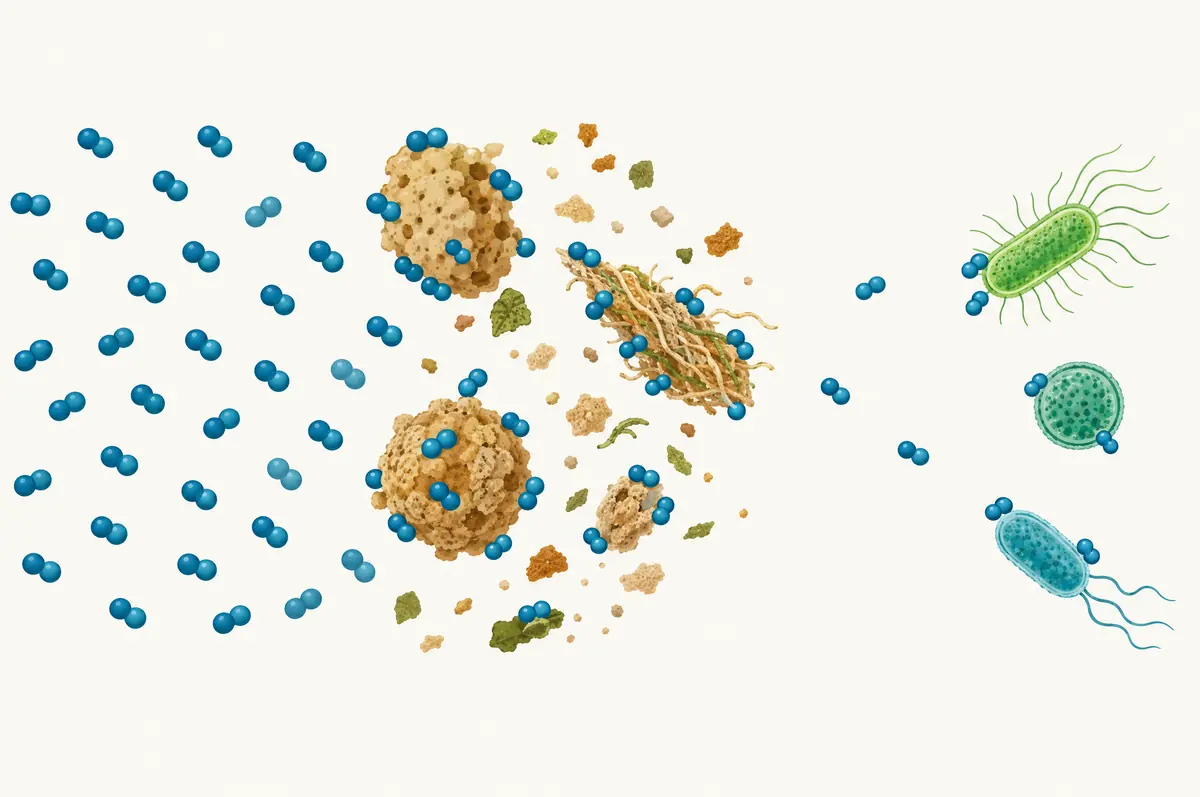
Household and farm bleach is sodium hypochlorite. In water it forms hypochlorous acid, the strong microbicidal form, in equilibrium with hypochlorite ion, which is far weaker. The balance depends on pH: near neutral much is HOCl, but above about pH 8 most is the weaker ion, and concentrated bleach is highly alkaline. Both forms react with proteins, fats and nitrogen compounds in manure and litter, forming chloramines and chlorinated organics and using up available chlorine.
Why does organic load matter so much?
Organic matter shields microorganisms physically and consumes disinfectant chemically. Oocysts, spores and bacteria inside biofilm or dried manure are not reached. Guidance for healthcare and veterinary settings is consistent: remove gross soil and wash with detergent before applying any disinfectant. Skipping cleaning is the single most common reason a terminal cleandown fails. Detergent washing lifts the organic film so that the disinfectant contacts the surface itself. Drying between washing and disinfection avoids diluting the applied solution.
What other problems does bleach have?
Bleach corrodes metal equipment and degrades with heat, light and time, so stored stock is often weaker than labeled. Mixing bleach with ammonia-containing cleaners or acids releases toxic chloramine or chlorine gas. In water lines, chlorine reacts with organic matter to form trihalomethanes and does little to established biofilm at drinking-water doses. Store bleach cool and dark, and date the container when opened. Never store it near acids or ammonia products, and replace stock that has sat through a hot season.
What works instead?
Dry clean, wash with detergent, rinse, let dry, then apply a labeled disinfectant at the correct concentration and contact time. For water lines and surfaces with residual organic load, chlorine dioxide is less affected by pH and does not chlorinate organics. See disinfectants compared for the full picture. Check contact time on the label and keep surfaces wet for that full period. Verify results with swabs or ATP testing where the stakes justify it, especially before restocking.
Key takeaways
- Organic matter inactivates chlorine-based disinfectants, so cleaning must come before disinfection.
- Chlorine's microbicidal activity comes largely from hypochlorous acid, whose share falls as pH rises.
- Skipping cleaning is the most common reason a terminal cleandown fails.
- Stored bleach degrades with heat, light and time, so stock is often weaker than labeled.
- Chlorine dioxide is less affected by pH and does not chlorinate organics.
Key facts
- Organic matter inactivates chlorine-based disinfectants, and cleaning must precede disinfection (Rutala and Weber 2008, CDC Guideline for Disinfection and Sterilization in Healthcare Facilities).
- The microbicidal activity of chlorine is attributed largely to undissociated hypochlorous acid, whose fraction falls as pH rises (Rutala and Weber 2008, CDC Guideline for Disinfection and Sterilization in Healthcare Facilities).
- Chlorine dioxide efficacy is less pH dependent than chlorine and it does not form trihalomethanes (US EPA 1999, Alternative Disinfectants and Oxidants Guidance Manual, EPA 815-R-99-014).
- Vetpure Disinfectant forms no THMs, HAAs or HANs on use (Vegalab product specification, Vetpure Disinfectant).
How our delivery technology applies
Bleach loses potency in storage and on dirty surfaces. Vetpure Disinfectant stores chlorine dioxide precursors in encapsulated powder, so the oxidant forms only on dissolution, at 98% purity or higher, and holds in solution for up to one month. That gives a known concentration at use, which matters after cleaning when the remaining organic film still demands oxidant.
Questions
Does organic matter inactivate bleach?
Yes. Hypochlorite reacts with proteins, fats and nitrogen compounds in manure and litter, forming chloramines and chlorinated organics and using up available chlorine. Organic matter also shields microorganisms physically, so oocysts, spores and bacteria inside biofilm or dried manure are not reached.
Why does pH matter for bleach?
In water, bleach forms hypochlorous acid, the strong microbicidal form, in balance with the far weaker hypochlorite ion. Above about pH 8 most of it is the weaker ion, and concentrated bleach is highly alkaline.
Is stored bleach still full strength?
Often not. Bleach degrades with heat, light and time, so stored stock is often weaker than labeled. Store it cool and dark, date the container when opened, and replace stock that has sat through a hot season.
Can bleach be mixed with other cleaners?
No. Mixing bleach with ammonia-containing cleaners or acids releases toxic chloramine or chlorine gas. Never store it near acids or ammonia products.
Integrators: request a Vetpure Disinfectant cleandown protocol for your houses.