

Vehicle and Equipment Disinfection
Last updated:
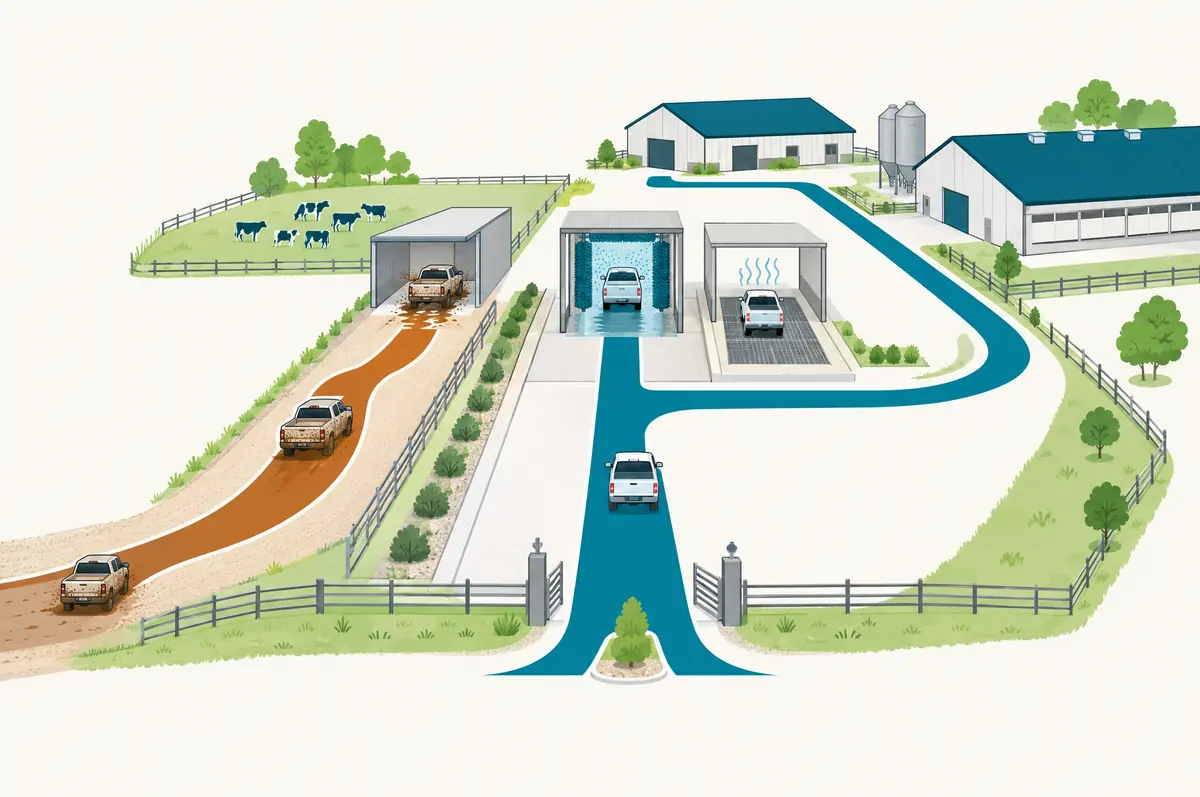
Livestock trucks, feed trucks and shared equipment are among the most important routes for moving viruses between farms. The protocol is the same as for buildings: remove organic matter, wash, disinfect for full contact time, then dry. Drying is the step most often skipped and one of the most effective.
Plan the traffic
Restrict vehicles to a controlled entrance and keep them outside the perimeter buffer where possible. Feed delivery, rendering and manure trucks should not cross into animal areas. Schedule visits from clean to dirty sites. Keep a log of every vehicle, driver and prior site. Shared equipment such as loading boards, sorting panels and pressure washers should either stay on one site or pass through the same cleaning routine as vehicles.
Clean, disinfect, dry
Remove bedding and manure, then pressure wash with a detergent, including wheel arches, undercarriage, mud flaps and cab floor mats. Rinse. Apply disinfectant at label dilution to all surfaces and keep wet for the label contact time. Let the vehicle dry fully before it returns to service. Heated drying, used in swine transport, adds a further margin for environmentally stable viruses. Cold weather slows disinfectants and can freeze solutions; use products labeled for low temperatures.
Cabs and small equipment
Drivers carry contamination on footwear into the cab. Provide disposable boot covers, a cab kit with a floor mat that can be removed and washed, and hand sanitizer. Small tools, buckets and needles for treatment should be site-specific. Items that cannot be washed, such as electronics, can be wiped with a labeled disinfectant or kept in sealed bags. Check wash bay drainage so runoff does not recontaminate cleaned vehicles or reach waterways. Audit the wash with swabs on wheel arches and floors at intervals.
Key facts
- Contaminated trailers were identified as an important route of PEDv spread between farms after its 2013 introduction (Lowe et al. 2014, Emerg Infect Dis 20:872).
- The Secure Pork Supply plan designates a perimeter buffer area and a line of separation that vehicles and people must respect (Secure Pork Supply Plan, Iowa State University CFSPH).
- Disinfection must be preceded by cleaning, and surfaces should be allowed to dry after treatment (WOAH Terrestrial Code, ch. 4.14).
- Disinfectant efficacy declines at low temperatures, which matters for winter vehicle washes (USDA APHIS, FAD PReP/NAHEMS Guidelines: Cleaning and Disinfection, 2014).
How our delivery technology applies
Truck washes need a disinfectant that holds concentration in a tank over a shift and is not quenched by residual manure. Vetpure Disinfectant delivers chlorine dioxide from a stabilized nano-encapsulated powder at at least 98% purity on dissolution, with the working solution stable for up to one month, so wash bays can run one prepared batch at a verified strength without generator equipment.
Transport and truck wash operators: request product samples for a wash bay trial.