

How does Bacillus subtilis protect plants?
Last updated:
Bacillus subtilis is a Gram-positive, spore-forming soil bacterium. It protects plants through several mechanisms at once: antimicrobial lipopeptides such as iturins and fengycins that disrupt fungal membranes, rapid root colonization that takes space and exudates from pathogens, and induced systemic resistance that primes the plant's own defenses. It is preventive, so it must colonize before or as disease pressure arrives.
What is bacillus subtilis?
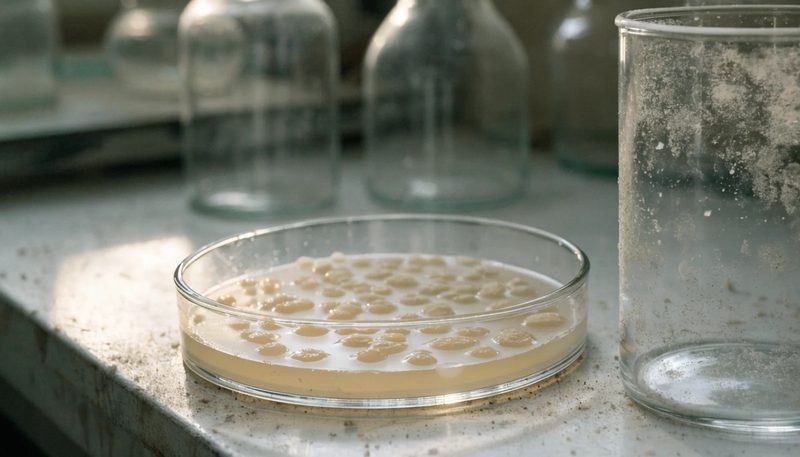
Bacillus subtilis is a Gram-positive, spore-forming soil bacterium - one of the best-characterized organisms in biology and a workhorse of industrial fermentation. Its spore-forming ability is what makes it commercially practical: spores survive formulation, storage and application in a way that vegetative cells do not.
How does bacillus subtilis work?
Antibiosis: it produces a range of antimicrobial lipopeptides, including surfactins, iturins and fengycins, which disrupt fungal membranes. Iturins and fengycins in particular have direct antifungal activity.
Competition: it colonizes root surfaces rapidly, occupying space and consuming root exudates that pathogens would otherwise use.
Induced systemic resistance: colonization primes the plant's own defense pathways, so the plant responds faster to subsequent attack. This is a genuinely different mode from direct antagonism and part of why effects can appear at sites the bacterium has not colonized.
Plant growth promotion: phosphate solubilization and production of plant hormones, contributing to root development independently of disease suppression.
Having several mechanisms operating together is the main argument for durability against resistance, and a real point of difference from single-site synthetic fungicides.
What does bacillus subtilis not do?
It is preventive and establishment-dependent, not curative - it needs to colonize before or as pressure arrives, and applying it to an established epidemic will disappoint. Colonization depends on soil biology, moisture, temperature and organic matter, so performance varies more by site than a chemical would. It is not a fungicide substitute under high disease pressure. And it competes with the existing soil microbial community, which in a biologically active soil may already occupy the niche.
Is bacillus subtilis safe?
Very low risk. Non-pathogenic to humans, animals and plants, no residue concerns, and widely accepted in organic programs. Inhalation of concentrated spore powder should be avoided during handling, as with any microbial product.
Where does bacillus subtilis appear in the range?
Bacillus subtilis is one of eleven strains in Charge BioBoost, alongside three other Bacillus species, five mycorrhizal species and two Trichoderma species, in a humic, fulvic, amino-acid and kelp base.
Key takeaways
- Spores survive formulation, storage and application, which makes Bacillus subtilis commercially practical.
- Iturins and fengycins have direct antifungal activity.
- Induced systemic resistance explains effects at sites the bacterium has not colonized.
- Several mechanisms acting together are the main argument for durability against resistance.
- It is not curative and not a fungicide substitute under high disease pressure.
References
- Bacillus lipopeptides: versatile weapons for plant disease biocontrol
- Surfactin and fengycin lipopeptides of Bacillus subtilis as elicitors of induced systemic resistance in plants
- Biocontrol of Bacillus subtilis against infection of Arabidopsis roots by Pseudomonas syringae is facilitated by biofilm formation and surfactin production
Frequently asked questions
Is Bacillus subtilis harmful to people or animals?
It is very low risk: non-pathogenic to humans, animals and plants, with no residue concerns, and widely accepted in organic programs. As with any microbial product, avoid inhaling concentrated spore powder during handling.
Can Bacillus subtilis cure an existing plant disease?
No. It is preventive and establishment-dependent, so it needs to colonize before or as pressure arrives. Applying it to an established epidemic will disappoint.
Why do results with Bacillus subtilis vary between sites?
Colonization depends on soil biology, moisture, temperature and organic matter, so performance varies more by site than a chemical would. It also competes with the existing soil microbial community, which in a biologically active soil may already occupy the niche.
Does Bacillus subtilis promote plant growth?
Yes, through phosphate solubilization and production of plant hormones. These contribute to root development independently of disease suppression.
Related reading
Products
No direct product mapping. Nothing in the Vegalab range declares bacillus subtilis in its composition, so this page has no product link - the absence is deliberate, not an omission.